
Araghchi says Iran will fight 'as long as it takes'
Clip: 3/9/2026 | 12m 14sVideo has Closed Captions
Iran’s Araghchi calls U.S. strikes a ‘failure’ and vows to fight 'as long as it takes'
For perspective from the Iranian government on the conflict with the U.S. and Israel, Amna Nawaz spoke with Foreign Minister Abbas Araghchi from Tehran.
Problems playing video? | Closed Captioning Feedback
Problems playing video? | Closed Captioning Feedback
Major corporate funding for the PBS News Hour is provided by BDO, BNSF, Consumer Cellular, American Cruise Lines, and Raymond James. Funding for the PBS NewsHour Weekend is provided by...
Araghchi says Iran will fight 'as long as it takes'
Clip: 3/9/2026 | 12m 14sVideo has Closed Captions
For perspective from the Iranian government on the conflict with the U.S. and Israel, Amna Nawaz spoke with Foreign Minister Abbas Araghchi from Tehran.
Problems playing video? | Closed Captioning Feedback
How to Watch PBS News Hour
PBS News Hour is available to stream on pbs.org and the free PBS App, available on iPhone, Apple TV, Android TV, Android smartphones, Amazon Fire TV, Amazon Fire Tablet, Roku, Samsung Smart TV, and Vizio.
Providing Support for PBS.org
Learn Moreabout PBS online sponsorshipAMNA NAWAZ: Now to the view from the Iranian government.
Earlier today, I spoke with Iran's Foreign Minister Abbas Araghchi, who joined us from Tehran.
Mr.
Minister, welcome to the "News Hour."
Thank you for joining us.
ABBAS ARAGHCHI, Iranian Foreign Minister: Thank you for having me, Amna.
Thank you indeed.
AMNA NAWAZ: So I'd like to ask you first about the news, the selection of Mojtaba Khamenei, the son of the late ayatollah, who's been named the new selected supreme leader of Iran.
Some say his selection is a message of continuity of his father's leadership, of continued defiance to the U.S.
and Israel.
Do you agree with that?
Is that the message Iran would like to send?
ABBAS ARAGHCHI: Well, I think that is the correct evaluation.
It shows that -- the continuity and some sort of stability at the same time.
AMNA NAWAZ: And since his selection, has he or anyone in your leadership had any contact with U.S.
officials?
Is that something that he is open to, to talk about negotiations or a cease-fire?
ABBAS ARAGHCHI: Well, first of all, it's too soon for him to make any comment.
We are all waiting for his speeches and comments, which will come later on.
But I don't think the question of talking with Americans or negotiation with Americans once again would be on the table, because we have a very bitter experience of talking with Americans.
We negotiated with them last year, in last June, and they attacked us in the middle of negotiations.
And again this year, they tried to convince us that this time is different.
They promised us that they don't have any intention to attack us, so -- and they wanted to resolve Iran's nuclear question peacefully and to find a negotiated solution.
And we finally accepted.
But, again, after three rounds of negotiation, and after the American team in the negotiation said itself that we made a big progress, still they decided to attack us.
So I don't think talking with Americans anymore would be on our agenda anymore.
AMNA NAWAZ: Mr.
Minister, this war has now entered its 10th day.
I know you have said that, unless there's a permanent end to the war, not a cease-fire, in other words, that Iran will continue to defend itself, continue to fight.
Can I ask you, what do you believe that the U.S.
and Israel are trying to achieve or trying to change with this war?
ABBAS ARAGHCHI: Well, actually, they tried to achieve some targets, some of their goals, but they failed.
They thought that, in a matter of two or three days, they can go for a regime change, they can go for a rapid, clean victory, but they failed.
So I believe that the option plan A was a failure, and now they are trying other plans, but all of them have failed as well.
And I don't think they have any realistic endgame in their mind, because we are seeing some sort of a chaos thing.
Their sayings and their actions, they have just started to attack us blindly.
They are attacking -- today, they attacked residential areas.
They attacked hospitals.
They attacked schools.
And they entered into attacking our infrastructure, which is a very dangerous move.
And, as a result, you can see that the -- the oil prices everywhere in the world.
So I don't see any reasonable goal that they are following.
They failed to achieve their goals at the beginning, and now, after 10 days, I think they are aimless.
AMNA NAWAZ: I do want to ask more about the oil prices.
As you mentioned, there have been widespread disruptions in the delivery of oil in the Persian Gulf.
We're seeing prices here in the U.S.
start to rise as well.
Do you believe that you can pressure the U.S.
and Israel to stop their attacks by slowing or stopping oil production as well?
ABBAS ARAGHCHI: Well, this is not our fault.
This is not our plan.
The oil production, the transportation of oil has been slowed down or stopped not because of us, because of the attacks and aggression made by Israelis and Americans against us.
So they have made the whole region insecure.
And this is why the tankers, the ships are scared to pass through the Strait of Hormuz.
We have not closed that strait.
We have not -- we are not preventing them to navigate in that strait.
But this is the result of the aggression by Israelis and Americans, which has made the whole region insecure, unstable.
And the consequences are huge for not only us, but for the whole region, and now for the international community.
AMNA NAWAZ: Iran has, though, hit multiple oil facilities in other nations and some of the region's top-producing nations, in fact, Saudi Arabia and Iraq and Kuwait.
And we heard from your top military spokesman today, who said: "If you can tolerate oil at more than $200 per barrel, continue this game."
So is limiting oil supply part of your strategy here?
ABBAS ARAGHCHI: Well, actually, this is a war imposed on us.
And what we are doing is only defending ourselves.
We are facing an act of aggression, which is absolutely illegal.
And what we are doing is the act of self-defense, which is legal and legitimate.
Well, we have already warned everybody in the region that, if the U.S.
attack us, since we cannot reach the American soil, we have to attack their bases in the region, their facilities, their installations, their assets.
And as a result, the war would be spread into the whole region.
So this is the consequences, the consequence of the U.S.
aggression against us.
We are not responsible for that.
AMNA NAWAZ: I do want to ask you about another recent strike that killed more than 170 people in Minab in Southern Iran.
It was at a girls school.
We have heard from President Trump, who said this weekend he denied any U.S.
involvement.
On Saturday, he actually said: "Based on what I have seen, that was done by Iran."
You have said that strike would not go unanswered.
What did you mean by that?
ABBAS ARAGHCHI: Well, this is ridiculous.
I think all U.S.
medias and different sources from American intelligence and American media, everybody have admitted that this is done by an American missile.
There are footages of that.
The footages are analyzed by neutral sources.
And it is now a consensus that the attack is made by the United States, and they are in charge of the killing of 168 schoolgirls who were absolutely innocent.
They had sat in their classrooms, and they -- all of a sudden they were killed by American military.
AMNA NAWAZ: And we've heard from the secretary of defense an investigation is ongoing.
But in saying that that strike will not go unanswered, I should note that Iranian strikes in other nations have already killed civilians.
Are you saying now that civilians are fair targets in other nations?
ABBAS ARAGHCHI: No, no, no, not at all.
Civilians are not target.
Maybe there has been some collateral damages, which is quite natural in any war, but we have not targeted -- contrary to Americans, who deliberately targeted our schools and hospitals and our infrastructure, even freshwater desalinations, we have never targeted any civilian location, any civilian purpose, any civilian place.
There might be some collateral damages, as I said, but we -- this is not our plan to do that.
AMNA NAWAZ: Your strikes in some of your neighboring nations, though, have hit a hotel.
They've hit oil facilities as well.
We've heard from Saudi Arabia's foreign minister, who is condemning those attacks and warning that it retains its full right to take all necessary measures to safeguard its security.
Are you worried about the regional impact of your strikes in the neighboring nations, that you will damage Iranian relations in the long run?
ABBAS ARAGHCHI: Well, if they have all rights to take all necessary measures to protect their facilities, I think we are even -- we have more rights to take all necessary measures to defend ourselves, to protect our people.
And this is exactly what we are doing.
No, we -- this is not our war.
This is not our choice.
This war is imposed on us.
We are under aggression.
And we are defending ourselves.
They cannot accuse us for things which happened on the other side.
They should accuse those who started this war.
And I think they should be held responsible for any damage inside Iran and in the region, because everything has -- started by the United States and Israel.
AMNA NAWAZ: U.S.
officials have noted that they're targeting your nuclear programs, your ballistic missile and drone programs, your naval assets.
There are some who've pointed out they're also targeting headquarters and facilities of your internal security forces, some of those forces who have been used to suppress public dissent in the past.
And some analysts say the U.S.
may be laying the groundwork for some kind of public uprising.
Do you believe that's the case?
And if protesters take to the streets, will they be allowed to protest?
ABBAS ARAGHCHI: Well, where are those protesters?
We have now millions of people in the streets right now in support of the Islamic Republic, in support of the new supreme leader, in support of the military armed forces.
Now, where are those protesters?
People are - - the big majority of people are now angry about this aggression.
They are supporting our armed forces.
They are in the streets with the Iranian flags everywhere.
So where are those accusations come from?
Yes, they have attacked many of our facilities.
They have attacked our nuclear facilities, but they couldn't destroy our nuclear program because it is technology advanced and developed by ourselves.
They have also attacked our missile facilities, but they have not been able to stop firing missiles against themselves.
So the firings continues.
And we are prepared.
We are well prepared to continue attacking them with our missiles as long as needed and as long as it takes.
AMNA NAWAZ: That is the foreign minister of Iran, Abbas Araghchi, joining us today.
Mr.
Foreign Minister, thank you for your time.
ABBAS ARAGHCHI: Thank you, indeed.
Thank you for having me.
AMNA NAWAZ: And a note.
We did invite White House officials for an interview on the "News Hour."
They declined.
Our invitation still stands.
Hany Farid joins Amna Nawaz on 'Settle In'
Video has Closed Captions
On 'Settle In,' Hany Farid and Amna Nawaz discuss spotting manipulated images (4m 29s)

Iran war will end 'soon' but targets remain, Trump says
Video has Closed Captions
Iran war will end 'soon' but 'important targets' remain if needed, Trump says (3m 1s)
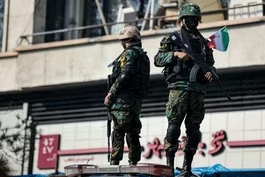
Khamenei’s son named supreme leader in Iran
Video has Closed Captions
As Iran war deepens, Khamenei’s son named new supreme leader (4m 52s)

News Wrap: 2 charged with bringing explosives to NYC protest
Video has Closed Captions
News Wrap: 2 charged with bringing explosives to New York protest (6m 25s)

Oil expert warns of 'nightmare scenario’ war could spark
Video has Closed Captions
Oil expert warns of ‘nightmare scenario’ Iran war could spark (6m 23s)
Tamara Keith and Amy Walter on Trump's midterm message
Video has Closed Captions
Tamara Keith and Amy Walter on Trump's midterm message (7m 5s)
Providing Support for PBS.org
Learn Moreabout PBS online sponsorship
- News and Public Affairs

FRONTLINE is investigative journalism that questions, explains and changes our world.

- News and Public Affairs

Amanpour and Company features conversations with leaders and decision makers.












Support for PBS provided by:
Major corporate funding for the PBS News Hour is provided by BDO, BNSF, Consumer Cellular, American Cruise Lines, and Raymond James. Funding for the PBS NewsHour Weekend is provided by...