Here and Now
Maria Lazar on the 2026 Wisconsin Supreme Court Race
Clip: Season 2400 Episode 2430 | 9m 8sVideo has Closed Captions
Maria Lazar on her perspectives on the law and the politics of judicial elections.
Wisconsin Court of Appeals District II Judge Maria Lazar, a conservative running for an open Wisconsin Supreme Court seat, discusses her perspectives on law and the politics of judicial elections.
Problems playing video? | Closed Captioning Feedback
Problems playing video? | Closed Captioning Feedback
Here and Now is a local public television program presented by PBS Wisconsin
Here and Now
Maria Lazar on the 2026 Wisconsin Supreme Court Race
Clip: Season 2400 Episode 2430 | 9m 8sVideo has Closed Captions
Wisconsin Court of Appeals District II Judge Maria Lazar, a conservative running for an open Wisconsin Supreme Court seat, discusses her perspectives on law and the politics of judicial elections.
Problems playing video? | Closed Captioning Feedback
How to Watch Here and Now
Here and Now is available to stream on pbs.org and the free PBS App, available on iPhone, Apple TV, Android TV, Android smartphones, Amazon Fire TV, Amazon Fire Tablet, Roku, Samsung Smart TV, and Vizio.
Providing Support for PBS.org
Learn Moreabout PBS online sponsorshipGwen Moore, we leave it there.
Thanks very much.
>> Thank you.
>> We'll hear from a Republican congressional member on these matters next week on this program.
In the race for a seat on the Wisconsin Supreme Court.
We are two months away from Election Day.
The seat is currently held by Conservative Justice Rebecca Bradley, but she decided not to run again.
Liberals currently hold a 4 to 3 majority, so the winner of this race will not change the balance of the court.
The conservative candidate is appellate Court judge Maria Lazar, and the Liberal candidate is appellate Court Judge Chris Taylor.
Here and now, senior political reporter Zac Schultz sat down with each of the candidates tonight.
We hear from Maria Lazar.
>> Well, Judge Lazar, thanks for coming in today.
>> Thank you for having me.
>> So let's start with your judicial philosophy.
How would you describe it and how does it guide you from the bench?
>> I describe my philosophy as originalism with a slice of textualism, which means for those who are not law nerds like me, which means that I look at the documents and the laws as they're written, and I interpret them from that point of view.
And if you have to go a little bit outside, I do, but I don't go all the way outside to intent of legislators and things like that.
>> So obviously this race is now an open seat because Justice Bradley decided not to run again.
What was what was your first thoughts when she announced she was not going to do that?
>> Well, it was it was a surprise.
My thoughts were that I looked at the last election, and I thought that it was so politicized for the people in the state of Wisconsin that I thought they actually could use a judge or a justice like me, who's someone who is calm, judicial, has the experience and will not legislate from the bench.
>> Has she given you any guidance?
Have you reached out to her about what it's like to run for Supreme Court?
of the past justices.
I've talked to anyone who will talk to me, and actually more people talk to me than you would think.
to be needed to win this race?
>> I'm not positive on that.
I know it will not be anywhere close to last year.
>> So in what way?
How is this different from, I guess, the last two races when control of the court was up for grabs?
>> Well, that's one thing.
I think what I meant by not being anywhere close, I think the numbers were bigger because it would have changed the composition of the court.
This time we're talking about a position that is going to be most likely in the minority, but someone who will stand up to be a strong voice for the common sense people of my home state.
fundraising totals came out, and you raised about 200,000, your opponent close to 2 million.
Some people raised their eyebrows at that.
But you got into this race after her and you're trying to, I guess, fight your way into kind of an oxygen starved environment when it comes to fundraising.
So what's it been like for you?
>> Well, that's true.
So I started on October 1st.
So I think the numbers actually are relatively good for starting that late.
Also since January, which was the cutoff date January 1st, we've had a big groundswell of support from people who've recognized and actually heard about this race and realize there is no primary, and they've looked at it and they've said, this is a race and a candidate they're interested in supporting.
>> So when you look at the last two elections, has that impacted morale for the number of people paying attention to this race, or perhaps for for people getting behind your your campaign and seeing, well, the last two conservative candidates lost in rather large fashion.
>> I don't I don't know if it's impacted morale.
What I will say is this, I think that the state of Running and for what reason?
And when I look at this race.
The reason I am running is because I want to be someone on that court who represents the law for the state of Wisconsin.
I want to be someone who is their voice, bringing diversity of thought and and judicial backgrounds and experience to that court.
I don't look at those past races as anything indicative of what's going to happen.
In fact, I'm kind of hoping that there's going to be a line in the sand drawn now where we can look forward and say, who's the better judicial candidate, who has more experience?
And I think in this race, it's pretty clear that that's my candidacy.
>> When when you compare the records of the two candidates here, you're both circuit court judges.
You've both now in the appellate court.
So how do you explain to the public that the difference in your background.
>> Well, numbers, numbers are the reason.
So I spent 20 years in private practice.
I spent five years at the Department of Justice representing the state of Wisconsin.
But I spent seven years in the circuit court in every branch criminal, civil, juvenile, mental commitments.
My opponent spent two years in criminal.
I've spent four years in the Court of Appeals, published many written opinions.
My opponent has spent two.
I think when you add up the numbers, it's pretty clear who has the judicial and legal experience.
>> Obviously, there's a pretty high profile race for governor also kicking off right now when we talk about that oxygen starvation of people paying attention, how do you cut through to let people know, hey, this race is really important?
>> Well, you're right.
So my race is April, April 7th and all the other races are in November.
I think since I've been on the Circuit court and the Court of Appeals, I have continually gone to my 12 counties and anywhere else, including Milwaukee, to talk to people, to talk to high school kids, college kids about the courts, about why it's so important.
And I do that all the time.
So I think this is just a continuation of telling people why this race is so important.
It's in April because it's nonpartisan and it's in April because that's how Wisconsin legislature has determined it to be.
>> We've seen in the past couple of races, candidates talk more about their own personal values versus issues.
And that's that's a change compared to races in prior decades.
How are you talking about your values versus issues, and what does that mean to the public when they're hear maybe more, more clues to what you actually feel or how you might rule, even though that's obviously not what you're supposed to be talking about.
things that are really important.
So how I might rule is never an issue.
And no judge, no justice, no candidate should ever say that.
But we've looked at the rules and we've looked at the ethical rules, and we've determined that it's possible to tell the state of Wisconsin more information about where I stand, what I stand up for, and what issues I believe are important and how I view the law, how I interpret the law, what my philosophies are.
So on my website, you can go there.
Judge Maria Lazar com, you can go there.
And it has my positions on important issues that are set there, written in Black and white so people can see it, can see what I stand for.
I don't say how I will rule on a case, but I say what I believe is important.
>> Is that frustrating when you when you speak to people that are potentially voters who they want to hear more, they want to hear you talk like a politician because they they think of these races more political as opposed to an independent judicial race.
>> They do.
And in some, some respects, I'll go places where there will be politicians speaking.
And it's always that interesting dichotomy between the calm demeanor of a judge versus the politician who's yelling at the room and screaming at everybody.
But I think that's what people want.
They want their judges not to be someone who's yelling with their hair on fire in the room.
They want someone they think they would like to have adjudicate their cases.
So when I go and talk to people, I explain to them that I can't tell them how I'll rule on case A versus B, but I do tell them, here's how I rule, here's how I respect people in my court, here's what I think of victims rights, those sort of things.
I think that gets across to people.
They recognize that there are certain limits and that we're bound by those limits, or we should be.
precedent, you've mentioned a couple of times that if you win, you would be in the minority.
But that's not a forever thing.
As we've seen, the court can change what is the standard when it comes to overruling precedent.
Well.
>> So people have to understand that its precedent means that you don't.
Just because the court changes composition, you don't necessarily go back and then revisit things you've just done.
Precedent is that you respect, you give stereo decisis.
Its a credit, and it's a benefit to cases that have been done.
And you give them time to maybe air to be to be looked at.
When courts have overturned precedent, the US Supreme Court in general, it's something that's maybe 20, 30 years down the road.
It's not something that they just do willy nilly as as Scalia would say, it's something that you have to have seen that it doesn't work.
You can't just say, I'm now the member of the majority.
So everything that was done, I get to undo.
That's not how courts work.
We need to restore the respect and integrity in those courts and have them move forward and not always be looking back to things that they want to change.
>> And finally, will you seek Donald Trump's endorsement?
We saw Brad Schimel go out and ask for that towards the end of his campaign.
endorsements of anyone who's out of the state of Wisconsin.
If someone looks at my campaign and they agree with my vision, my idea that we need to restore justice and integrity to the Wisconsin State Supreme Court, I would welcome the discussion.
But I'm not

Gwen Moore on ICE and Funding Levels for Homeland Security
Video has Closed Captions
Clip: S2400 Ep2430 | 9m 31s | Gwen Moore on debate in Congress over funding the Department of Homeland Security. (9m 31s)
Here & Now opening for February 6, 2026
Video has Closed Captions
Clip: S2400 Ep2430 | 59s | The introduction to the February 6, 2026 episode of Here & Now. (59s)
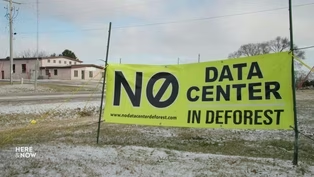
The Local Battles Over Data Center Developments in Wisconsin
Video has Closed Captions
Clip: S2400 Ep2430 | 6m 27s | Debates grow over energy-intensive data centers that are a backbone for tech business. (6m 27s)
Providing Support for PBS.org
Learn Moreabout PBS online sponsorship
- News and Public Affairs

Top journalists deliver compelling original analysis of the hour's headlines.

- News and Public Affairs

FRONTLINE is investigative journalism that questions, explains and changes our world.












Support for PBS provided by:
Here and Now is a local public television program presented by PBS Wisconsin