
February 11, 2026 - PBS News Hour full episode
2/11/2026 | 57m 46sVideo has Closed Captions
February 11, 2026 - PBS News Hour full episode
Wednesday on the News Hour, a sudden closure of El Paso's airspace leads to confusion and security concerns. A delayed report shows stronger-than-expected hiring last month, but newly revised numbers inject more uncertainty into the jobs market. Plus, Judy Woodruff explores Boston's patriotic past and its struggles to live up to its founding principles.
Problems playing video? | Closed Captioning Feedback
Problems playing video? | Closed Captioning Feedback
Major corporate funding for the PBS News Hour is provided by BDO, BNSF, Consumer Cellular, American Cruise Lines, and Raymond James. Funding for the PBS NewsHour Weekend is provided by...
Support provided by:

February 11, 2026 - PBS News Hour full episode
2/11/2026 | 57m 46sVideo has Closed Captions
Wednesday on the News Hour, a sudden closure of El Paso's airspace leads to confusion and security concerns. A delayed report shows stronger-than-expected hiring last month, but newly revised numbers inject more uncertainty into the jobs market. Plus, Judy Woodruff explores Boston's patriotic past and its struggles to live up to its founding principles.
Problems playing video? | Closed Captioning Feedback
How to Watch PBS News Hour
PBS News Hour is available to stream on pbs.org and the free PBS App, available on iPhone, Apple TV, Android TV, Android smartphones, Amazon Fire TV, Amazon Fire Tablet, Roku, Samsung Smart TV, and Vizio.
Providing Support for PBS.org
Learn Moreabout PBS online sponsorshipGEOFF BENNETT: Good evening.
I'm Geoff Bennett.
AMNA NAWAZ: And I'm Amna Nawaz.
On the "News Hour" tonight: A sudden closure of El Paso's airspace leads to confusion and security concerns.
GEOFF BENNETT: A delayed jobs report shows stronger-than-expected hiring last month, but newly revised numbers inject more uncertainty into the jobs market.
AMNA NAWAZ: And Judy Woodruff explores Boston's patriotic past and its struggles to live up to its founding principles.
NATHANIEL PHILBRICK, Author, "Bunker Hill: A City, a Siege, a Revolution": You know, you see factors from the past, from the really distant past, hundreds and hundreds of years before, that were never settled.
(BREAK) GEOFF BENNETT: Welcome to the "News Hour."
The commercial airspace over El Paso, Texas was temporarily shut down early this morning.
The FAA,citing unspecified security concerns, initially said all flights would be halted for 10 days.
AMNA NAWAZ: But just a short time later, the FAA reversed course and reopened the airspace, saying only that the closure was done out of an abundance of caution.
The explanations offered by the Trump administration have led to many questions and tough criticism about how it was handled.
William Brangham has more on this chaotic, confusing turn of events.
WILLIAM BRANGHAM: That's right, Amna.
After the FAA announced the reopening, an official with the Trump administration blamed the issue on Mexican drug cartels, alleging they'd sent drones near the airport that had to be dealt with.
Secretary of Transportation Sean Duffy stood by that assertion later today.
But multiple news organizations reported that the closure was in fact triggered by a Pentagon trying out a new anti-drone defense system without giving aviation officials enough time to assess its danger to commercial flights.
On the ground in El Paso, though, the city's mayor, Renard Johnson, decried the confusion and lack of communication.
RENARD JOHNSON, Mayor of El Paso, Texas: I want to be very, very clear that this should have never happened.
You cannot restrict airspace over a major city without coordinating with the city, the airport, the hospitals, the community leadership.
That failure to communicate is unacceptable.
WILLIAM BRANGHAM: So, for more on the many questions around this, we are joined again by Juliette Kayyem.
She's the faculty director of the Harvard Kennedy School's Homeland Security Project and was an assistant DHS secretary during the Obama administration.
Juliette, welcome back.
Just let's go through this ticktock one more time.
The FAA says we're going to close the airport for 10 days, then reverses it.
The administration says this was Mexican cartel drones, but others report that this was likely a Pentagon test that spooked those officials.
Meanwhile, locals on the ground are saying, what on earth is going on?
What are we to make of all of this?
JULIETTE KAYYEM, Former U.S.
Department of Homeland Security Assistant Secretary: Right.
It's not good, just from a communication standpoint, because we're talking about commercial aviation space, passengers in the air, and a lack of coordination and confusion, at best.
So, basically, the notice goes out by the FAA last night.
People like me see it and go -- I cannot describe how unique this is.
No notice just comes out of nowhere, and it's a 10-day no flight.
So just to give comparison, when we bombed in Venezuela, that was a one-day no flight, so just to give you a comparison.
So no one knows what's coming.
There's silence.
Then there's a false story -- that's the best way of putting it -- about Mexican cartels and drones.
To give your audience a perspective, according to NORAD, the military division, thousands of drone excursions happen between Mexico and us monthly.
So there's nothing new about sort of a drone excursion.
We then get to I think the explanation that makes a lot of sense, which is -- or at least makes -- is understandable.
It doesn't make a lot of sense, which is the Pentagon has been trying out what's called high-energy laser technology.
You just envision very powerful electricity that has come through a laser.
The public does not know exactly the capacity of this technology, but it's suspected that it could probably bring down a commercial airplane.
They're testing it out at Fort Bliss nearby.
And perhaps they tested it out prematurely.
The FAA gets nervous, says we don't know what's going on in the sky and makes a sweeping judgment.
So everything we heard from the administration was essentially not accurate.
WILLIAM BRANGHAM: So is the FAA,in your view, in the right here?
Because if they suddenly felt that there was the potential for these high-electricity lasers shooting through the airspace where commercial flights might be going, maybe they were right to ground this and that they were kind of caught off guard here.
JULIETTE KAYYEM: Yes.
I think that's right.
I think the Defense Department, if they utilized this technology without notice to the FAA earlier this week, where there's some reporting that that is true, it's -- I don't use the word outrageous, but you don't mess around with commercial aviation space.
We saw what happened in January of 2025 when the airline regional jet and Black Hawk helicopter crashed; 67 people died.
There were new security rules put in place.
Those got unwound recently.
And there's been a little bit of a fight between DOD and the FAA about communication and clarity.
It's a fight that needs to get resolved.
The FAA, stuck with this new technology near a major -- a major airport near the Mexican border, basically made the sweeping decision.
They should have told the White House.
They should have told the Department of Defense.
But from our -- from all reporting, they just simply didn't know what the Defense Department's plans were in terms of use or testing.
And, as I said earlier, you don't mess around with commercial aviation space.
Maybe the FAA did this to get people's attention, which they did.
It's the Pentagon's responsibility to make sure they do not use technology that in any way puts at risk commercial aviation.
WILLIAM BRANGHAM: Right.
I think we could certainly all agree on that.
Again, on what the FAA did vis-a-vis the local officials, Representative Escobar, who represents El Paso, said she'd heard nothing officially about this.
The mayor, we heard, said nobody gave them a heads-up.
They had to divert emergency hospital flights to a city 45 minutes away.
Isn't there a protocol for the FAA to alert local officials to do this?
JULIETTE KAYYEM: Yes, and the airlines.
I mean, the airlines literally were caught sort of having to divert.
We heard from the mayor that there were medical aviation that were coming in that had to be diverted, so people's health care was put at risk.
There is a whole protocol.
Every airport -- I was part of this.
Every airport has local, state, federal, every federal alphabet soup, the private sector, the airlines, all who meet every morning and discuss what is going on.
So, as I said, the FAA, their hands aren't clean here.
They probably made the right decision, but they should have notified the localities and the airlines before this happened.
The protocols are in fact there.
And it's part of this idea, I think, coming, that there's like no homeland for this administration, that the federal agencies work without -- or do things without coordination with state, locals, governors and mayors, or Mexico.
WILLIAM BRANGHAM: Juliette Kayyem, thanks for helping us wade through a very confusing day.
Appreciate it.
JULIETTE KAYYEM: Yes, thank you.
AMNA NAWAZ: The U.S.
economy opened 2026 on better footing, with the latest jobs report showing employers added 130,000 jobs in January.
And the unemployment rate edged down to 4.3 percent from 4.4 percent in December, a stronger-than-expected result for last month.
GEOFF BENNETT: But the data also had newly revised figures that paint an even weaker picture of last year's performance.
The U.S.
economy added just 181,000 net jobs last year, about 400,000 fewer than initially reported, and far from the 1.4 million jobs added in 2024.
This all comes as some corporations like Amazon and UPS are announcing tens of thousands of layoffs.
To break down all these numbers.
And what it all means for the U.S.
economy, we're joined now by Harry Holzer, a professor of public policy at Georgetown University.
He's a former chief economist for the Department of Labor.
Thanks for being here.
We appreciate it.
HARRY HOLZER, Professor of Public Policy, Georgetown University: Thank you.
Nice to be here.
GEOFF BENNETT: So we should say 130,000 jobs added is not a strong number.
Not long ago, that number would have been reported as underwhelming.
Why have the goalposts shifted?
HARRY HOLZER: Well, because job growth all of last year was so weak.
So compared to a lot of the weakness we saw in 2025, 130,000 is a pretty good number.
So relative to that.
But another misleading thing about that, and this has been true for a while, almost all of the job creation is limited to a few key sectors, like health care, social assistance, and, this month, construction and professional services.
There were other sectors that actually had job loss.
GEOFF BENNETT: And what are those?
What sectors remain under pressure?
HARRY HOLZER: Last month, we saw declines in information technology, in financial services, and continuing declines in the federal government, federal government because of DOGE activities and other cutbacks.
Federal government shed about 300,000 workers last year.
They dropped another 33,000 to 34,000 last month.
GEOFF BENNETT: And the revisions to last year's numbers are also striking.
Just 181,000 jobs were added in 2025.
That's about 14 percent of the gains that we saw in 2024.
What does that say about the underlying strength of the economy?
HARRY HOLZER: Well, the economy weakened in 2025.
There was so much uncertainty.
The policy environment was so chaotic, tariffs and immigration cuts and things like that.
I think employers face less consumer demand in the market, and they just had so much uncertainty about what was going to happen month to month that they cut way back.
Of course, the other factor was less immigrant - - fewer immigrants coming into the market, and therefore fewer workers available for being hired.
GEOFF BENNETT: And there's been a surge in corporate layoffs, as we mentioned.
The global outplacement firm Challenger, Gray & Christmas released a report that said layoffs were 118 percent higher compared with January of 2025.
What kind of warning sign does that send?
Or is this a normalization after pandemic era overexpansion?
HARRY HOLZER: I think, for the tech sector, for companies like Amazon, some of it is normalization and that's been going on for a few years already.
But some of it is they have invested very heavily in A.I.
with the idea that they're going to -- that's going to save them on labor costs and they want to start seeing the returns on that investment.
So they're announcing some cutbacks.
More broadly, we're not seeing an enormous number of layoffs, but they are a bit higher, certainly relative to a year ago and even relative to last month.
You see some uptick in layoffs.
Most of the decline has been new hiring, rather than layoffs, but it's something to keep an eye on.
GEOFF BENNETT: Yes.
You could argue we're not in a recession, but for a lot of workers and Americans generally, it might feel like one.
Claudia Sahm, the former Fed economist, she noted that the 181,000 jobs you mentioned earlier in an economy of 158 million is basically nothing.
And then you have the Fed Governor Chris Waller -- he's a Trump appointee -- he mentioned in his dissent that the recent payroll gains do not remotely look like a healthy labor market.
Is this a cyclical cooling or is something more structural happening beneath the surface here?
HARRY HOLZER: We're not sure yet.
And that's why from one month to the next, we keep watching the numbers closely.
I think both of those comments are basically accurate, just very, very little new hiring going on, for the reasons that I have already said, because businesses face so much uncertainty.
There was a drop-off in consumer demand.
Normally, when new hiring drops that much, you see the unemployment rate go up by more than this small uptick to 4.3 percent.
There again, the drop-off in immigration means the labor force is shrinking as well.
Fewer new workers are entering the labor market to find jobs.
So the good news there is that unemployment doesn't go up that much.
The bad news is that it causes other problems for the labor market, less GDP growth, perhaps more inflation, things like that.
Over the long term, our pool of scientific talent will drop if immigrants are scared to come here.
So there's a pretty big downside for that as well.
GEOFF BENNETT: Harry Holzer, thanks so much for sharing your insights.
HARRY HOLZER: Thank you.
AMNA NAWAZ: We start the day's other news in Canada.
Police there have identified the suspect in yesterday's mass shooting as an 18-year-old who had a history of mental health issues.
Authorities said today that Jesse Van Rootselaar is suspected of killing eight people.
They also shared she was born biologically male and began transitioning to female six years ago.
Van Rootselaar allegedly killed her mother and step-brother in the remote town of Tumbler Ridge, British Columbia, plus several others at a local school, most of them students age 12 and 13.
Eyewitness videos show survivors exiting the Tumbler Ridge Secondary School with their hands raised.
Police say the shooter's motive remains unclear and that she took her own life.
Earlier today, Prime Minister Mark Carney called it a very difficult day for the nation.
MARK CARNEY, Canadian Prime Minister: Parents, grandparents, sisters, brothers in Tumbler Ridge will wake up without someone they love.
The nation mourns with you.
Canada stands by you.
We will get through this.
We will learn from this.
But, right now, it's a time to come together, as Canadians always do.
AMNA NAWAZ: Carney has said that flags will fly at half-staff for seven days to honor the victims.
Such attacks are rare in Canada, which has strict gun control laws.
In Arizona, police are widening their search along multiple roadways for Nancy Guthrie after releasing a man they detained for questioning.
MAN: I mean, I hope they get the suspect, because I'm not it.
AMNA NAWAZ: The man had told reporters he had nothing to do with Guthrie's disappearance and authorities have not said why they pulled him over and searched his home.
That came just hours after the FBI released surveillance video of a masked figure on Guthrie's porch.
The disappearance of the 84-year-old mother of "Today Show" co-host Savannah Guthrie has captured the nation's attention since she vanished 11 days ago.
NATO has officially started a new mission to strengthen its presence in the Arctic.
The effort, called Arctic Century, comes after President Trump ratcheted up tensions within the alliance with his threats to annex Greenland.
This new effort does not involve long-term troop deployments to the region.
Rather, NATO will coordinate military exercises there in a bid to deter China and Russia.
Separately today, Moscow said it will stick to the limits of the last nuclear arms treaty with the U.S.
so long as Washington does as well.
Speaking to Russian lawmakers, Foreign Minister Sergey Lavrov said such an arrangement could lead to a more formal deal.
SERGEY LAVROV, Russian Foreign Minister (through translator): For now, our moratorium on exceeding the limits of this treaty remains in effect.
We have reason to believe that the United States is in no hurry to abandon these limits.
If our American colleagues intend to maintain some kind of cooperation, we will work actively on a new agreement.
AMNA NAWAZ: For the first time in decades, the U.S.
and Russia have no limits on their nuclear arsenals after the New START Treaty expired last week.
President Trump has called for a new pact and has said he wants China to be a part of it.
Beijing has so far rejected that possibility.
In Madagascar, authorities say the tropical cyclone Gezani has killed at least 31 people and their warning of potential flooding and landslides still to come.
The storm may landfall on the east coast of the Indian Ocean Island late last night, bringing high winds and rain.
It carved a path of devastation through the main port city of Toamasina, flooding streets and blowing the roofs off buildings.
Officials say the storm damaged or destroyed around 75 percent of the city's infrastructure, and residents have been without power since yesterday.
On Wall Street today, stocks ended a touch lower after the new monthly jobs data.
The Dow Jones industrial average slipped 66 points on the day.
The Nasdaq fell nearly 40 points.
The S&P 500 ended virtually unchanged.
And turning to sports news now, the Seahawks took to the streets of Seattle today to celebrate their Super Bowl victory.
The team rode a bus emblazoned with "World Champions" on the side, as the city celebrated its second title in franchise history.
They beat the New England Patriots 29-13 on Sunday in a game watched by nearly 125 million people, according to Nielsen data.
That is the second largest audience ever behind last year's matchup between the Eagles and Chiefs.
Bad Bunny's halftime show this year was the fourth most watched in history, with 128 million viewers, more than the game itself.
The U.S.
added a few more golds in today's action at the Winter Olympics.
Fair warning, there are spoilers ahead.
Team USA dominated the freestyle women's moguls, with Liz Lemley and Jaelin Kauf taking the gold and silver respectively.
In men's speed skating, us prodigy Jordan Stolz took gold in the 1,000 meters and set a new Olympic record along the way.
Taking a look now at the medal leaderboard, the U.S.
has moved up from fourth place to third in total medals with 12, four of them gold.
They trail Norway and host nation Italy with 13 each.
And a passing of note.
"Dawson's Creek" star James Van Der Beek has died.
With its moody theme song and whip-smart dialogue, the show ran for six seasons with Van Der Beek at its center.
He played Dawson Leery, the earnest high schooler who along with his friends learns about life, love, family and their futures.
The show later found a new generation of fans through streaming services.
Van Der Beek also appeared on the big screen in "Varsity Blues" and on TV as an FBI special agent on "CSI: Cyber."
In late 2024, he revealed that he was being treated for colorectal cancer, a journey he chronicled on social media.
Last year, he made a surprise appearance via video at a "Dawson's Creek" reunion after initially canceling due to poor health.
JAMES VAN DER BEEK, Actor: I wanted to stand on a stage and thank every single person in this theater for being here tonight, from the cast to the crew, to everybody who's donated time and been so generous, and especially every single last one of you.
You're the best fans in the world.
AMNA NAWAZ: In a social media post, his wife described him as a loving husband father, son, brother and friend.
James Van Der Beek was 48 years old.
Still to come, on the "News Hour": Israel's prime minister visits Washington to discuss nuclear negotiations with Iran; lawmakers grill Attorney General Pam Bondi over the Epstein files; and Congressman Jason Crow discusses a failed effort to indict him and others for encouraging the military to refuse unlawful orders.
GEOFF BENNETT: President Trump hosted Israeli Prime Minister Benjamin Netanyahu today for a hastily arranged meeting to discuss renewed U.S.
talks with Iran over its nuclear program.
Mr.
Trump has, of late, been both threatening and cajoling the Islamic Republic.
This week, the president is emphasizing diplomacy, and that has worried Israel.
Stephanie Sy examines Israel's demands for the talks and why aggressive Israeli action against Palestinians in the West Bank may be causing a rift between the leaders.
STEPHANIE SY: The meeting between Israeli Prime Minister Benjamin Netanyahu and President Trump lasted 2.5 hours.
In a statement, the president said the meeting was very good, and that there was nothing definitive reached, other than he insisted negotiations with Iran continue to see whether or not a deal can be consummated.
The Israeli leader has visited the White House more in Trump's second term than any other world leader.
He made his intentions for this sixth visit clear before he left Israel.
BENJAMIN NETANYAHU, Israeli Prime Minister (through translator): On this trip, we will discuss a number of issues, Gaza, the region, but, of course, first and foremost, the negotiations with Iran.
I will present to the president our ideas about the principles in the negotiation.
STEPHANIE SY: Netanyahu's hasty meeting comes as the U.S.
restarts talks on Iran's nuclear program.
Israel and the U.S.
are demanding Iran end its uranium enrichment program, limit its ballistic missile program, and end funding for militant groups in the region.
In an interview on FOX News this week, President Trump projected confidence in his ability to make a deal, but doubted Iran would keep its word.
DONALD TRUMP, President of the United States: I'd rather make a deal.
It's got to be a good deal, no nuclear weapons, no missiles, no this, no that, all the different things that you want.
But some people worry that they have been very dishonest with us over the years.
STEPHANIE SY: The talks come amid a U.S.
military buildup in the region that followed President Trump's promise to help Iranian citizens during deadly mass demonstrations last month.
Help never came.
Instead, the Trump administration's threats of military action have shifted toward pressuring Iran on a nuclear deal.
DONALD TRUMP: As you know, we have a massive flotilla right now going over to Iran.
We will see what happens.
STEPHANIE SY: Today, Vice President J.D.
Vance underscored that point.
J.D.
VANCE, Vice President of the United States: Well, look, I mean, if the Iranian people want to overthrow the regime, that's up to the Iranian people.
What we're focused on right now is the fact that Iran can't have a nuclear weapon.
STEPHANIE SY: Meanwhile, ahead of his meeting with the president, Netanyahu officially joined President Trump's Board of Peace, which promises to transform Gaza from a war-ravaged territory to a wealthy metropolis by 2035.
But ahead of the visit, another flash point.
Defying Trump's stance against Israel's annexation of the West Bank, last weekend, Israel's Security Cabinet approved a measure that would make it easier for Jewish settlers to force Palestinians to give up land.
Israel's ultra-nationalist finance minister Bezalel Smotrich said in a statement the measure would continue to -- quote -- "bury the idea of a Palestinian state."
The move drew sharp international criticism.
STEPHANE DUJARRIC, Spokesman, Office of the U.N.
Secretary-General: The secretary-general warns that the current trajectory on the ground, including this decision, is eroding the prospects for a two-state solution.
STEPHANIE SY: Munther Al Natsheh, who lives in Hebron, one of the world's oldest inhabited cities, says this is the latest move by the Netanyahu government to exile Palestinians.
MUNTHER AL NATSHEH, Resident of Hebron, West Bank (through translator): This government is a fascist government that wants to control all areas of the West Bank and does not want a Palestinian presence in the West Bank or Gaza.
They want to displace the Palestinian people.
STEPHANIE SY: Trump reiterated in an interview with Axios this week that he was against annexation, adding -- quote -- "We have enough things to be thinking about now."
For the "PBS News Hour," I'm Stephanie Sy.
GEOFF BENNETT: For perspective on all of this, we turn now to two people with extensive experience dealing with Israel and Iran.
Dennis Ross played leading roles in the Middle East peace process for both Democratic and Republican administrations.
He's now at the Washington Institute for Near East Policy.
And Alan Eyre had a four-decade career in the U.S.
Foreign Service focusing on the Middle East, including Iran.
He's now a distinguished diplomatic fellow at the Middle East Institute.
Thank you both for being here.
Dennis Ross, we will start with you.
The Trump administration says its talks with Iran are focused on three pillars, the nuclear program, ballistic missiles, and support for proxy forces.
These are things that the Israeli prime minister has been emphasizing for years.
Given that President Trump and Netanyahu apparently have alignment on this, why the need for this hastily arranged meeting?
DENNIS ROSS, Former U.S.
Envoy to Middle East: Well, I suspect there's several reasons for it.
The first reason is that Prime Minister Netanyahu, I think, has some concerns about how Steve Witkoff and Jared Kushner are approaching the negotiations.
He seems to believe that they're quite anxious for a deal and he wanted to underscore the conditions that would make any deal acceptable.
Being able to do it face-to-face with President Trump is something that obviously he thinks allows him to be more persuasive than to do it over a phone call.
But I think also there's a secondary domestic political reason for this.
He's gone and seen the president more than anybody else.
The president's standing among the Israeli public is quite high, largely because he was seen as producing the release of all the American hostages.
And Bibi wants to be in a position where he can demonstrate, we all know how important Trump is to us and I'm the only one who can manage that relationship.
Look at how often I go.
Look at the impact I have.
GEOFF BENNETT: Alan Eyre, you were part of the nuclear negotiating team for years.
Based on your experience, is Iran realistically willing to accept limits not just on its program, but also on missiles and its support for proxies?
Or is that simply a bridge too far for the regime?
ALAN EYRE, Middle East Institute: That's many bridges too far.
There's -- I think it's highly unlikely that Iran would be willing to accept limitations on its missiles or on its support for proxies.
Even before the 12-day war, it would have been a tough slog to get an agreement on the nuclear issue between this administration and the regime in Iran, largely due to the difference over the question of indigenous enrichment.
When you add that agenda, it becomes exponentially harder.
The U.S.
administration seems to feel that, because Iran is strategically weaker, it can ask for more.
The paradox is, that's actually the exact opposite.
Iran is in many ways too weak to accept what in other situations would have been an acceptable deal, so tough times ahead.
GEOFF BENNETT: Want to shift our focus to Israel, Dennis, because the government there has taken steps that critics describe as accelerating de facto annexation in the West Bank, including changes that make it easier for Israeli Jews to acquire land.
From a U.S.
strategic standpoint, is that in the U.S.
interest?
DENNIS ROSS: It is not.
If you pay attention to the Trump 20 points, point 19 says if the Palestinian Authority faithfully carries out reform, that will create the pathway to self-determination and statehood for the Palestinians.
By the way, no American president had ever publicly endorsed the idea of self-determination for the Palestinians before.
And what you're seeing -- you mentioned critics are suggesting this is de facto annexation.
It's not the critics who are saying.
Minister Smotrich himself says it.
He says it very explicitly.
He says it quite proudly.
He would like to do annexation formally, but short of formally doing it, he wants to do it in step-by-step, day-by-day fashion.
And he's doing it -- what he is doing is ensuring a one-state outcome.
That doesn't seem to be where the 20 points are at least potentially leading.
In any case, what he's doing is designed to foreclose any possibility of a Palestinian state.
GEOFF BENNETT: Alan, if President Trump decides that settlement expansion undermines broader us regional goals, does he have the leverage to stop it?
ALAN EYRE: I think he does, yes.
I think President Trump and this administration at this time is the only entity that can exercise effective leverage on the Netanyahu administration.
President Trump has said he's against annexation.
So there's a serious loss of face were it to go forward.
And it also imperils not just the 20-point peace plan for Gaza, but the Abraham Accords.
And it confirms the slide of the region toward this more Hobbesian state of nature that's not in President Trump's benefit or the U.S.'
benefit.
So, yes, I think he does have leverage.
The question is, will he use it?
GEOFF BENNETT: Alan, is the two-state solution functionally dead or just politically dormant right now?
ALAN EYRE: I would hazard -- Ambassador Ross probably I'm sure has far more insight than I do on this, but I would say, yes, it's deader than Vaudeville.
It hasn't been a realistic possibility for a while.
And with these latest moves, which is just continuation of a disturbing trend on the part of Israel, I think that, for the foreseeable future, it's not a realistic scenario.
GEOFF BENNETT: Dennis Ross, how do you see it?
DENNIS ROSS: Look, I think that in the near term it's not realistic.
The vast majority of Israelis, left to right, feel that, if there's a Palestinian state, it will be led by Hamas or Hamas-like group.
So they're against it.
But the Palestinians themselves are divided at this point.
The traumas that Palestinians have suffered, the traumas that Israelis have suffered mean that being able to bridge the differences between them, at this point, I think, is almost impossible.
I don't think you give up on it, though.
I think what you want to do is preserve it as an option for the future.
Certainly, you want to keep it as something that could be a possibility.
The key thing is to act in a way or at least to prevent actions that make it impossible.
Minister Smotrich, as I said before, his aim is to make it impossible.
No one has to guess at that.
He says it very clearly, and he said it again just the other day.
GEOFF BENNETT: Dennis Ross, Alan Eyre, thank you both for this discussion.
Deeply appreciate it.
ALAN EYRE: Thank you, Geoff.
DENNIS ROSS: You're welcome.
AMNA NAWAZ: Today, on Capitol Hill, Attorney General Pam Bondi faced a barrage of questions over a range of issues, from the handling of the Jeffrey Epstein files to the fatal shootings of two U.S.
citizens in Minnesota by federal officers.
GEOFF BENNETT: Bondi repeatedly sparred with lawmakers and at times engaged in shouting matches and left many questions unanswered, the tense exchanges unfolding with Epstein's survivors seated just behind her.
Our Ali Rogin has more.
PAM BONDI, U.S.
Attorney General: Mr.
Chairman... ALI ROGIN: On Capitol Hill, few answers and many insults.
REP.
PRAMILA JAYAPAL (D-WA): I'm reclaiming my time.
PAM BONDI: Twice when he sat in my chair.
I will continue to answer.
WOMAN: Mr.
Chairman, the gentlelady has reclaimed her time.
PAM BONDI: I'm not going to get in the gutter for her theatrics.
REP.
JIM JORDAN (R-OH): Do you swear or affirm under penalty of perjury that the... ALI ROGIN: Attorney General Pam Bondi faced questions about what some lawmakers said were poorly redacted Epstein files that endangered survivors, many of whom were in the room behind her.
REP.
JAMIE RASKIN (D-MD): As attorney general, you're siding with the perpetrators and you're ignoring the victims.
That will be your legacy unless you act quickly to change course.
ALI ROGIN: Her responses putting the blame back on the questioners, asking why they didn't ask her predecessor about Epstein.
REP.
PRAMILA JAYAPAL: You apologize to the survivors and your opening statement for what they went through with the hands of Jeffrey Epstein.
Will you turn to them now and apologize for what your Department of Justice has put them through with the un -- absolutely unacceptable release of the Epstein files and their information?
PAM BONDI: Congresswoman, you sat before - - Merrick Garland sat in this chair twice.
REP.
PRAMILA JAYAPAL: Attorney General Bondi... PAM BONDI: No, can I finish my answer?
REP.
PRAMILA JAYAPAL: No, I'm going to reclaim my time because I asked you a specific question.
REP.
JIM JORDAN: The attorney general, yes or... WOMAN: No, no, no.
ALI ROGIN: Lawmakers also questioned the role of the Justice Department in immigration enforcement operations in Minnesota, where two U.S.
citizens were killed by federal immigration officers.
REP.
STEVE COHEN (D-TN): The fact is, ICE is running rampant, and you are not investigating them.
When they killed Mr.
Pretti and Ms.
Good, that was an execution, and you did not investigate it.
And you tried to investigate her -- Ms.
Good's widow, and you tried to investigate Mr.
Pretti.
ALI ROGIN: This was Bondi's first hearing since the release of millions of additional Epstein files.
Lawmakers wanted to know if the DOJ planned to prosecute anyone and why some names like retail CEO Les Wexner were selectively redacted in incriminating documents, questions many, including Epstein's victims, have been asking.
But Bondi largely remained on offense.
PAM BONDI: You don't tell me anything!
REP.
JAMIE RASKIN: Yes.
Oh, I did tell you because we saw what you did in the Senate.
(CROSSTALK) PAM BONDI: ... a lawyer.
Not even a lawyer.
Within 40 minutes, Wexner's name was added back in.
REP.
THOMAS MASSIE (R-KY): Within 40 minutes of me catching you red-handed.
PAM BONDI: Red-handed.
There was one redaction out over 4,700.
REP.
THOMAS MASSIE: Where he's listed as a co-conspirator.
PAM BONDI: And we invited you in.
This guy has Trump derangement syndrome.
He needs to -- you're a failed politician.
I, Pamela, Bondi, do solemnly swear.
ALI ROGIN: The hearing comes a year into Bondi's tumultuous tenure with repeated concerns from lawmakers about the Justice Department's role in using law enforcement to target political foes of President Trump.
Bondi passionately defending the president.
PAM BONDI: I find it interesting that she keeps going after President Trump, the greatest president in American history.
And if they could maintain their composure, this isn't a circus.
This is a hearing.
ALI ROGIN: Republicans applauded Bondi's focus on fraud and crime.
REP.
JIM JORDAN: What a difference a year makes.
Under Attorney General Bondi, the DOJ has returned to its core missions, upholding the rule of law, going after the bad guys and keeping Americans safe.
ALI ROGIN: And Bondi praised President Trump's nominee for a newly created assistant attorney general for national fraud, who will report directly to the president, rather than to her.
PAM BONDI: The cavalry's coming, and we have Colin McDonald, who is hopefully will be confirmed soon.
It's out of control, but we are coming to your rescue.
Donald Trump is coming to the rescue.
ALI ROGIN: Hours later, the gavel closed on a hearing that provided few answers for the public, lawmakers, and especially Epstein survivors.
REP.
JIM JORDAN: Without objection, the hearing is adjourned.
ALI ROGIN: For the "PBS News Hour," I'm Ali Rogin.
AMNA NAWAZ: A federal grand jury put a halt, at least temporarily, into the Trump administration's efforts to prosecute Democratic lawmakers under an anti-insubordination law.
In November, six lawmakers with military and intelligence backgrounds published a message urging members of their former communities to disobey illegal orders.
Senators Mark Kelly and Elissa Slotkin of Arizona and Michigan respectively, as well as Representatives Jason Crow of Colorado, Maggie Goodlander of New Hampshire, and Pennsylvania's Chris Deluzio and Chrissy Houlahan each took part in the video.
The Trump administration reportedly sought to indict all six of them.
Joining us now is one of those members.
That's former Army Ranger Representative Jason Crow of Colorado.
Congressman, welcome back to the "News Hour."
Thanks for being with us.
REP.
JASON CROW (D-CO): Thank you.
AMNA NAWAZ: I want to put to you the response we heard today from House Speaker Mike Johnson in reaction to the DOJ's failure to indict.
Here's what he told reporters.
REP.
MIKE JOHNSON (R-LA): Any time you're obstructing law enforcement and getting into the way of these sensitive operations, it's a very serious thing and it probably is a crime.
And, yes, they probably should be indicted.
AMNA NAWAZ: What's your response to the leader of your chamber?
REP.
JASON CROW: Well, it's too bad that Speaker Johnson continues to prostrate himself and sell his soul to Donald Trump.
But let's be really clear.
The man has never served a day in his life in uniform.
I went three times to war for this country in Iraq and Afghanistan.
I was a paratrooper and I was an Army Ranger.
From my first day of boot camp, we were taught about the law of war.
We were taught about the Constitution.
Before we ever deployed, I sat my men down, my soldiers, my paratroopers, and I taught them about their obligations under the law and the Constitution.
This is ingrained in service.
AMNA NAWAZ: So your attorney, Abbe Lowell, is now asking the U.S.
attorney and D.C., Jeanine Pirro, who is seeking these indictments, to preserve all evidence, all documents, all materials related to this case.
Why is that?
Are you going to seek some legal recourse here?
REP.
JASON CROW: Yes, why that is because I'm unwilling to sit back and let political goons in the administration and the Department of Justice lob grenade after grenade my way and just keep my head down.
They threatened us.
They tried to bully and intimidate us.
They failed.
They will always fail.
And if they think they're going to get us the back down, they have another think coming.
So what I'm trying to make very clear to them, they tried to send a message to us.
They failed.
So I have a message now for them.
There's going to be cost to this.
There's going to be accountability for this.
If you have turned your back on the Constitution, if you are abusing your government position, your position of public trust, if you are abusing process, then we will seek accountability for as long as it takes.
AMNA NAWAZ: What does that cost or accountability look like?
Are you going to sue the administration, take some other action in Congress?
REP.
JASON CROW: Well, I'm not going to get into legal strategy, but some of that's up to Donald Trump and the administration.
If they want to continue to abuse the process and weaponize America's justice system against political opponents and against Congress, then, yes, there will be recourse, and we're not going to just sit back and take it.
So the ball's kind of in their core.
They have a decision to make.
AMNA NAWAZ: As you know, all this evidence went before a grand jury that declined to bring charges here.
You have heard the saying, I'm sure, that a grand jury could indict a ham sandwich because of that lower legal standard in a grand jury as opposed to a criminal trial.
The fact that this group of Americans declined to charge anyone, the fact that we have now had two different grand juries refuse to reindict Letitia James, another political enemy of the president, does all of this say to you that the system, at least this piece of the system, is working?
REP.
JASON CROW: Yes, that's exactly the message here, is the founders of our Constitution knew that this could happen, knew that exactly the scenario that played out yesterday could play out, that you would have a runaway, rogue, lawless administration that would abuse the system.
The system is working.
And this is actually failing.
This is blowing back.
Let's be really clear here that they thought they were going to chill dissent.
They thought that they were going to intimidate and bully Americans, because the message was not to us.
They came after us to send a message to America that, if you dare step out of line, that we will come for you and the cost will be too high.
But, instead, what happened is they awakened the courage, the tenacity, and the resilience of the American people, just like what happened in Minneapolis.
Every time they abuse process, they murder Americans, they come after political opponents, the tide continues to turn more in favor of democracy.
AMNA NAWAZ: At the same time, are you at all worried the federal prosecutors could seek an indictment through some other means?
REP.
JASON CROW: They might.
They might try.
I mean, God knows they have tried in repeated cases before, but we will be ready, right?
Listen, nothing that they're going to do here to come after me and to come after folks in my position is going to get me to back down from my job.
AMNA NAWAZ: So let me revisit that original message you and others posted urging military members to remember their oath, to disobey illegal orders.
Do you yourself now believe that President Trump is issuing and that military and intelligence officers are executing illegal or unlawful orders?
REP.
JASON CROW: I think Donald Trump has violated the law by sending our military to do things without congressional authorization.
I think they violated the law with several strikes in the Caribbean.
We know they violated the law by sending the National Guard into several states because courts have struck those deployments down.
He threatened to send troops to polling stations, which is a violation of U.S.
criminal law.
He threatened to shoot protesters in Lafayette Square in his first administration.
He has threatened to kill the family members and children of terrorists, which would be a violation of the law of war and would be murder under U.S.
law.
So if he carries out any of those threats and puts our service members in that position, what we wanted to do is remind them that the American people will have their back, that Congress will have their back, and that their Constitution and, again, the rule of law is their North Star.
AMNA NAWAZ: As you're speaking directly to those service members now, they just saw the DOJ try to charge sitting lawmakers, right, for delivering this message about disobeying unlawful orders.
Why should they believe that the system will protect them if they come forward or disobey those orders?
REP.
JASON CROW: Well, we're going to have their back, for one.
The tide is turning and Americans are stepping up.
They have had enough of the corruption.
They have had enough of Donald Trump and his family lining their pockets at their expense.
They have had enough of the military adventurism.
You know, Donald Trump bombed seven countries in his first year.
They have had enough of that.
And I have had enough of that.
And they want something new and different.
And they're stepping up.
So, yes, I have amazing faith in the American people to join with us to retake their democracy.
AMNA NAWAZ: That is Congressman Jason Crow, Democrat from Colorado, joining us tonight.
Congressman, thank you.
It's good to speak with you.
REP.
JASON CROW: Thank you.
AMNA NAWAZ: This year, many are marking 250 years since our Declaration of Independence.
But even before that, the greater Boston area played a critical role in the country's founding.
Judy Woodruff explores some of that long ago history, as well as some more recent turmoil, to ask what it tells us about the country today.
It's for her series America at a Crossroads.
NATHANIEL PHILBRICK, Author, "Bunker Hill: A City, a Siege, a Revolution": The British ships in the harbor around Charlestown are firing their cannons.
JUDY WOODRUFF: Coming from over there.
NATHANIEL PHILBRICK: Coming from over there.
JUDY WOODRUFF: High above Boston's Charlestown neighborhood, a 221-foot obelisk marks the first major battle of the American Revolution and one of its bloodiest waged between the British troops then occupying the city and intent on taking this position from the colonial militiamen who had dug in to protect it.
NATHANIEL PHILBRICK: Towards the end, it was hand-to-hand fighting in the fort.
And just brutal stuff.
JUDY WOODRUFF: Bloody.
NATHANIEL PHILBRICK: Bloody.
The British were very angry that they had gone through all of this to get there.
And it was an ugly, bloody scene.
JUDY WOODRUFF: Though fought on Breed's Hill, it became known as the Battle of Bunker Hill, and marked an undeniable escalation in this conflict more than a year before the Declaration of Independence.
And even though the British won, the message was, the Americans can hold their own.
NATHANIEL PHILBRICK: Right.
And this was - - established the pattern of the war, that the British will win on the battlefield, but the Americans are still left to fight.
JUDY WOODRUFF: Nathaniel Philbrick is the author of many books about American history, including his 2013 "Bunker Hill: A City, a Siege, a Revolution," which transports readers to this area during the run-up to the war, the Boston Massacre in 1770 at the Old State House, the Boston Tea Party three years later, the in the Old North Church for Paul Revere's famous ride in 1775, and months later, the Battle of Bunker Hill, when there was no turning back.
NATHANIEL PHILBRICK: This is where it all began.
And what would next happen is an eight-year war to declare American independence.
JUDY WOODRUFF: And this building that we're in, the Athenaeum.
NATHANIEL PHILBRICK: It's full of history.
Oh, it is.
JUDY WOODRUFF: I joined Philbrick at the Boston Athenaeum, a library, museum, and cultural center, home to a collection from the Revolutionary period.
REED GOCHBERG, Boston Athenaeum: This is The Massachusetts Gazette.
JUDY WOODRUFF: Partisan newspapers, firsthand accounts, and detailed drawings and maps of Bunker Hill.
REED GOCHBERG: So this was created in the 1790s to show the action at Bunker Hill.
JUDY WOODRUFF: Philbrick explained that this area's Puritan origins and their search for religious freedom as well as a series of wars with Native Americans led to a fierce resistance against the British occupation.
NATHANIEL PHILBRICK: Boston and New England was militarized in a way with militia companies.
They were used to fighting wars.
And when it came to the British government deciding after these wars that Boston had to help pay for them, the people there weren't willing to just sort of take it.
They erupted in violence.
MOE GILLEN, Resident of Charlestown: Without Bunker Hill, July 4 doesn't happen.
JUDY WOODRUFF: Now 87, Moe Gillen is a long time resident of Charlestown, who has seen this neighborhood change, from the working class Irish-American enclave he grew up in to one more gentrified by young professionals today, with some turbulent times in between.
MOE GILLEN: This is where we stood up and we proved normal people could stand up against tyranny and win.
JUDY WOODRUFF: This city is full of reminders of the instrumental role it played in the founding of our country and in establishing the ideals that those early patriots fought and died for.
But it also contains reminders of the ways that at times this country has fallen short of those ideals over its 250-year history.
DENISE PRUITT, Former Bused Student: Growing up, it was a fight.
It was a fight to be able to go to the school that I wanted, to go into the career I wanted.
It was a fight.
KIM JANEY, Former Mayor of Boston, Massachusetts: What all families want is a quality education.
That is what Black families were fighting for.
I don't think they got it.
MOE GILLEN: The parent had the right to decide which school their child went to.
The government had no right to tell us where to send our kid to school.
MAN: Boston officials had expressed concern that there might be trouble when the city's 200 public schools opened today.
JUDY WOODRUFF: Two hundred years after the famous Revolutionary battle, Charlestown became a flash point again.
MAN: Police were keeping a special eye on the white close-knit community of Charlestown.
JUDY WOODRUFF: Opposing the effort to finally desegregate Boston's public schools; 14 plaintiffs had joined an NAACP lawsuit against the district, and, in 1974, a federal judge ordered nearly 17,000 children BUSSED across Boston to address chronic disparities.
The backlash was swift.
MAN: Some buses were stoned leaving the area this afternoon.
MAN: A car was set on fire in Charlestown, and another turned over.
WOMAN: I live in Charlestown.
My child should be able to go to the neighborhood school, not to be put on to a bus and have to be driven out so many miles.
MOE GILLEN: You have to understand the context of what's working hard to get new schools.
We worked to get a community college.
We worked to get a new high school, and that was ripped right away from us.
DENISE PRUITT: Inside the school, we all got along great.
JUDY WOODRUFF: Denise Pruitt was bused from her home in Dorchester to Hyde Park, where she faced angry white parents as a 13-year-old freshman.
DENISE PRUITT: I was walking in from the bus, and one of the women got through the barricade and came right up and spit in my face.
And my friend, who was white, was standing at the top of the stairs, came running down, and she got me, and she walked me up the stairs, and she's wiping my face.
"I'm so sorry.
My grandmother is really rude."
JUDY WOODRUFF: It was her grandmother?
EARLINE PRUITT, Mother of Denise Pruitt: Yes.
DENISE PRUITT: Yes.
And she was embarrassed by it.
JUDY WOODRUFF: Denise's mother, Earline Pruitt, is now 91.
She was one of the original plaintiffs to join the lawsuit, hoping it would force the city to better fund their local school.
EARLINE PRUITT: I could remember when I was in school and what I had, and I felt that they weren't getting as much as I got.
And so I wanted more for them than what I had.
JUDY WOODRUFF: But busing wasn't what she wanted.
DENISE PRUITT: Every day that we drove in those bus droves in, there were adults there, angry adults.
JUDY WOODRUFF: So, Earline, your daughter is experiencing this, and she's telling you about it.
And what are you thinking?
EARLINE PRUITT: Anger that my children had to go through this.
And I wanted to do something to help them.
So I got a job at the high school and I was there to protect my children.
KIM JANEY: It was a difficult time in our city.
It was a difficult time for me personally.
JUDY WOODRUFF: In 1976, Kim Janey was bused to Charlestown for middle school.
She would grow up to become a community organizer, city counselor, and, in 2021, the first Black and female mayor of Boston after Marty Walsh left to join the Biden administration.
She says the city has come a long way, but there's still a lot of work to be done.
KIM JANEY: I have to ask myself, did those parents get what they were fighting for?
Fifty years later, are schools still lack quality and they are not integrated.
Our schools are still very much racially segregated here in Boston.
JUDY WOODRUFF: In fact, a Boston Globe piece just last week found that more than a third of public school seniors are failing to meet core curriculums.
A disproportionate number are students of color.
NATHANIEL PHILBRICK: So, you see factors from the past, from the really distant past, hundreds and hundreds of years before, that were never settled.
JUDY WOODRUFF: For Nathaniel Philbrick, it's a complicated picture that reflects the country's past, present and future.
NATHANIEL PHILBRICK: Each generation of Americans is always wrestling with these issues.
The great challenge put to us in the Declaration of Independence that all of us are created equal is something that gets reinvented with every generation.
I think there is a continuity there and a tragedy there.
But I also think it's part of a process that America will always be going through, of trying to live up to the ideals that we set forth in the beginning.
We're an aspirational society.
And we will inevitably fail, but I think the important thing is that we keep on trying.
JUDY WOODRUFF: For the "PBS News Hour," I'm Judy Woodruff in Boston.
GEOFF BENNETT: And that's the "News Hour" for tonight.
I'm Geoff Bennett.
AMNA NAWAZ: And I'm Amna Nawaz.
On behalf of the entire "News Hour" team, thank you for joining us.

Bondi sidesteps Epstein questions in tense hearing
Video has Closed Captions
Clip: 2/11/2026 | 4m 34s | Bondi sidesteps Epstein questions in tense Judiciary Committee hearing (4m 34s)

Boston's struggle to meet the ideals of America's founding
Video has Closed Captions
Clip: 2/11/2026 | 9m 20s | Boston's role in America's founding and its struggle to meet its ideals (9m 20s)

Mideast experts on what Israel wants from U.S.-Iran talks
Video has Closed Captions
Clip: 2/11/2026 | 6m 58s | Mideast experts on what Israel wants from U.S.-Iran nuclear discussions (6m 58s)

Netanyahu visits Trump as U.S. restarts Iran nuclear talks
Video has Closed Captions
Clip: 2/11/2026 | 4m 3s | Netanyahu meets with Trump as U.S. restarts talks on Iran’s nuclear program (4m 3s)

News Wrap: Canadian police identify mass shooting suspect
Video has Closed Captions
Clip: 2/11/2026 | 7m 7s | News Wrap: Canadian police identify mass shooting suspect (7m 7s)
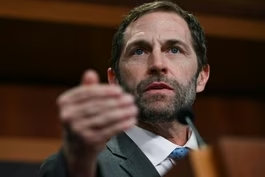
Rep. Crow signals legal action after effort to indict 6 Dems
Video has Closed Captions
Clip: 2/11/2026 | 7m 6s | Rep. Crow signals legal action after administration’s effort to indict 6 Democrats (7m 6s)
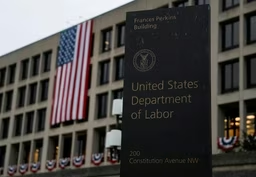
Revised economic numbers inject uncertainty into jobs market
Video has Closed Captions
Clip: 2/11/2026 | 5m 33s | Revised economic numbers inject uncertainty into jobs market (5m 33s)

What caused the sudden closure of El Paso's airspace
Video has Closed Captions
Clip: 2/11/2026 | 7m 34s | What caused the sudden and confusing closure of El Paso's airspace (7m 34s)
Providing Support for PBS.org
Learn Moreabout PBS online sponsorship
- News and Public Affairs

FRONTLINE is investigative journalism that questions, explains and changes our world.

- News and Public Affairs

Amanpour and Company features conversations with leaders and decision makers.












Support for PBS provided by:
Major corporate funding for the PBS News Hour is provided by BDO, BNSF, Consumer Cellular, American Cruise Lines, and Raymond James. Funding for the PBS NewsHour Weekend is provided by...