
August 3, 2026 - PBS News Hour full episode
8/3/2026 | 57m 46sVideo has Closed Captions
August 3, 2026 - PBS News Hour full episode
August 3, 2026 - PBS News Hour full episode
Problems playing video? | Closed Captioning Feedback
Problems playing video? | Closed Captioning Feedback
Major corporate funding for the PBS News Hour is provided by BDO, BNSF, Consumer Cellular, American Cruise Lines, and Raymond James. Funding for the PBS NewsHour Weekend is provided by...
August 3, 2026 - PBS News Hour full episode
8/3/2026 | 57m 46sVideo has Closed Captions
August 3, 2026 - PBS News Hour full episode
Problems playing video? | Closed Captioning Feedback
Where to Watch PBS News Hour
PBS News Hour is available to stream on pbs.org and the PBS app.
Providing Support for PBS.org
Learn Moreabout PBS online sponsorshipAMNA NAWAZ: Good evening.
I'm Amna Nawaz.
Geoff Bennett is away.
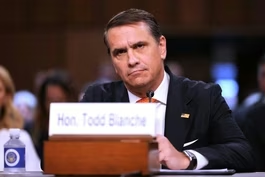
On the "NewsHour" tonight: Two holdout senators agree to support Todd Blanche's nomination for attorney general after he finally puts in writing that the so-called anti-weaponization fund has been scrapped.
President Trump says a new round of talks is Iran's last chance to make a deal, as Iran is suspected of multiple cyberattacks against U.S.
water systems.
CYNTHIA KAISER, Former FBI Cyber Deputy Director: The main aim of these operations is to sow chaos, confusion, and fear.
It's to say, we got in somewhere and think about what we could do next.
AMNA NAWAZ: And we examine how deep divides inside the Democratic Party are playing out in the Michigan Senate primary and what that means for the general election.
MATT GROSSMANN, Michigan State University: Republicans think, regardless of who wins on the Democratic side, they have a chance here.
(BREAK) AMNA NAWAZ: Welcome to the "News Hour."
Acting Attorney General Todd Blanche cleared a major hurdle in his push to permanently lead the Department of Justice after he reached a deal with two Republican senators who had said they would block his nomination.
Senators John Cornyn of Texas and Thom Tillis of North Carolina said they will now officially back Blanche after he put into writing that the DOJ is scrapping a $1.8 billion anti-weaponization fund, one that could have provided settlements to the president's political allies, including January 6 rioters.
For more on the agreement, I'm joined now by our justice correspondent, Ali Rogin.
So, Ali, how did they reach this deal and what exactly is in it?
ALI ROGIN: This deal came about after several weeks of talks between Senator Cornyn and the White House.
The White House had a lot of resistance.
President Trump had openly contemplated withdrawing Blanche's nomination and simply waiting out Senators Cornyn and Tillis because they lost their primaries a few weeks ago and will be leaving the Senate.
But late last night, there was some agreement.
Blanche released a new written order rescinding the so-called anti-weaponization fund.
The order is a half-a-page-long and declares that the fund is -- quote -- "rescinded and shall have no force or effect."
And it says it establishes -- quote - - "beyond any doubt that there is no fund."
Today, Tillis and Cornyn said that Blanche has addressed their concerns and they are ready to support his nomination.
AMNA NAWAZ: And just remind us, why was the fund such a sticking point in the first place for Senators Cornyn and Tillis?
ALI ROGIN: Well, this fund was a settlement as part of a lawsuit that President Trump filed against the IRS for leaked tax returns.
It got near immediate bipartisan criticism for concerns that it could lead to big payouts for January 6 rioters.
There were also court challenges and a federal judge blocked the fund from going into effect.
And around the time of that court decision, Blanche started saying that the fund was dead, but he wouldn't put that in writing.
And that's what Senators Tillis and Cornyn were asking for, written assurance that the fund would not go forward.
There was, Amna, another part of the IRS settlement that these senators both objected to, and that was a declaration of immunity from tax-related prosecution for President Trump, his family members, and unnamed affiliates.
And Cornyn had an issue with the scope of that being so broad.
Blanche also seemed to walk back that immunity in his latest order, clarifying that it only pertains to President Trump and his family members.
AMNA NAWAZ: So, just to be clear, is there anything in this new written deal that would stop January 6 defendants from receiving payouts of some kind, or that would prevent the president from reviving the fund?
ALI ROGIN: There is nothing in this language that would prevent either of those things from happening.
Even though the document says that there is no more fund, Trump allies could still claim weaponized prosecutions and seek compensation from other government accounts.
And as of last night, President Trump was defending this fund and talking about it as a very real possibility, as he did last night on Air Force One.
Take a listen.
DONALD TRUMP, President of the United States: These people were attacked.
And this would be a reimbursement, going to pay them.
A lot of people like it.
If they don't approve Todd, I will put it back on the table.
A lot of people like it.
A lot of big supporters of Trump like it.
ALI ROGIN: But, of course, Amna, Trump often sends mixed messages.
And, today, a reporter asked him if there were other avenues that people could pursue to receive payouts like this.
And he said there were no other avenues that he knew of.
AMNA NAWAZ: So what about Democrats on the Senate Judiciary Committee?
What are they saying about all this?
ALI ROGIN: Democrats are calling this deal meaningless.
Senator Adam Schiff said on a social media post that it -- quote -- "doesn't prevent payouts to violent insurrectionists in the future.
It doesn't prevent the administration from bringing the slush fund back from the dead next week or using an existing DOJ settlement fund for the same purpose."
And Schiff notes it leaves in place Trump's tax immunity deal.
AMNA NAWAZ: So, when it comes to tomorrow's vote, is that now a lock for Todd Blanche?
ALI ROGIN: It seems so.
The math is there for him to proceed out of committee.
In terms of the full Senate confirmation, it seems like he also has the votes there too.
That vote is set to -- expected to happen on Saturday.
Blanche can afford to lose two Republicans.
It's a slightly smaller margin than has been the case because Senator Mitch McConnell is still out.
But the fact that Tillis and Cornyn have gotten on board is a pretty good barometer for other moderate Senate Republicans like Lisa Murkowski and Susan Collins.
And, Amna, it seems like Todd Blanche is headed towards becoming the next permanent attorney general.
AMNA NAWAZ: All right, that's our justice correspondent, Ali Rogin, beginning our coverage.
Ali, thank you.
ALI ROGIN: You bet.
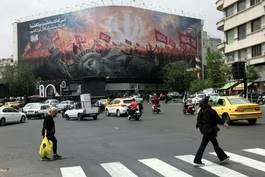
AMNA NAWAZ: Today, President Trump said his decision not to escalate the war in Iran over the weekend was Iran's -- quote -- "last chance" to make a deal.
He said he called off large-scale strikes because countries in the Gulf asked him to do so.
This threatening of new strikes and then calling them off is something the president has done many times over the past few months.
Our Nick Schifrin has more.
NICK SCHIFRIN: Today on the Strait of Hormuz, it is deja vu.
Once again, ships sit stranded.
And, once again, the commander in chief cancels plans to escalate.
DONALD TRUMP, President of the United States: We are talking right now.
We're talking, and we're talking at the request of Iran.
NICK SCHIFRIN: Over the last few days, it's been another example of Iran whiplash.
DONALD TRUMP: Well, we're going big.
NICK SCHIFRIN: On Friday, the president and senior aides suggested escalation was imminent.
DONALD TRUMP: We're going to hit them very hard yesterday, very, very hard, harder than any attack, I think I can say, General, from a point of knowledge, any attack since World War II.
NICK SCHIFRIN: But he now says that Saudi crown prince, Mohammed bin Salman, and other regional leaders changed his mind, at least for now.
DONALD TRUMP: This is a last chance.
This is not something that, if it doesn't happen -- this is a last chance for them to sign a good document.
NICK SCHIFRIN: U.S.
and regional officials tell "PBS News Hour" there are talks between the U.S.
and Iran and Iran and Oman over the Strait of Hormuz.
But Iran reiterated today it would never reopen the strait.
ESMAEIL BAGHAEI, Iranian Foreign Ministry Spokesman (through translator): As long as the current U.S.
evil acts continue, as long as the naval blockade of Iran remains in place, there will naturally be no significant development or major change in the situation in the Strait of Hormuz.
NICK SCHIFRIN: This is not the first time the president has claimed diplomatic progress that Iran has denied, nor the first time he's threatened to escalate and backed off.
In April: DONALD TRUMP: Every bridge in Iran will be decimated by 12:00 tomorrow night.
NICK SCHIFRIN: And then two days later.
PETE HEGSETH, U.S.
Defense Secretary: Operation Epic Fury was a historic and overwhelming victory on the battlefield.
NICK SCHIFRIN: Across one week in May.
DONALD TRUMP: We're either going to make a deal or they're going to be decimated.
There seems to be a very good chance that they can work something out.
NICK SCHIFRIN: And 24 hours in June.
DONALD TRUMP: We're going to be attacking them and attacking them very hard.
We found them to be rational, and they're going to make a deal.
NICK SCHIFRIN: And so this question today: QUESTION: Mr.
President, this is at least the fifth time you have turned off airstrikes against Iran since April to negotiate.
What is your message to the American people?
DONALD TRUMP: I want to give them every last chance before decapitation.
Very tough to do what we have planned, still planned.
We will see what happens.
NICK SCHIFRIN: The U.S.
military is still poised to escalate.
And it's still implementing a blockade of Iranian ports, what the president now calls the United States wall of steel.
MAN: If you do not comply, we will compliance with force.
NICK SCHIFRIN: This weekend, Central Command redirected dozens of commercial ships, disabled two and boarded two others, as the president today predicted quick success.
DONALD TRUMP: It's not very complex.
We're talking about the strait, the opening of the strait, having it open literally by tomorrow.
NICK SCHIFRIN: And as the U.S.
attention remains fixed on the Strait of Hormuz, the U.S.'
Gulf allies increasingly find themselves caught between preventing a wider war and protecting their own economic futures.
Joining us now is Dania Thafer, executive director of the Gulf International Forum.
Thanks very much.
Welcome to the "News Hour."
DANIA THAFER, Gulf International Forum: Thank you, Nick, for having me.
NICK SCHIFRIN: We just watched this presidential call it back-and-forth half-a-dozen times nearly over the last few months, threatening escalation and then backing off.
How has it affected how the region sees the president and sees the United States?
DANIA THAFER: Well, that is a great question.
Certainly, from the perspective of the region, they saw that their -- especially the Gulf states, notably, they saw that their security concerns were secondary and they lobbied very heavily against this war.
And so it does put them in a very awkward situation with their most important partner and ally, the U.S., and also with a regional belligerent Iran.
So the Gulf states have obviously had difficult relations with Iran, historically speaking, but they were well aware of what the consequences of this war was and that it would be a strategic blunder.
And so this is the reason why they lobbied against it.
There's a lot of questions circulating about I wouldn't say the future of U.S.-Gulf relations, because the Gulf states' grand strategies will generally stay with the U.S.
But, of course, they're looking at an international, layered approach for defense procurement, so a diversification or sort of hedging, if you will.
NICK SCHIFRIN: Hedging, a little hedging, yes.
You mentioned how these Gulf states, the U.S.'
Gulf allies were worried about this war going in.
They have been worried about it throughout, and specifically Saudi officials tell me that the Saudi government, the crown prince, Mohammed bin Salman, has been very worried about escalation.
He called the president over the weekend.
Saudi officials believe that call convinced the president to back off.
The president basically said as much.
Why for Saudi Arabia, why for some of the other countries have they been so worried about this particular escalation right now?
DANIA THAFER: Well, we are going into a dangerous phase.
Iran has sent warning shots to the Gulf states and to Saudi Arabia specifically, maybe not directly.
They have a degree of plausible deniabilities because it came through the Houthis, through... NICK SCHIFRIN: The Iranian-backed group in Yemen.
DANIA THAFER: Yes, through the Houthis, who are an Iranian-backed group in Yemen, and also from Iraq.
Saudi Arabia was attacked.
And more noteworthy is also ports near the Suez Canal, which is the other outlet, area in which boats can go through, because there's two choke points in the Red Sea, the Suez Canal and Bab al-Mandab.
So basically, the Iranians are sending the message that they will lock them into the Strait of Hormuz.
NICK SCHIFRIN: And we have got this map right here, the three choke points that you referred to, the Strait of Hormuz, of course, but in addition, the Bab al-Mandab strait, the gateway to the Red Sea, that's what the Houthis are threatening, and now we have this explosion outside the Suez Canal.
What does that triangle, if you will, of maritime choke points, what does that -- what power does that give Iran and its allies?
DANIA THAFER: Well, the Saudi ports were the lungs for the Gulf states in this war.
So this is how they were able to bypass the Strait of Hormuz, not only for Saudi Arabia to sell oil, which is incredibly important to the international economy, and is critical for Saudi's economy, but also, talking about supply chains, this is the only one of the core areas in which the Gulf states are all receiving their supply chains.
So cutting off Saudi Arabia would also be very costly for the GCC states as well.
And this is why Saudi Arabia has been establishing a Red Sea coalition to try to address this with other Gulf states, not all of them, and also with Turkey, with Pakistan, and other coastal states along the Red Sea to try to address this.
But over -- the overarching issue is that Saudi Arabia wants de-escalation, and the point to Trump is that this is going to be too costly without any strategic returns.
NICK SCHIFRIN: And we only got about 45 seconds left, so it's a hard question to answer in that time.
But, at this point, does Iran believe that, whether it's those choke points or what we saw with the president, going back and forth, that it has leverage?
DANIA THAFER: Yes, I think the Iranians think they are winning this war.
And they think they have the leverage and the influence to push-pull and push their will on the Trump administration, the international community, and in fact thinks they can reestablish the regional order in their favor.
NICK SCHIFRIN: Dania Thafer, the executive director of the Gulf International Forum, thank you very much.
DANIA THAFER: Thank you for having me, Nick.
NICK SCHIFRIN: Thank you.
AMNA NAWAZ: In the day's other news: Firefighters are battling a series of blazes that began this weekend in Washington state and are continuing to burn in and around Spokane, the state's second most populous city.
The fires have breached containment lines.
Tens of thousands of people have been displaced, and hundreds of buildings have now been destroyed.
Stephanie Sy has our report.
STEPHANIE SY: Thick smoke billowing in the Washington sky, cars, homes, and whole swathes of neighborhoods in flames and left in ashes.
Senator Maria Cantwell described the situation in her state.
SEN.
MARIA CANTWELL (D-WA): This is the most risked and resourced fire in the United States today.
It is the top fire in our nation.
STEPHANIE SY: More than 600 structures, including homes and businesses, have been destroyed.
ARIC FRANK, Wildfires Survivor: I was on the roof.
I couldn't see my feet, and I had to feel my way down the ladder because everything just turned black.
STEPHANIE SY: Aric Frank has lived here for more than 45 years.
ARIC FRANK: I don't think I'm going to rebuild here, because I don't ever want to have to relive a fire coming up this hill again.
STEPHANIE SY: Spokane Mayor Lisa brown said officials were still assessing whether the fires had claimed lives.
LISA BROWN, Mayor of Spokane, Washington: To the people who are suffering right now in our region from either loss or uncertainty, everyone here, our hearts go out to you.
We are here for you for the long term.
MAN: That's gas burning.
STEPHANIE SY: Some 60,000 residents in the Spokane area have been evacuated, hundreds finding shelter with the Red Cross.
Bob Ferguson, Washington's governor, said recovery would be long for many.
GOV.
BOB FERGUSON (D-WA): There are just so many Washingtonians who have literally lost everything in a very, very short period of time.
Just in a matter of hours, their lives changed in deeply dramatic and fundamental ways.
LIZZIE DAVIS, Wildfire Victim: My dad had actually just finished paying off the house.
Yes.
He worked really hard for that.
And I'm really grateful for everything that he was able to provide for my family.
STEPHANIE SY: Crews are technically battling three fires, the Autumn Lane, Fairview, and Old Trails fire.
Together called the Spokane Complex Fire, it's already torn through more than 7,000 acres.
Satellite imagery from NOAA shows the magnitude of the fires and smoke affecting the Northwest.
MAN: They wanted us to evacuate, but the waves were crashing, the wind was blowing, it was smoky.
Figured we were safer just staying put on our beach.
STEPHANIE SY: High temperatures, dry air, and strong winds have made for extraordinary wildfire conditions.
Firefighters from neighboring states are helping in the effort.
ROBERT GRAY, Spokane County, Washington, Fire: There just wasn't enough rigs with how many fires we had going and how large the fire got with how quick it was.
It was jumping through multiple neighborhoods.
Nobody is capable of handling that in this country.
STEPHANIE SY: Cooler temperatures today and tomorrow offer hope that firefighters can start to contain the fires, which are being called Spokane's worst natural disaster to date.
For the "PBS News Hour," I'm Stephanie Sy.
AMNA NAWAZ: Also today, health officials in Michigan reported the first deaths in the U.S.
related to a cyclosporiasis outbreak.
According to a statement -- quote -- "Both individuals had significant underlying health conditions that may have been impacted by cyclosporiasis and dehydration."
The officials add that the intestinal parasite disease is not usually considered life-threatening.
The CDC has confirmed some 6,700 cases nationwide since early may, though Michigan alone has reported more than 11,000 suspected cases.
More than two dozen states, nearly all led by Democrats, are suing the Trump administration over its latest tariffs.
Last month, the government announced double-digit levies on 60 trading partners, saying they'd not done enough to crack down on imports produced by forced labor.
The new tariffs took effect just as prior ones expired.
In their lawsuit, the states argue the president exceeded his authority and is trying to replace tariffs that the Supreme Court struck down earlier this year.
They're asking the U.S.
Court of International Trade to halt the tariffs and refund duties paid by the states.
Officials in Southern Ukraine say Russia dropped eight glide bombs in a span of 90 minutes last night, killing at least one person and wounding dozens more.
The attacks damaged residential buildings and a warehouse complex in the southern city of Zaporizhzhia.
Meantime, Russia says two separate attacks by Ukrainian forces killed at least nine people nationwide.
Also today, Ukraine's President Volodymyr Zelenskyy announced military cooperation deals with nine countries.
And he continued to shake up his top ranks, dismissing Ukraine's ambassador to the United States and announcing the top negotiator, Rustem Umerov, would lead the foreign intelligence service.
Firefighters in Greece are battling a major blaze outside Athens for a fourth straight day.
Strong winds returned to fan the flames, and a major highway was closed.
Authorities say that areas around the city remain at high risk throughout the week with temperatures set to rise.
Water-dropping flights were able to resume today after a midair helicopter collision killed two crew members on Sunday.
In the meantime, the U.K.
's weather service says a long heat wave and lack of rain led to the driest July in England and Wales in nearly two centuries.
All of Wales and more than half of England are now officially in drought.
Mauricio Pochettino is staying on as coach of the U.S.
men's soccer team through the 2030 World Cup.
The 54-year-old signed a four-year deal after guiding the team to a record three wins in this year's tournament.
The team fell to Belgium in the Round of 16, but managed to drive up enthusiasm for the sport nationwide.
Also today, the European soccer body UEFA threatened lawsuits against the international overseeing group FIFA for the now-canceled proposal to sell commercial stakes in the World Cup to private investors.
UEFA threatened to boycott the World Cup if the plan went forward and has led calls to replace FIFA President Gianni Infantino.
The world's third-smallest country, the Pacific island of Nauru, has changed its name, in a return to its roots.
The country's president says the new name, the Republic of Naoero, stays truer to its national language rather than Nauru, which was considered easier for foreigners to pronounce.
The country's international code will also change from NRU to NRO.
And its people will now be known as the dei-Naoero, instead of Nauruan.
It's the latest nation to change its name, joining countries like Turkiye and Eswatini, which is formerly Swaziland.
In movie news, "Spider-Man: Brand-New Day" now holds the box office record for the biggest opening weekend in North America.
The latest installment of the web-slinging series brought in $360 million across the U.S.
and Canada, topping another Marvel outing, "Avengers: Endgame."
Spidey also teamed up with "The Odyssey" to help set a record weekend overall for theaters.
Despite years of decline in theatergoing, the movie industry is enjoying a strong 2026, with one estimate showing ticket sales up roughly 15 percent over last year.
Well, today was the first official trading day for financial firms and others to get early access to Donald Trump's TRUTH Social posts.
That is if they signed up to a new subscription service from Trump Media and Technology Group, which went live this weekend.
Subscribers can pay up to $100,000 per month to get TRUTH Social posts from Trump and other top accounts before general users do.
Critics say the arrangement raises questions about insider trading.
The company has dismissed such concerns.
Elsewhere on Wall Street today, stocks rallied as oil prices cooled.
The Dow Jones industrial average jumped nearly 700 points.
The Nasdaq added more than 2 percent.
The S&P 500 closed just below a record set earlier this summer.
And Kay Granger, the first Republican woman from Texas to be elected to the U.S.
House of Representatives, has died.
She was the mayor of Fort Worth in the early 1990s before her election to Congress in 1996, where she stayed for nearly three decades.
As a longtime member of the House Appropriations Committee, she focused on defense spending, including production of the F-35.
Lockheed Martin assembles the fighter jet in her former district.
Granger was the first Republican woman to chair that committee.
She didn't run for reelection in 2024 as her health declined.
Granger's son said she died from Alzheimer's.
Kay Granger was 83 years old.
Still to come on the "News Hour": Congressman Max Miller faces accusations of domestic violence as his former father-in-law calls for his resignation; divides inside the Democratic Party play out in the Michigan Senate primary; and Tamara Keith and Amy Walter break down the latest political headlines.
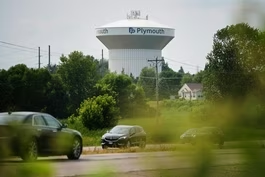
Well, according to the FBI, at least seven states have now been targeted in a growing wave of cyberattacks on critical water infrastructure across the country.
Federal officials are reportedly investigating Iran as the likely culprit.
Liz Landers has the latest on this story.
LIZ LANDERS: Amna, the coordinated attacks follow urgent warnings issued last month by cybersecurity agencies who said Iran was actively targeting water and energy infrastructure nationwide.
In Minnesota, officials said at least 30 municipal water systems were hit.
Utilities providers across the country are now scrambling to beef up their security.
For more, we're joined by Cynthia Kaiser.
She is former deputy assistant director of the FBI's Cyber Division and a senior vice president at the cybersecurity company Halcyon.
Cynthia, thank you for joining "News Hour."
CYNTHIA KAISER, Former FBI Cyber Deputy Director: Thank you for having me.
LIZ LANDERS: What do we know so far about these attacks?
What kind of damage were they able to do and who is being targeted here?
CYNTHIA KAISER: Attackers have been breaking into the small computers that run America's water system.
In a very small number of cases, there have been some disruptive actions.
Now, FBI and EPA have reported that utilities in at least seven states have known incidents that are of similar kind of severity, which shows just how broad this issue really is.
LIZ LANDERS: So far, federal authorities have not linked this to any specific actor.
Who do you think is behind this attack?
CYNTHIA KAISER: I would be shocked if Iran wasn't behind this attack.
When I was at the FBI, we looked at several different aspects when we were thinking about attribution, especially initially in a campaign.
One was, have we seen this type of targeting recently?
The answer here is yes.
Just a week ago, FBI and CISA, as well as a host of other U.S.
government agencies, put out an urgent warning saying that Iran was continuing to target these mini-computers that control much of our critical infrastructure, including water infrastructure.
The second aspect we looked at on attribution was, do they have a motive to do it now?
Is the attack actually for money or is it for disruptive actions?
This appears focused on disruption, not money.
And, geopolitically, the actor that has the main motive here is Iran.
And then, third, we would look at, who just has a longer history of doing these types of attacks and is willing to cross that red line of targeting critical infrastructure?
The answer here also is Iran.
Going back several years, they have conducted attacks against those these many computers at these facilities, including just kind of stopping at these devices and not going further, which is what's occurring in this operation here.
So we should all be moving forward assuming it's Iran, because there isn't really a plausible other scenario.
LIZ LANDERS: Why would Iran want to target these kinds of municipal water systems?
CYNTHIA KAISER: Iran wants to target these types of municipal water systems because they just want to get into anywhere.
The main aim of these operations is to sow chaos, confusion and fear.
It's to say, we got in somewhere and think about what we could do next.
So when you look at all of these different types of targets, they're going after the ones that they have the ability to get into, and oftentimes that is the smaller municipalities, the smaller locations' water systems because they lack the funding or the I.T.
personnel to be able to fully secure them.
LIZ LANDERS: On Friday, the president blamed the state of Minnesota and its Governor Tim Walz for the attacks, calling them grossly incompetent and corrupt.
Is that a fair criticism?
CYNTHIA KAISER: The FBI itself has noted that at least seven states have been impacted.
And even since Friday, Michigan has come out saying that they have also been victims or at least targeted as a part of this attack.
So it really is broader than the state of Minnesota.
LIZ LANDERS: Just how vulnerable is our country's infrastructure to these sorts of attacks, especially to the local utility systems?
CYNTHIA KAISER: The truth of the matter is that our -- especially our water facilities are very vulnerable to attack.
And that should be scary because everybody depends on water.
When I was in the FBI and policymakers asked me which sector I was most worried about, it was water, because they lack the funding.
They lack the I.T.
personnel necessary.
And they're run by these small municipalities.
They just don't have that full resources, which means the attackers are able to get into something.
It may not be everything, but something within those systems.
And if those systems goes down, we have a lot of problems across our communities.
LIZ LANDERS: The Trump administration has fired nearly a third of the employees at the Cybersecurity and Infrastructure Security Agency, CISA, and they're proposing to cut hundreds of millions of dollars more from the budget next year.
That agency typically maintains those relationships between the state, local, and federal governments and some of the infrastructure of those various places.
Have those cuts impacted the United States' ability to counter these kinds of threats?
Does this worry you?
CYNTHIA KAISER: What I really get worried when we're talking about cuts is not the big events.
Whenever there's been a big event, historically, like, throughout all of these cyber operations, the FBI, CISA, NSA, everybody is able to pull together, push resources towards that and ensure Americans are safe.
But if there aren't additional personnel, what happens to the other types of operations that are happening every day?
What do we miss?
I think that's the first concerning aspect.
But the second doesn't necessarily have to do with CISA at all.
It's the need to renew the funding for state and local cybersecurity grants that all of these municipalities are dependent on to be able to have the right kind of cybersecurity.
It's with the Senate now to act, but it will lapse if it's not renewed by this fall.
LIZ LANDERS: Cynthia Kaiser, thank you for your expertise.
CYNTHIA KAISER: Thank you.
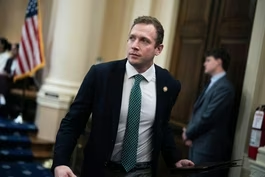
AMNA NAWAZ: Ohio's senior U.S.
senator is calling for an Ohio congressman who is also his former son-in-law to drop his reelection bid and resign from office.
In a social media post yesterday, Republican Senator Bernie Moreno called Republican Representative Max Miller -- quote -- "a danger to my daughter," writing -- quote -- "I hold my breath every minute he has custody of my granddaughter.
If there are any basic standards of character required to hold elected office, Max Miller fails them."
Moreno had been publicly silent over the past couple of years as allegations and messy divorce proceedings swirled around Miller and Moreno's daughter, Emily.
Senator Moreno's comments followed a live video from Miller over the weekend addressing accusations from his former wife that he abused her and their child.
REP.
MAX MILLER (R-OH): No criminal charge has ever been filed against me.
My former wife is engaging in a pattern of reporting incredible, serious, and destructive allegations with absolutely no evidence.
AMNA NAWAZ: Our congressional correspondent, Lisa Desjardins, joins us now with more.
So, Lisa, let's start with the accusations being made against Max Miller.
What do we know?
LISA DESJARDINS: Some of these accusations go back years.
Some are from this year.
And I should note, this is not the first time a woman has accused Max Miller of domestic abuse and he has denied it.
In this case, it is his ex-wife, Emily Moreno.
She has not spoken publicly, but court documents and photos published by The Daily Mail detail some very serious abuse allegations.
She says that he in different times pushed her, pushed her against her wall, bruised her, held a gun to her head, and at one point doused her with hot water from a sink.
Now, Congressman Miller denies all of that adamantly.
He says the sink incident was horseplay, and the rest of them he says were invented.
There's also an incident with their young 2-year-old daughter in which her collarbone was broken while she was in his custody.
Emily Moreno did not accuse him of that abuse, but did raise concerns.
To that, Mr.
Miller put out documents over the weekend showing the findings of a local investigation which declared that this was an unsubstantiated allegation.
He says the daughter was in a nanny's care at the time of that injury.
This document is one of dozens that Max Miller has put out in his defense.
AMNA NAWAZ: And why is all of this spilling out into the public now?
Why is Senator Moreno weighing in on this now?
LISA DESJARDINS: Right.
This does go back months, but after that collarbone incident, Emily Moreno filed to change their shared custody agreement.
Then, shortly after, Miller won his May primary.
Then The Daily Mail our article came out about these abuse allegations.
Following that, we now had Senator Moreno not weighing in.
Why is he changing now?
Well, speaking to someone who's involved, he says over the weekend they realized that Congressman Miller was ramping up his attacks on his daughter, Emily Moreno, and that as a father he had to weigh in.
Until that point, they say Emily Moreno had asked him not to.
Now he felt he had to spoke -- to speak up.
AMNA NAWAZ: So these custody proceedings are playing out in the courts.
But what do domestic violence advocates say about all of this?
LISA DESJARDINS: This is a high-conflict divorce.
This is complicated in almost every case, even when there aren't members of Congress involved.
But a particular facet here is Congressman Miller's defense.
He is trying to point the finger back at his ex-wife.
He has raised things that says she offered to make him food at the time of these abuse allegations, and she said he was kind.
On one hand, he says that shows she was different in private than her public accusations imply.
But domestic abuse experts say it's not that simple.
We spoke to Joan Meier of the National Family Violence Law Center at George Washington University.
JOAN MEIER, National Family Violence Law Center, George Washington University: Those are the kinds of claims that are very commonly made by alleged abusers.
And they can get traction because they seem counterintuitive.
Why would someone who's been violently assaulted be being nice to their violent assaulter?
The problem is, is that takes it out of context.
LISA DESJARDINS: Separately, we spoke to the National Domestic Violence Hotline.
They said this is still a major issue in the country.
They get 3,000 calls for help a day.
AMNA NAWAZ: Obviously, there's serious allegations here.
As you point out, there's a child at the heart of all of this, but there are political implications given the people here.
What should we know about that?
LISA DESJARDINS: Congressman Miller's in a vulnerable Republican seat, and now Democrats think it may be even more vulnerable.
But it also comes in a year with patterns of these kinds of stories.
For example, Graham Platner in Maine, as we all remember, had to pull out of that Senate race after past allegations of abuse.
You see three congressmen there.
Two of them resigned after sexual misconduct allegations, and then in the middle one, Cory Mills, who still faces those kinds of allegations.
There are now calls for an Ethics investigation into Congressman Miller.
He says he is not resigning, but those Ethics investigations, we know, take time.
AMNA NAWAZ: Finally, Lisa, we know that you have just returned from a key state in this midterm election year, Michigan.
What should we know?
LISA DESJARDINS: This was fascinating.
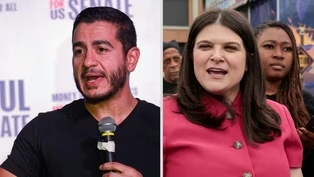
We found Democrats in Michigan wrestling over an absolutely critical and intense Senate race.
Their primary is tomorrow between two candidates who both say they're underestimated, but it's really about how Democrats try to win and who they want to be.
LISA DESJARDINS: In Michigan, is this a phase or is this the future?
ABDUL EL-SAYED (D), Michigan Senatorial Candidate: All right, so money out of?
AUDIENCE: Politics!
ABDUL EL-SAYED: Money in your?
AUDIENCE: Pocket!
ABDUL EL-SAYED: Medicare for?
AUDIENCE: All!
ABDUL EL-SAYED: That's what we're fighting for.
You all, it just shouldn't be this hard.
LISA DESJARDINS: Abdul El-Sayed is many things, a Michigan native, a Rhodes Scholar with a medical degree, and a former public health director.
Vigor is his brand.
A progressive who's never held office before, he is banking on enthusiasm.
DORICE STEINER, Abdul El-Sayed Supporter: He's authentic.
He doesn't owe anything.
He's not representing anyone but the people.
BRUNO NAVARRE, Abdul El-Sayed Supporter: He's not just like, hey, I'm pushing the same buttons as everyone else.
He's actually like, hey, this is messed up.
You have got to fix this.
LISA DESJARDINS: Battling him is Congresswoman Haley Stevens.
REP.
HALEY STEVENS (D-MI), Senatorial Candidate: We all know we're a swing state, and we're going to win big in November.
LISA DESJARDINS: Her brand is hard worker, can-do, as in 2018, when she flipped a Republican district to win her U.S.
House seat, or, in 2009, when she helped run President Obama's auto bailout.
Stevens leans in on her record and her Michigan accent.
REP.
HALEY STEVENS: I have this community's back.
I have this state's back, and I'm going to lead in the way we need and deserve.
I'm going to stick it to them.
LISA DESJARDINS: Her supporters say she's the one who can win in the fall.
SUSAN ANDERSON, Haley Stevens Supporter: There's no contest.
She has a proven record.
TYLER MCCASTLE, Haley Stevens Supporter: Fighter for the working man or woman.
She really stands up for that.
LISA DESJARDINS: One party choosing from two different directions.
CINDY GROENE, Haley Stevens Supporter: I have got friends on both sides.
LISA DESJARDINS: And they feel strongly.
CINDY GROENE: And they feel very strongly about their choice.
LISA DESJARDINS: In the Detroit suburbs, Cindy Groene is highly engaged.
She volunteers and campaigns with the local Democratic Party, and she's supporting Stevens.
CINDY GROENE: I feel strongly that she's the right choice.
One is her policies.
And the other is I feel she has the best chance of winning the race once the primary is over.
LISA DESJARDINS: How important is that?
CINDY GROENE: I think it's critical.
The state is a purple state, and I think it's going to be close.
LISA DESJARDINS: Polling backs that up.
A recent Michigan Education poll found Stevens neck-and-neck with Republican Mike Rogers.
He's a former congressman who narrowly lost a Senate race two years ago and has President Trump's endorsement.
In the same poll, Abdul El-Sayed trailed Rogers by 10 points.
ABDUL EL-SAYED: It is hard past time for us to show up and start taxing billionaires their wealth.
LISA DESJARDINS: But El-Sayed says this misses his momentum.
ABDUL EL-SAYED: The way you win is to bring more voters to the coalition and to win some of these folks who want a politician who's not bought off.
I will also tell you this that to beat somebody like Mike Rogers, you actually have to offer a contrast.
If you need $60 million, as my Democratic opponent has taken, to barely be competitive in a primary, tell me how you're electable again.
LISA DESJARDINS: This is one of the most expensive Senate primaries in history, fueled not just by divide over the Democratic Party's direction, but by one high-stakes debate over Israel and Gaza.
NARRATOR: She's fighting back against Trump's Medicare cuts.
LISA DESJARDINS: This ad may not mention the Middle East, but the super PAC involved is focused on it.
Tied to AIPAC, or the American Israel Public Affairs Committee, the group has spent more than $30 million for Stevens and against El-Sayed.
NARRATOR: That's the real Abdul El-Sayed.
LISA DESJARDINS: The outside spending is sparking wide backlash.
At the same time, Democrats are divided over Gaza.
El-Sayed sharply criticizes America's role in providing weapons to Israel.
ABDUL EL-SAYED: Antisemitism is a scourge and we must stand up against it.
But this is about love for the people who go without those basic things in America.
So how dare we ask how we're going to pay for improvements to our schools or health care while we don't bat an eyelash to sending $3.3 billion of our taxpayer money to a foreign government doing genocide and apartheid.
LISA DESJARDINS: Aleena Malik's a rising senior at the University of Michigan studying business.
While home for the summer, El-Sayed inspired her to canvass for the first time.
ALEENA MALIK, Abdul El-Sayed Supporter: I was definitely scared going into it, but it was really nice.
LISA DESJARDINS: A core issue for her, the AIPAC and corporate money in this race.
ALEENA MALIK: I didn't realize how campaigns were funded and how they can be funded by these corporate political action committees and how that can affect the policies that are made.
REP.
HALEY STEVENS: I'd love a constitutional amendment to get rid of money in politics.
LISA DESJARDINS: Stevens has responded, as we saw at the regional Chamber of Commerce in Lansing.
REP.
HALEY STEVENS: We're in a moment of reckoning.
And it's cheap shots to say, oh, well we can't have nice things because of this and that, a super PAC, which yes, that's garbage that we have this dark money.
LISA DESJARDINS: You said very clearly, and you have been clear.
You want to reform.
You don't -- campaign finance reform.
Why not tell super PACs not to use your name?
Why not openly reject the dark money and outside money that's helping you?
REP.
HALEY STEVENS: Well, the Republicans certainly wouldn't be listening to that.
LISA DESJARDINS: So, two wrongs make a right?
REP.
HALEY STEVENS: I'd love to tell the Republican super PACs not to donate -- or not to do a super PAC.
LISA DESJARDINS: Stumping for Stevens is Zach Nessel.
He's secretary of the state Democratic Jewish caucus and the son of the state's attorney general.
He says the AIPAC focus is misguided.
ZACH NESSEL, Haley Stevens Supporter: They support her because she supports Israel and she always has been.
It's not that she owes them anything.
It's that she has been -- their values are aligned.
LISA DESJARDINS: This divide isn't new.
But Democrats criticizing Israel and those pushing left are notching up recent gains, like Democratic Socialist Zohran Mamdani's win in New York City.
Here in Michigan, a recent poll shows El-Sayed with a 16-point lead over Stevens, winning big with independents likely to vote in the race.
MATT GROSSMANN, Michigan State University: They open, like all, with us.
LISA DESJARDINS: Matt Grossmann is a political science professor at Michigan State and co-owns Hooked, a bookstore in Lansing.
MATT GROSSMANN: Democrats are competitive now in Texas, in Iowa, in Alaska, in Ohio.
This shouldn't be the competitive state, certainly to determine the outcome of the U.S.
Senate.
But I think Republicans think, regardless of who wins on the Democratic side, they have a chance here.
LISA DESJARDINS: Grossmann also says the general election could get ugly, particularly if Republicans run against El-Sayed, who'd be the first Muslim senator in history.
ALEENA MALIK: He's fighting for what people want.
And so I think that will make people see past the racism and the superficial things like his name and his identity.
LISA DESJARDINS: If Stevens wins, Aleena Malik will probably vote for her over the Republican.
ALEENA MALIK: I think it goes back to kind of choosing the lesser of two evils.
CINDY GROENE: I don't have any real negatives towards Abdul, but I would like to see him hold another elected job before he made a huge move to the Senate.
LISA DESJARDINS: But, even so, Stevens supporter Cindy Groene says she will definitely vote for El-Sayed if he is on the fall ballot.
CINDY GROENE: My concern is both sides, Abdul supporters, Haley supporters, will not vote for the other if they win.
And that would not result in the Democrats retaining this Senate seat.
LISA DESJARDINS: This is a classic Michigan hard political fight, a test of Democrats' divide and their ability to quickly reunite.
For the "PBS News Hour," I'm Lisa Desjardins in Lansing, Michigan.
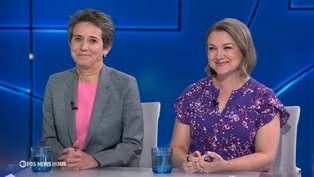
AMNA NAWAZ: Well, for more now on tomorrow's midterm primary races, we turn to our Politics Monday duo.
That is Amy Walter of The Cook Political Report With Amy Walter and Tamara Keith of NPR.
It's great to see you both.
AMY WALTER, The Cook Political Report: Hello.
TAMARA KEITH, National Public Radio: Good to be here.
AMNA NAWAZ: Let's pick up where Lisa left off, in Michigan.
The defining issues in that Senate primary, you have got the moderate Congresswoman Haley Stevens and the progressive Abdul El-Sayed running to take on the presumptive Republican nominee, Mike Rogers.
Amy, for Democratic primary voters here, seems to be at issue of which direction they want to see the party go or which candidate they think can actually win in November.
Is that fair?
AMY WALTER: Right.
I do think that's fair.
And I think Haley Stevens was a great example of the kind of candidate that could win in the first Trump midterm election.
She was part of the establishment at a time when people in thought the establishment and institutions were going to be the answer to Trumpism.
She came from working in the Obama White House.
She was somebody who was going to stand up, all those things that Democrats believed Trump was knocking over.
In the eight years since then, what many Democratic voters have seen is that standing up for the -- what they thought were universal values of democracy, of institutions and of norms is no longer as powerful, and that those institutions and norms didn't protect the country from a second Trump election.
And so where you see Democrats now is very similar to where Republicans were at this point in, say, 2014 or even in 2010, when they believed that the Republican leadership was not properly reacting to the election of President Obama, and they needed a new direction to go.
So she will run and she's continuing to run on, I'm the electable candidate.
But I think, for many voters in Michigan, what they're saying is we don't need to play it safe anymore because playing it safe is really what got us Donald Trump back.
AMNA NAWAZ: And, Tam, we have already seen the Republican, Mike Rogers here, release an attack ad before he even knows who he's running against, against Abdul El-Sayed.
He's sort of depicting him as a Trojan horse who will bring communism to Michigan.
We should point out that El-Sayed doesn't identify as a Democratic Socialist, but he has several backing him.
What do you make of that line of attack?
TAMARA KEITH: I think we're going to see a lot of it.
That is a line of attack that we're going to see all over the country, whether the Democratic candidates are actually aligned with Democratic socialists or not, because that is one of the ways that Republicans have keyed in on to say, oh, those other guys, they are way too extreme for you.
And they're after this sort of narrow piece of the pie of voters who are actually persuadable.
And so what you have to do to convince a persuadable voter is to disqualify the other party.
And so absolutely this race is going to be -- if El-Sayed moves on to the general election, it is going to be like a pretty perfect test of can a populist progressive outsider win in a swing state?
And Mike Rogers is -- some people I have been talking to in the state have described him as sort of a plain vanilla Republican.
He's not -- he's not a flamethrower, he's obviously endorsed by President Trump, he's campaigned with President Trump, but he's sort of a mainline Republican.
And so you're going to see what happens when Democrats, if El-Sayed is the nominee, nominate someone who is considered a little bit more of a risk, who has taken some positions on social issues, not what he's campaigning on, but has taken some positions that could be portrayed as extreme.
And progressives are watching this and saying, hey, this is our chance.
If he can win in the general election, then we can convince well-meaning electability voters that, come 2028, they should vote with their hearts and not with their heads.
And let's also be clear that President Trump is so much more unpopular in Michigan today than he was in 2024.
TAMARA KEITH: Yes.
AMNA NAWAZ: That's a good point.
AMY WALTER: So the actual electorate looks a lot different today than it did in '24 than it will in 2028.
AMNA NAWAZ: And there's an issue Lisa pointed out in her reporting as well that is coming up in this election that hasn't as strongly in previous.
That's the funding from AIPAC in particular.
We see it as a factor in this primary.
We also seeing it in Missouri, where there also -- there's a primary there for the First Congressional District.
And that race is a rematch between the progressive Cori Bush and the moderate Wesley Bell.
Two years ago, Bush lost to Bell, blamed her loss on AIPAC's spending there.
But Lisa's reporting shows this is something voters are paying attention to you.
Why is this happening now?
I think what they're paying attention to, it's less the issue of Israel, though the issue of Israel looks very different today to Democratic voters than it did a few years ago because of the war in Gaza.
So I think already you have seen the shift in opinions of Israel among Democrats going down significantly, and then the issue of corruption now being front and center and of money in politics being part of that corruption message.
When you hear the term AIPAC now in the way -- especially in Michigan, the way that El-Sayed talks about it is the corrupting power of money, right?
These are donors who are spending millions and millions of dollars to bring someone to Washington.
I'm not going to take that money, much more so than this is a debate between the two of them over Israel.
TAMARA KEITH: Yes, and this is something that we have seen in other primaries all over the country.
We saw it in Illinois.
We saw it in New Jersey.
And AIPAC money has become sort of a -- just like a phrase that represents money in politics, outside influence.
And we have to say that this comes at a time when the war in Iran is unpopular, and many of these candidates are on the Democratic side linking it to an economic message.
They are saying the money should be spent in America on health care and food and housing and not on a foreign war that we don't agree with or supporting Israel, which we don't agree with.
It is very much linked to that economic message in a way that may make it more resonant than just talking about foreign policy, which typically does not move elections in America.
AMNA NAWAZ: Meanwhile, I want to ask you about something we have seen from the president in the last few days.
He went on another sort of spree posting on TRUTH Social on Saturday, about 40 or so posts within an hour or so, ranging from A.I.-generated images of himself, hinting at a U.S.
takeover of Greenland or making Venezuela the 51st state, also a rebuke of his U.S.
attorney Jeanine Pirro, who's longtime been an ally of his.
That, as you both know, followed Pirro and the DOJ dropping charges on Friday against a man they accused of vandalism at the Lincoln Memorial Reflecting Pool, saying the damage in their filing was because of hasty installation and renovation, not because of vandalism.
We should note prosecutors just today have released -- or really actually pulled back more cases related to vandalism there, so they're dropping those charges.
President Trump continues to insist it was vandalism, even today in the Oval Office.
Here's what he had to say.
DONALD TRUMP, President of the United States: And I was disappointed with Jeanine Pirro, really disappointed with Jeanine Pirro.
She folded like an umbrella.
AMNA NAWAZ: Tam, explain to us why the president is doubling down on this and also reports that he could drop Jeanine Pirro now?
TAMARA KEITH: Because the president doubles down on everything.
The Reflecting Pool was an embarrassment for him.
It was supposed to be this glorious American flag blue, repairing something that Obama couldn't repair, and it became a metaphor, a really unfortunate metaphor for the president with green algae and paint peeling.
And he rapidly started blaming vandalism.
And it wasn't just once.
He blamed vandalism at least 20 times, by my count.
And the length of the gash that he said that the vandals put in the sealant got longer and longer and longer.
It was like 250 feet.
Then it was 300 yards.
It got longer and longer.
The reality is, he does not ever apologize.
He never looks back.
He always doubles down, even if, in court filings, the truth matters, which is a different than the court of public opinion, where he -- which is his realm.
And that's what -- the really important point, which is you can say whatever you want on TRUTH Social, you can make claims that are outrageous in the public square.
When you come in front of a federal judge, you cannot make those same comments, not only because you will lose your case, but you could also be held in contempt if you're actually lying, knowingly lying to a judge.
So the stakes are much higher for somebody who's actually arguing that case than for Donald Trump, who can actually just needle the person who's supposed to be arguing the case.
AMNA NAWAZ: Standards for evidence are higher as well.
AMY WALTER: Yes, those things.
AMY WALTER: I didn't go to law school, but I have heard such things.
AMNA NAWAZ: Nor did I. AMY WALTER: Yes.
(LAUGHTER) AMNA NAWAZ: Amy Walter, Tamara Keith, great to start the week off with you both.
Thank you so much.
AMY WALTER: Thank you.
TAMARA KEITH: You're welcome.
AMNA NAWAZ: And that is the "News Hour" for tonight.
I'm Amna Nawaz.
On behalf of the entire "News Hour" team, thank you for joining us.
Blanche wins support from GOP holdouts after scrapping fund
Video has Closed Captions
Blanche wins support from GOP holdouts after vowing to scrap 'anti-weaponization fund' (4m 58s)
Cyberattacks on water systems reported in 7 states
Video has Closed Captions
What we know about the cyberattacks on water systems in 7 states (6m 32s)
Michigan Senate primary divides Dems over direction of party
Video has Closed Captions
Contentious Michigan Senate primary divides Democrats over direction of party (7m 50s)
News Wrap: Michigan reports deaths related to cyclosporiasis
Video has Closed Captions
News Wrap: Michigan reports 2 deaths related to cyclosporiasis outbreak (6m 38s)
Sen. Moreno calls on ex-son-in-law Rep. Miller to resign
Video has Closed Captions
Sen. Moreno calls on ex-son-in-law Rep. Miller to resign amid domestic abuse allegations (4m 50s)
Tamara Keith and Amy Walter on Democrats not playing it safe
Video has Closed Captions
Tamara Keith and Amy Walter on Democratic primary voters not playing it safe (9m 35s)
Trump says new talks are Iran's 'last chance' to make deal
Video has Closed Captions
Trump says new talks are Iran's 'last chance' to make deal 'before decapitation' (8m 41s)
Wildfires destroy hundreds of buildings in Washington state
Video has Closed Captions
Wildfires destroy hundreds of buildings, displace tens of thousands in Washington state (3m 8s)
Providing Support for PBS.org
Learn Moreabout PBS online sponsorship New Episode
- News and Public Affairs

Today's top journalists discuss Washington's current political events and public affairs.

- News and Public Affairs

FRONTLINE is investigative journalism that questions, explains and changes our world.

 New Episode
 New Episode
 New Episode
 New Episode
 New Episode
 New Episode
 New Episode
 New Episode
 New Episode
Support for PBS provided by:
Major corporate funding for the PBS News Hour is provided by BDO, BNSF, Consumer Cellular, American Cruise Lines, and Raymond James. Funding for the PBS NewsHour Weekend is provided by...