
The Making of The American Revolution
2/27/2026 | 1h 17m 28sVideo has Closed Captions
Go behind the scenes with Ken Burns and the filmmaking team to learn about making the series.
Go behind the scenes with Ken Burns, Sarah Botstein, David Schmidt and their team to learn about the production, which took nearly a decade to complete. The program includes clips from the series and visits stops on the film’s cross-country tour. It also provides an exclusive look at the composers, cinematographers, editors, researchers and more who came together to make the landmark series.
Problems playing video? | Closed Captioning Feedback
Problems playing video? | Closed Captioning Feedback
The Making of The American Revolution
2/27/2026 | 1h 17m 28sVideo has Closed Captions
Go behind the scenes with Ken Burns, Sarah Botstein, David Schmidt and their team to learn about the production, which took nearly a decade to complete. The program includes clips from the series and visits stops on the film’s cross-country tour. It also provides an exclusive look at the composers, cinematographers, editors, researchers and more who came together to make the landmark series.
Problems playing video? | Closed Captioning Feedback
How to Watch The Making of The American Revolution
The Making of The American Revolution is available to stream on pbs.org and the free PBS App, available on iPhone, Apple TV, Android TV, Android smartphones, Amazon Fire TV, Amazon Fire Tablet, Roku, Samsung Smart TV, and Vizio.
Providing Support for PBS.org
Learn Moreabout PBS online sponsorship- [Announcer] For over 50 years, Ken Burns has been creating films that tell the powerful and complicated history of America.
Now, Ken and his team at Florentine Films have tackled the sprawling and challenging origin story of the United States in "The American Revolution," a film by Ken Burns, Sarah Botstein and David Schmidt.
A decade in the making, this landmark film, covering six episodes in 12 hours, explores the country's founding struggle and its eight-year war for independence.
- I think it still excites us that we are the product of a... of a revolutionary moment where the world turned upside down.
(intense cinematic music) - [Announcer] The series is a culmination of the work of scholars, writers, researchers and cinematographers who help us examine how America's founding turned the world upside down.
- [Christopher Brown] One of the most remarkable aspects of the revolutionary War is that you had such different places come together as one nation.
- [Vincent Brown] It mushrooms into a global campaign that touches Europe and all parts of the world.
- [Announcer] Viewers will experience the war through the men and women who lived it firsthand.
- [Keery as Greenwood] "In the time I was at school, the troubles began to come on, and I was told the day of judgment was near at hand, and the moon would turn into blood and the world would be set on fire."
(cinematic music intensifying) - [Announcer] In this program, we'll hear from the entire team that created this incredible series.
We'll take you behind the scenes from the music and the museum pieces, to the fresh historical discoveries and jaw-dropping reenactments.
Learn what it takes to create a production that's this extensive and comprehensive.
Simultaneously a war for independence, a civil war fought by neighbors in American cities, towns, and farms and a world war between global powers an ocean or more away.
Join us as we explore "The Making of 'The American Revolution.'"
(mysterious synthesizer music) (foreboding string music) (horse whinnying) - [Narrator] The Massachusetts Assembly defiantly reconstituted itself and soon set about creating a clandestine provincial fighting force, tens of thousands strong.
(mysterious music continuing) (soldiers shouting distantly) There had been organized town militias in New England since the earliest days, in case of trouble with "Indians."
Every man between the ages of 16 and 60 was expected to arm himself and take part.
- [Burns] So we were working on our history of the Vietnam War, and I remember looking up after watching a map-- a 3-D map-- that we had made, that, um, showed a perspective down the central highlands in the Drang Valley.
And I suddenly had this "Aha" moment, and I turned to Sarah Botstein and I said, "We're going to do the Revolution next."
- It was an enormously scary thing to say, "Yes," and to begin to think about how we might visualize and put together a compelling story about the American Revolution, which is... both... a very long, complicated, deeply brutal, bloody 18th century war, and a big revolution about the great ideas that we still are wrestling with today.
In "Vietnam," we were looking at this moment when so many of the divisions and fractures that we feel today happened.
And I think if I hadn't worked on that film and thought about war that way, I wouldn't have... had the guts to, to do the Revolution, actually.
- I think one thing that I've understood from talking to people about this film is that a lot of people are really hungry for this information.
We show them 45 minutes and they want more, because what they learned in those 45 minutes was really new, um, but made their country make more sense to them.
And I think that the full 12 hours, mu- much of it will be new to you, and it will make you understand your country better.
(foreboding string music) (wood splintering) - [Narrator] The men banged open 342 crates and poured more than 46 tons of tea into the harbor.
(yelling and splashing) No other property was disturbed, and when one of the boarders was seen filling his coat pockets with fistfuls of tea, he received a severe bruising.
(splashing and shouting) (foreboding music continuing) - [Taylor] This is an assault on the property of the East India Company, and it's an assault upon the pride and the power of Parliament.
So it's a very big deal.
- [Burns] I was looking for some sense that we could offset the obvious and initial deficit, which is no photographs and of course, no newsreels, in addition to no living witnesses.
- [Reidy] When Florentine Films first approached me about a 12-hour piece on the American Revolution... I said, "Well, let me think about that for a while"-- because I was really very concerned about what we were going to look at.
- It means that maps are going to become more important.
Documents are going to become more important.
Live cinematography is going to be important.
Paintings, drawings-- first-person voices will be huge.
We have hundreds of them.
- [Keery as Greenwood] "Then, I saw a Negro man wounded in the back of his neck.
(sorrowful woodwind music) I saw the wound very plain, and the blood running down his back.
(sorrowful music continuing) (musket fire) I asked him if it hurt him much, as he did not seem to mind it.
He said 'No,' and that he was only going to get a plaster put on it, and meant to return.
(distant sounds of gunfire) Immediately, you cannot conceive what encouragement it gave me.
I began to feel, from that moment... brave... and like a soldier."
(sorrowful music and gunfire fading) (cannon fire) (gentle piano music) - [Schmidt] In the case of the American Revolution, I thought I knew a thing or two.
And basically that's what I knew-- a thing or two.
There's so much more that I've gotten to learn while making this film.
It's real- It's a real blessing.
And we're really happy that we get to share our work with, uh, with the country.
- It's hu... humbling.
You know, you think you know something about the Revolution, and every day of that nearly decade-long period is a sort of quiet reminder of how little you actually know.
- What I learned was everybody then was very much like us today.
And they are human beings.
And, as with all history, you- the- the deeper you get into it, the more fascinated and, and sort of, um, intimately knowledgeable you are about the individuals involved.
- I've come out of this film, and this project, newly appreciative of what it meant to pursue citizenship as opposed to subjection.
To be an imperial subject is about the relationship, in one way or another, to the Crown.
To be an American citizen is, in one way or another, about relationships to each other.
And I have to say, I come out of this project newly inspired... and challenged by that idea-- that part of what it means to be an American is... the stance that we take towards each other.
- Regardless of your political persuasion, regardless of where you live, regardless of how old you are, what your sex is, how wealthy you are, how p- it's- it's a story for all of us.
And one of the reasons that it is a story for all of us is that we've now pulled back our camera and, and widened the lens to show people the- a more complete story of the Revolution.
So it isn't just guys thinking great thoughts in Philadelphia.
Don't worry-- they're there.
They're the best thoughts I know.
Um, and they're well-represented.
But it's, there's, it's a lot more complicated story.
And I'm so excited to share this.
(gentle piano music continuing) - [Daniels as Jefferson] "...all men are created equal, that they are endowed by their creator with certain inalienable rights, that among these are life, liberty, and the pursuit of happiness."
(gentle music continuing) - [Wood] Everything that we believe in comes out of the Revolution.
Our ideals of liberty, equality.
I- I- it's, it's the defining event of our history.
(whooshing sound) - [Announcer] Perhaps more than any other Florentine Film, the live cinematography in "The American Revolution" is crucial to the storytelling.
(ominous percussion music) (vocalist humming) - [Narrator] The American Revolution was fought in hundreds of places, from the forests of Quebec, to the back country of Georgia and the Carolinas, (plaintive humming intensifying) From the rough seas off England, France and in the Caribbean, to the towns and orchards of "Indian Country."
(contemplative piano music) - We're going to-- over many, many years, in every season, and every time of day and night, film reenactors doing their stuff (gunshot) and collect this critical mass of imagery that we can add to the live cinematography of the main character of our film, the beauty of the Eastern Seaboard-- New Hampshire, Maine to Georgia-- and combine it with all the other archival elements and the voices to sort of wake that moment up.
- We started filming for "The American Revolution" in 2019.
So it's been over the course of six years that we have been filming this project.
We've captured over 200 hours of footage at 165 locations.
To be able to do that in every season up and down the Eastern Seaboard took an incredible team.
- [Philbrick] America is this huge continent.
There's tornadoes, there's hurricanes.
There's winter storms.
(wind howling) Turns of weather that we know are coming for weeks on end hit the people of the 18th century completely by surprise.
(melancholy orchestral music) They're not just fighting each other.
In a profound way, they are fighting the American climate and geography and topography.
(wind whipping through trees) This is a difficult place to conduct a war.
(traditional American string music) - A lot of the things which we were filming were in traditional ways that we work.
We do a lot of landscape work.
We do a lot of work that has to do with being in places with, as our old teacher, Jerome Liebling, would say, filming the residue of history.
What is actually the evidence that this thing happened in this place?
What does this place feel like?
And how does one move through that space?
- [Botstein] When we're talking about how we made the film, it's just the extraordinary work of Buddy Squires.
He brought his A game every single day to every single shoot.
And he's notoriously fast and agile, and is ferocious and fearless, shooting in every season, with every type of camera.
And finally we got him a uniform and he embedded with the guys.
(string music fading) - [Squires] When it came to trying to deal with things like battles, things like... troop movements, it was great fun because, finally, I got to be close.
Finally, I got to be in the middle of it, and... we were really able to create a much more intimate relationship to what these people were doing.
(soldiers shouting) (gunfire) - [Norton as Fithian] "Blood.
Carnage.
Fire.
Many, many, we fear, are lost.
(soldiers crying out) Such a dreadful din, my ears never before heard."
(gunfire and shouting) Philip Fithian.
- [Squires] And then on top of that very close, almost macro sense of it, we also started working with a fantastic drone operator named Mike Doyle, who would do the exact opposite.
While I was down on the ground, Mike would be 300 feet above, looking straight down on the battlefield, so you can actually see... What does this array look like?
What does this line of troops look like as it moves?
What does this other group coming this way look like?
It's really all about trying to create impressionistic sense of what it might have been like to be at a given place at a given time.
- We were thinking about filling the gaps of what was missing from the archival record, and brought that to life with some incredible reenactors who do some of the most thorough research I've seen on the material culture of the time.
They hand sew their uniforms, they study exactly what rations people got and how much.
They're so excited to be in the authentic conditions that it was really perfect for capturing, like the grittiness.
- There was a small stream bed, and I walked through the stream bed.
And said, "Oh, this would be really cool to have these guys kind of running through the stream bed," you know, with this little bit of water and mud, but n- nothing much.
And then we took the camera and brought it down to the first feet and we started walking down, and I panned a little bit and let them pass me.
And instead of splashing through the water, they sunk up to their hips in mud.
And they were-- but they were still in character and decided to just press on through the mud.
And so this whole stream of guys is coming down, sliding down this bank, And rather than saying, like, "Oh, dude, man, I messed up my shoes, I- I'm filth- I'm, I'm out of here," they were like, "That was so much fun."
- Once we had a script, we had to then kind of take these made to order requests from the editors.
So some editors would request soldiers walking through a dark forest or something.
But one of our editors specifically requested the reflection of a total solar eclipse in a swamp, which at first, when I heard it, I thought it was completely unreasonable.
But then it turns out there was a total solar eclipse coming through the East Coast in 2024.
(peaceful string music) - [Squires] My charge was like, okay, go film the eclipse.
And, uh, I started studying it, and started learning all about solar filters that were, literally like, the-- 1/1000 of the light would come through and not burn your eye out or burn your camera out, looking straight up at the sun.
So in the end, I think I had about six cameras going.
We had the drone, we had another set of cameras working those reflections.
- [Ruffe] We had a two-headed tripod with two cameras up for different exposures so that we could capture both the daylight and then the eclipse.
Like when it's in totality, it's much darker.
- [Squires] They really are once-in-a-lifetime experiences, and there is something very ethereal, very different, and, in a way, I think something that makes us all pause for at least a moment and go like, wait a minute, we're all on this planet.
(whooshing sound) (pen scrawling) - [Announcer] The film includes stories of the American Revolution from all Americans that fought for their liberty.
(string music fading) - [Narrator] Proclaiming the equality of all men was a genuinely revolutionary idea, but that equality was not yet extended to Native Americans, enslaved or free Blacks, the poor, or any woman.
- There are three groups that are central and always left out: women, who-- without whom the resistance in the w- y- w- years leading up to the war, the Revolution wouldn't have happened.
They kept it alive.
- [Botstein] Maggie Blackhawk, the great constitutional law scholar, basically just says in the most articulate way that the Declaration of Independence was most significant, actually, to people at the margins, because there's so much flexibility in that document that it allowed those people to press the levers of power, to make that document true and real in their own time.
And it's... many decades and 100 years before a lot of that history is real for women, (traditional fiddle music) for Native Americans, for African Americans.
And we're still wrestling with the great promise of America and how to make that real.
- [Narrator] Women, who normally played a subordinate role in public life and had almost no legal rights, joined the resistance by the thousands, as "Daughters of Liberty."
(traditional music continuing) - [Gordon-Reed] Crisis changes people, and it gave women different ideas about what they should be doing.
(traditional music continuing) - [DuVal] Women were the main consumers in colonial society, and they were the ones who made sure the boycotts worked.
(traditional music continuing) Women stopped drinking tea.
Women started making their own fabric.
Women started making toys for their children.
And they didn't just stop buying British things and start making their own things-- they publicized it.
(traditional music continuing) - While we were making this film, Sarah turned to me and said, "I think we really need the perspective of a child."
Then I thought back to something that I had read years before, some quotes by... a girl from Yorktown, Virginia, named Betsy Ambler, who was ten when the war began and who came of age with her country.
- [Botstein] She had two younger sisters and wrote, so that they would remember and understand what happened to them.
- [M. Hawke as Ambler] "The plan laid down for our education was entirely broken in upon by the war.
Instead of morning lessons, we were to knit stockings instead of embroidering, to make homespun garments.
And in place of the music of the harpsichord.
To listen to the loud, clanging trumpet and never-ceasing drum.
(soldiers drumming) For in every direction that we traveled, and heaven knows we left but little of Virginia unexplored, we heard nought but the din of war.
(distant shouting and gunfire) Our late peaceful country now became a scene of terror and confusion."
(military drumming continuing) Betsy Ambler.
(drumming concluding) - In understanding the Revolution, you have to understand that it's really, at its heart, about Native American land.
And so Native American people are hugely important.
(crickets chirping and dogs barking) - [Christopher Brown] It's not because the British government is especially concerned about Native Americans.
It's because... (wolf howling) they don't want Americans spreading out where they'll be even more difficult to control.
Part of British policy is... British settlers will stay near the coast, (uneasy string music) and part of the colonists' answer is...
"No."
"Sorry, we're not doing that."
(uneasy music continuing) - [Botstein] I'm very grateful to have worked on this project so that I understand more about how different Native nations responded and reacted to the events of the American Revolution.
Some sided with the Patriots, some sided with the British.
Both are very reasonable positions to take.
(sounds of nature) (solemn bass plucking) - [Bonaparte] For us, the Mohawk people, it was survival.
Period.
And you didn't know which side was gonna be the best choice.
We kind of gravitated mostly to the British because w- they had kinda won our respect, beating the French and pretty much having our interests when they dealt with the regular colonists.
(solemn music continuing) - [Schmidt] War of the American Revolution is about something different for every individual involved.
So, for somebody like Harry Washington, who escaped slavery at Mount Vernon, the war was about winning his freedom.
(solemn music continuing) - [Bailyn] Before the Revolution, slavery was never a major public issue.
(hoofbeats and footsteps on cobblestones) There were people who spoke against it and gave good reasons to what evil it was, but it was not a major public issue.
After the Revolution, there never was a time when it wasn't.
(tense string music) - [Burns] At the heart of the story is also the enslaved, the half-a-million enslaved and free African Americans who make up the population-- two-and-a-half to three million at the time of the Revolution that are in the 13 colonies.
And if you're unfree in a land that is discovering freedom, you're in an unusual position.
And we wanted to honor that and understand how-- different from any other players on this stage-- what a complex dynamic that would be.
- [Jackson as Sarter] "I need not point out the absurdity of your exertions for liberty while you have slaves in your houses.
If you are sensible that slavery is in itself and in its consequences a great evil, why will you not pity and relieve the poor, distressed, enslaved Africans?"
Caesar Sarter.
- And so there's choices that African Americans are, are making that are... (thoughtful guitar music) exquisitely tragic and hard and difficult.
- [Vincent Brown] It's not that the British are anti-slavery by any means in the 1770s, right?
Their colonies in the Caribbean are their most profitable colonies in the Americas.
They are firmly committed to slavery.
But opportunistically, when they think that they can encourage slaves to rise up against rebelling colonists, they'll do so.
(fire crackling) - [Gordon-Reed] For enslaved people this was a way of getting out of a situation that seemed intractable and it gave them an impetus to get involved in all of this.
In the sort of chaos of war, They found an opportunity, a way to escape their situation.
- And so what you have is many thousands fighting for the Patriot cause and many more thousands fighting for the British.
They're focusing on what might it be like for me to be free as well, which is the great human impulse.
And so, by, by engaging that story, you're just making the larger story richer, more accurate, and I think, in some ways, more triumphant, because once you say, "All men are created equal," no matter how long it takes, no matter what great a civil war you have to fight, right?
It's gonna happen.
(sober string music) The cat's out of the bag.
(sober music continuing) - [Announcer] When we return, we'll take a closer look at the unique process of creating a Florentine Film, and we'll reveal the long list of talented actors that lend their voices to this extraordinary production, as we continue with "The Making of 'The American Revolution.'"
(portentuous string music) (strings fading) (whooshing sound) - [Announcer] Welcome back to "The Making of 'The American Revolution.'"
Coming up, we'll go behind the scenes with the composers and musicians who create the stunning musical tracks heard throughout the film, and we'll see why first-person accounts bring the stories of the period to life.
But first, let's look (whooshing sound) at the process of creating a Florentine Film.
(contemplative guitar music) - People ask a lot about how we came up with the structure of the show.
We stand on the shoulders of Geoffrey C. Ward, the extraordinary writer who wrote this film and has worked with Ken for so many years, and his unbelievable genius at taking extremely complicated military history and making sure that the story is compelling, interesting, factually accurate, and also infused with personal stories.
- The script that Geoff Ward has written is just magnificent.
- When I was asked to do it, it was very daunting.
And I think of all the films I've worked on, um, I had to do the most swotting up, uh, of any really serious subject that we, that we did.
(campfire crackling) (muted chatter of soldiers) - [Ehrenreich as Martin] "I had experienced what I thought sufficient of the hardships of military life the year before, but we were now absolutely in danger of perishing.
And that too, in the midst of a plentiful country."
Joseph Plumb Martin.
(eerie orchestral music) (gunfire and shouting) - [Narrator] Private Joseph Plumb Martin had survived the battles of Long Island, Kips Bay... (distant gunfire) the disaster at Germantown, and the siege of Fort Mifflin... (echoing shouts and gunfire) and he was still just 17.
(eerie music continuing) - [Ward] I write a script, they collect pictures.
We don't really overlap.
I don't do the kind of script a lot of people do in which you say, "Here is where the camera pans across."
I don't do any of that.
It's a waste of time with Ken.
He has his own thoughts and they're better than mine, so it's not a problem.
- One of the first jobs I typically have on a project like this is to help figure out who are the advisors that are going to be behind the camera, first.
Like, who's just going to help us intellectually figure out the story and help us get it right.
- So we've engaged two dozen scholars who have helped us understand the Revolution from so many different points of view.
They've been able-- like spokes on a wheel-- to focus in on that hub.
Someone might have incredible knowledge of the economy of the British Empire.
Someone might know about Native people, someone might know the military story.
- [Ward] The historians who helped us with this project were the most helpful group of historians, uh, I have ever worked with.
They were as keen as we were to get this right.
It was the best sort of process I think we've ever had.
(energetic string music) - I've been involved with Florentine now for, I guess, five years.
They do real history.
(energetic music continuing) They do real scholarship.
With all of the apparatus, all of the investment, all of the work that goes into making these films... you really kinda want to be a part of it.
- I'm the only person I know who looks forward to meetings.
- I love our advisors meetings.
I love hearing their constructive feedback.
I love hearing what we've got wrong and them helping us try to figure out how to fix it.
- We have a great, uh, group of advisors and one person in particular, Don Hagist, was extremely helpful to us in trying to find... certain images, to help us depict the war.
- There are real clear limitations.
There's no photographs, there's no newsreels.
So, what are you going to do?
- [El-Amin] We reached out to a number of research institutions, repositories, libraries, archives, for material to help really tell this story in a, in a full way.
- I think filmmaking, in a lot of ways, is really just solving puzzles.
Ken would say, "There are millions of choices you have to make over the course of a production.
And you make those choices together, but you are solving puzzles."
- You know, the unsung heroes of this production are the editors.
They're the ones that labor with that huge amount of material which they have to digest.
- [Botstein] There's structure that they're always wrestling with.
They're wrestling with structure in one scene, to then a medium scene, to then the large scene, which is that episode, to then the whole epic story.
- Is this working for an audience, emotionally?
Do they understand the stakes?
So it, it's, it's a process of trial and error, I think, to, to some degree, you feel what works, and you go in that direction, and then you have a screening, and you listen to the incredible group that you have around you.
- I get to be part historian, I get to be part artist, I get to be part... computer scientist in piecing a film together, as well.
And so, in order to engage kind of all of those aspects of the art and the craft of filmmaking is... where, like, the edit lives and where the editor lives as well.
- [Burns] These people know how to grab you, and just pull you into something in a way that is the extra ingredient, the secret weapon, the... you know, the icing on the cake to all of the elements that we've been talking about.
- One of the reasons that I love my job, and that I'm able to do my job is because film is... at its heart, a collaborative art form.
No one can do a film like this, alone.
No one can figure out... a subject like this, alone.
And you see the credits roll, and it's hundreds of names, and all those people brought their A game every single day.
(bittersweet fiddle music) (soft military drumming) (distant chatter) - [Giamatti as J. Adams] "We are in the very midst of a revolution... (drumming continuing) the most complete, unexpected and remarkable of any in the history of nations.
(bittersweet music continuing) Objects of the most stupendous magnitude, (sponge brushing interior of cannon) and measures in which the lives and liberties of millions yet unborn are intimately interested, (fire crackling) are now before us."
(bittersweet music continuing) John Adams.
(cannon firing) - [Announcer] Perhaps more than any other element, the film's distinctive music helps transport viewers to the Revolutionary War period.
- [Keery as Greenwood] "I was so fond of hearing the fife and drum played by the British, that somehow or another, I got an old split fife, and fixed it by puttying up the crack to make it sound, (spritely fife and drum music) and then learned to play several tunes.
(fife and drum music continuing) I believe it was the sole cause of all my travails and disasters."
(fife and drum music continuing) - [Narrator] Before long, the boy was playing well enough to become a fifer for a local militia.
"The flag of our company," he remembered, was an English flag.
(fife and drum music continuing) They would not be English forever.
- All other art forms, when they die, and hopefully go to heaven, uh, aspire to be music.
Because music, as Wynton Marsalis says, in our "Jazz" film, is the art of the invisible, right?
It's, it's the only art form you don't see.
And, and, and it's the quickest, it's the most powerful.
And so you have to have a deep and abiding respect for that power and yield to it.
- [Giamatti as J. Adams] "The colonies had grown up under constitutions of government so different.
(ethereal vocalist humming) (church bells clanging) There was so great a variety of religions.
They were composed of so many different nations, their customs, manners and habits had so little resemblance.
(ethereal music continuing) Their intercourse had been so rare, and their knowledge of each other so imperfect, (ethereal music continuing) that to unite them in the same principles of theory, and the same system of action, (ethereal music continuing) (geese honking) was certainly a very difficult enterprise."
(ethereal music concluding) John Adams.
(ethereal music fading) - I love trying to figure out what kind of music to use in a film, and we approach it differently, depending on the subject in some ways, but we also approach it the same way in every film, which I think often surprises audiences that we don't score our films.
We record music before we start editing.
We bring in music before we start editing, we talk with our editors about different types of music we're thinking about using.
(cannon firing) - [Narrator] The British opened fire.
(cannon firing) (cannon sponge squeaking) The Americans fired back.
(melancholy orchestral music) (cannon firing) The guns would continue day and night, for a month.
(melancholy music intensifying) (cannons firing in succession) (distant shouting) As each blasted at the other, the British parallels moved closer to the American lines 800 yards.
(cannon firing) 450 yards.
(cannon firing) 250.
(melancholy music continuing) There was no escape.
(cannon firing) - With Johnny Gandelsman, over the course of two years, we kept trying different ideas and different things became themes.
And we brought musicians together.
- Working on "The American Revolution," this is the fourth film, uh, that I'm, I'm personally involved with.
So, you know, we, quickly identified some existing music that, just resonated, both, you know, it felt right in terms of time and place and also in terms of the emotional content.
And, uh, we have some incredible players doing that, including our friend, Yo-Yo Ma.
(peaceful cello music) - [Giamatti as J. Adams] "We have been sent into life at a time when the greatest law-givers of antiquity would have wished to have lived... (muffled discussion) when, before the present epocha, had three millions of people full power and a fair opportunity to form and establish the wisest and happiest government that human wisdom can contrive?"
(muffled discussion) (gavel tapping) John Adams.
(peaceful music continuing) (gavel tapping) - We tried to take some of those... uh, pieces, and kind of reimagine them.
Um, so, for example, a piece that, uh, in its origin, maybe played on the lute, you know, we, we tried to see what it would feel like if it was played on the cello or, um, harp.
And so there's a sense of, uh, both reaching to the past, but also sort of... creating something new, which is always exciting.
- [Announcer] In addition to music producer Johnny Gandelsman composer David Cieri contributes a different sound and approach to his share of the film's music.
- I got started with the project by-- as I do with Florentine Films, I do a lot of reading on the subject.
Some of the themes and phrases that got me going at first are the, the really big and wide ones.
Freedom, for example... (curious piano and string music) Um... Self-determination.
- [Narrator] Washington readied plans for a siege of the city, and called upon five neighboring states to provide him with more militia.
But French Admiral d'Estaing never came.
Instead, he appeared at the mouth of the Savannah River with 32 warships to join forces with southern Patriots who had already retaken Augusta and were eager to recapture the rest of Georgia.
(curious music continuing) (muskets firing) Aboard were 4000 French troops, including 750 free men of color-- Black and mixed race troops from what would one day be called Haiti.
- [Cieri] Working with this creative team is tremendous because they allow the kind of freedom... There's tremendous trust there.
The collaboration is what... a musician like myself-- that's what I've always hoped for.
- Johnny and David are amazing.
David's been contributing for many years, as has Johnny, and they have a different relation- They're totally different composers, and they're totally different arrangers, and they're totally different sensibilities.
(serene orchestral music) (birds chirping) - [Hogeland] Once it's a shooting war, as with Lexington and Concord, it's a war, there's no doubt about that.
But independence was not in any way officially on the table as a goal of the Americans at that point.
(gentle string music) (birds chirping) The idea of independence was still controversial.
(gentle music continuing) The official position was that the fight was essentially for redress, for... let's get back to the way things used to be-- back when things were good, when you left us alone.
(ominous marching music) (whooshing sound) - [Announcer] From our Founding Fathers, to Revolutionary War widows, an impressive cast helps bring their voices and stories to life.
(wistful string music) - [M. Hawke as Ambler] "The war, though it was to involve my immediate family in poverty and perplexity of every kind, was for the foundation of independence and prosperity for my country.
And what sacrifice would not an American, a Virginian, at the earliest age, have made for so desirable an end?"
(wistful music continuing) Betsy Ambler.
- This film has more archival voices than any film Ken has ever made.
- [Schmidt] The population of the original 13 colonies was one of the most literate societies on Earth at that time.
And because of that, we have memories of thousands of people who fought in or witnessed the American Revolution.
- We wanted to bring the past alive, not just with the third-person narrator, which is called in our industry, "The Voice of God," but by first-person voices that give you an idea of the way people felt, the way they wrote- letters, journals, diaries, - [Schmidt] We have hundreds of characters whose voices are in this film, and we have dozens of, of incredible actors who offered their expertise to reading them.
- [Burns] I think we have the best cast of any film... and any television series ever.
Period.
Full stop.
- Everyone on our team, but particularly David, Ken and... I just threw out all our favorite actors, and we wrote to all of them, and most of them said,"Yes."
- Tom Hanks and Meryl Streep... - Morgan Freeman and Sam Jackson... - And Sir Kenneth Branagh and Damian Lewis... - Maya Hawke and Ethan Hawke... - And Laura Linney and Paul Giamatti... - Tobias Menzies... - And Claire Danes... - And Hugh Dancy... - Mandy Patinkin and Domhnall Gleeson and Liev Schreiber... or Amanda Gorman comes in and is the voice of Phillis Wheatley, who is a young, teenaged enslaved girl who is the first published African American.
- [Gorman as Wheatley] "I, young in life, by seeming cruel fate Was snatch'd from Afric's fancy'd happy seat: What pangs excruciating must molest, What sorrows labor in my parent's breast?
(mournful string music) Steel'd was that soul and by no misery mov'd That from a father seiz'd his babe belov'd: Such, such my case.
And can I then but pray others may never feel tyrannic sway?"
(mournful music continuing) Phillis Wheatley.
- [Burns] And then, the voice that we haven't talked about is Peter Coyote, who inhabits the third-person narration.
- [Ward] Peter Coyote, our narrator, is simply an astonishment to me.
I write very long, complicated, comma-driven sentences.
He reads them perfectly.
He's done it now for years, and I'm very grateful to him.
- [Narrator] In Boston, when three of the ships loaded with tea arrived, thousands of Bostonians and supporters from outlying towns gathered at the Old South Meeting House and declared that the tea should remain on board and be sent back to Britain.
(ominous fiddle music) (distant shouting) On December 16th, 1773, hundreds looked on from shore as between 50 and 60 men, rich, as well as poor, all crudely disguised as Native Americans, climbed into boats and headed for the ships.
- [Burns] He has this extraordinary gift of inhabiting the words and communicating the meaning.
- Part of what I really like about this film is that... it's not only... the most famous names, right?
You really do get the sense of the American Revolution as something made by Americans, not by heroes, not only by people with grand ideas, but people who wanted to make a better life for themselves, for their communities.
And so you get that sense of the American Revolution as a deeply personal fight, There really is a sense of being transported back in time, (steady fiddle music) largely because of the language, but also because of what the voices who are brought into the film do with the language.
- [Ward] 18th century people were very eloquent, (chuckling) that's one of the great joys of working with Ken's films, is we get to weave these individual stories into the larger story.
Um... That's just... beyond fun.
(chuckling) - [Keery as Greenwood] "I told my lieutenant I was going home.
Says he, 'My God, you are not, I hope, going to leave us as you are the life and soul of us.
You are to be promoted.'
(tender string music) I told him I would not stay to be a colonel."
(tender music continuing) - [Narrator] 20 months earlier, 14-year-old John Greenwood had walked all the way from Maine to Massachusetts and joined the American cause, hoping it would somehow help him get back to his parents in British-occupied Boston.
(sleet falling) Now he would tramp more than 300 miles back home, where his father saw to it that the boy's clothes were baked in the oven, and he himself was fumigated with sulfur before he could reenter the home he'd yearned for for so long.
(fire roaring in fireplace) For now, the Revolution would have to go on without him.
(fire crackling) But it would go on, thanks to the sacrifices he and his fellow soldiers had made and the victory they had won when no victory had seemed possible.
(fire crackling) (tender music concluding) (energetic percussion and string music) - [Announcer] When we return, we'll see how the researchers at Florentine Films were able to scour the globe to find the perfect images for illustrating the film, and we'll learn more about the hundreds of maps that serve to keep the narrative on course, as we continue with (whooshing sound) "The Making of 'The American Revolution.'"
(pen scrawling) (energetic music crescendoing and fading) (whooshing sound) - [Announcer] Welcome back to "The Making of 'The American Revolution.'"
Coming up, we'll experience how the film's sound design helps transport viewers back to the 18th century and we'll reveal the extensive efforts that went into discovering the hundreds of artworks that illustrate the film.
(whooshing sound) But first, let's examine the writing of Thomas Paine.
(pen scrawling) (sentimental string music) - [Narrator] On January 9th, 1776, a slender pamphlet titled "Common Sense" was published in Philadelphia, the most important pamphlet in American history.
It was signed, simply, "an Englishman."
Its author, a recent newcomer to America, was 38-year-old Thomas Paine.
- [Burns] Nothing is more, to me, intimate and wonderful than this failure of an Englishman who arrives in Philadelphia half dead-- ca- has to be carried off the ship-- named Thomas Paine.
- Thomas Paine... is... the most important pamphleteer in American history.
He's saying we have this opportunity here to start the world over again.
It's not the affair of a, of a country.
It's an affair of a continent.
- [Narrator] Excerpts from "Common Sense" appeared in newspapers throughout the colonies.
(printing press squeaking) The pamphlet would sell tens of thousands of copies.
(press creaking and shifting) - [Taylor] It is an unprecedented bestseller.
With the exception of the Bible, in the colonies no book has been read as widely as "Common Sense" has.
- [Schmidt] His ability to synthesize really complex arguments into very easily digestible sentences is second to none.
And in some ways, "Common Sense," which he addressed to the inhabitants of North America, is still very readable today.
- Kings?
That doesn't make any sense.
Setting up your family for centuries in this job?
Uh-uh.
It's, i- you know, we're in the middle of the Enlightenment.
Let's just apply the Enlightenment to government.
And he speaks in this common language that everybody understands, not just the Adamses and the Jeffersons and the Washingtons, but the common people who are going to end up doing the fighting and the dying during the Revolution.
- [Hogeland] Some of the founders and others thought this is the moment we can start over again.
We can actually begin the world anew.
And it must have been, you know, wildly exciting at the time, and I think it still excites us that we are the product of a, of a revolutionary moment where the world turned upside down.
(quiet background discussion) - [Brolin as Washington] "My countrymen will come reluctantly into the idea of independency.
(quiet discussion continuing) (gentle piano music) I find 'Common Sense' is working a wonderful change in the minds of many men."
(gentle music continuing) George Washington.
(gentle music continuing) - And then, when the worst of the time, when Washington's retreating across New Jersey after the defeat in Long Island and in White Plains and Kips Bay, he's writing "The American Crisis."
(contemplative orchestral music) - [Rhys as Paine] "These are the times that try men's souls.
The summer soldier and the sunshine patriot will, in this crisis, shrink from the service of their country.
(wind blowing) But he that stands by it now deserves the love and thanks of man and woman.
Tyranny, like hell, is not easily conquered.
Yet we have this consolation with us that the harder the conflict, the more glorious the triumph."
(wind blowing) (uneasy orchestral music) - Later, when he writes "Rights of Man," he will say that the American Revolution started a small spark that has gone from nation to nation to nation and conquered-- and the world is forever changed.
- Every single one of our six episodes is from a phrase of Thomas Paine, because he is the person who insinuates himself-- in the best sense of the word-- into our hearts, and makes the revolutionary ideal real, and makes it something worth fighting for.
Because when you think about it, what are you willing to fight for?
What is the thing you believe in?
And what we Americans believe in is the idea that we invented the first time people weren't living under authoritarian rule, but were governing themselves, and that there had to be a system that could respect divergent points of view and have a place where you could have a civil conversation together.
That's the whole essence of our experiment.
(whooshing sound) (pen scrawling) - [Announcer] In addition to the spectacular visuals and music, sound design is an essential part of the film's extraordinary impact.
(shouting) (musket and cannon fire) (shouting intensifying) - [Vazquez as Knox] "My God, you can scarcely conceive of the distress and anxiety.
(distant explosions) The city in an uproar.
The alarm guns firing.
(cannon firing) The troops repairing to their posts."
(cannon firing) (horse whinnying) - [Narrator] Martha Washington and other officers' wives, including Lucy Knox and her infant daughter, were sent away from the city for their safety.
(seagulls crying) (distant shouting) The Royal Navy anchored off Staten Island and began to disembark some 10,000 British regulars.
Crowds of local Loyalists cheered them as they stepped ashore.
- I love post-production.
It's one of the things I, I really love to do.
I love to sort of take a movie once it's done and then technically make it look and sound beautiful and real and I particularly love how we sew music and sound design together.
- We have a very talented sound department, and we spend a good amount of time in the mix making sure that you understand what's going on, but you also are brought in emotionally from these sound effects.
(horse whinnying) - [Narrator] By the time he reached Quebec, Burgoyne had convinced himself that thousands of Native Americans would join his army.
In fact, no more than 500 men answered his call.
(horse trotting and whinnying) Mohawks, Algonquians, Abenakis and Wyandots drawn from seven villages along the Saint Lawrence River.
(ominous drumbeats) They joined him for many reasons to seek the honors of war, to receive British goods in payment of their service, and out of an eagerness to settle old scores with the hated people (ominous drumbeats continuing) they called Bostonians.
- And we've heard from veterans of the Second World War and veterans of Vietnam, how quiet and lonely war can be, and how loud and terrifying war can be.
And so, we're constantly working with our sound effects editors to try to make those two things happen.
- And it's not until our, our sound effects editors come in and really... bring the battles to life.
(muskets firing) - [Stevens as Howe] "There was a most infernal fire (cannon firing) of cannon and musketry.
The most incessant shouting.
(cannon sponge clinking) 'Incline to the right!'
(gunfire and shouting) 'Incline to the left!'
(screaming and cannon fire) 'Halt!'
'Fire!'
'Charge!'
(muskets firing) The balls plowing up the ground, (soldiers crying out) the trees crackling over one's head.
The branches riven by the artillery.
(shouting and gunfire) The leaves falling as in autumn, by the grapeshot."
(muskets firing) - We have a feature filmmaker's sensibility of what sound should be like.
We are trying to take these... paintings, take these drawings, take this stuff and make it alive, (muskets firing) make it like it's real.
(cannons and muskets firing) - [Narrator] After Continentals and Patriot militiamen arrived from Charleston, (distant gunfire) d'Estaing led a direct assault on October 9th.
(heavy gunfire) Some Americans became mired in a rice field.
(shouting and gunfire) (cannon bellowing) (swords clanking) French troops in white uniforms proved easy targets.
(cannons firing) British guns sent grapeshot, nails and chunks of iron tearing through the attackers.
(cannon booming) (soldiers shouting) The ditch, a British officer remembered, was chock full of their dead.
- [Burns] Cannons firing, (cannon firing) intimate shots of the flint hitting the moment when a, (musket firing) when a musket goes off.
You want to feel that and that tactile sense-- sound and music is, of course, uh, gives that the ability to sort of feel it as well as the visuals.
(whooshing sound) - [Announcer] The team from Florentine Films scoured the globe to find the best artwork and portraits to help illustrate the film's six episodes.
(traditional guitar and string music) - [Narrator] The most populated parts of Virginia all lay within reach of the Royal Navy, and any troops the British might land.
(traditional music continuing) Governor Thomas Jefferson and the Virginia Assembly chose to move the capital from nearby Williamsburg to Richmond.
And since Betsy Ambler's father had been appointed to the state government, her family would have to leave Yorktown again.
(hoofbeats) (traditional music continuing) George Washington had long known that Yorktown was particularly vulnerable.
As early as 1777, he had warned a Virginia militia commander against stationing troops there.
- We, we've been to more than 300 archives around the world to collect material.
Sometimes you arrive at an archive and they have dozens of things you need.
Sometimes it's one thing.
You know, we searched for years for a portrait of Benedict Arnold that wasn't as, as, um, bad (chuckling) as the only portrait that we had.
- [Narrator] On May 20th, 1781, Lord Cornwallis arrived at Petersburg, Virginia.
(eerie string and percussion music) He commanded some 7000 British, German and Loyalist troops.
(eerie music continuing) Benedict Arnold was not among them.
He had been recalled to New York and would eventually sail for England, never to see his country again.
(sails fluttering) (dog barking) (tense string music) - [El-Amin] When we are tasked to find a certain image of a particular person or event, and we're just not finding it, I do not want to give up.
You know, I just... I really want to, to find that one image, that one piece of document that I know it's out there, to make the show better.
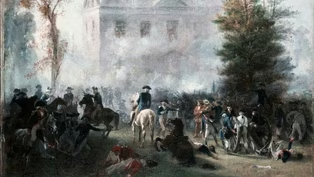
(shouting and cannon fire) - [Narrator] In the face of the advancing Americans, British Lieutenant Colonel Thomas Musgrave ordered half his regiment-- between 100 and 120 soldiers-- (shouting and gunfire) to duck inside the largest house in Germantown, the home of Benjamin Chew, the Loyalist ex-Chief Justice of Pennsylvania.
(heavy gunfire) Its walls were two feet thick.
(shouting and gunfire) Musgrave directed his men to block the door and ground floor windows with furniture.
(shuffling and cannons firing) Downstairs, his men were to bayonet anyone who dared try to enter, (muskets firing) while others fired into the passing rebels from the upstairs windows.
- [El-Amin] Most of the visual imagery are paintings, are, you know, engravings.
Um, they're not photographs, they're not something that you can just scan.
So, it took a lot of effort for us to... organize these photo shoots all around the world, essentially asking folks to open up their archives, their homes, their museums, to our crew to come in and photograph these pieces of art.
- [Schmidt] Washington in the very famous painting of "Washington Crossing the Delaware"-- in reality, it's the middle of a nor'easter on Christmas night, crossing the ice-clogged Delaware River.
And it's perfectly sunny.
(icy wind blowing) So it is not perfectly true, but it tells a story, and it's important that we include it at-- in, in its context-- because it is so important to the memory of the American Revolution.
(wind blowing) (horse whinnying) - [Narrator] The river was fast-running and filled with swirling, jagged pieces of floe ice.
(horse whinnying) Somehow, Colonel John Glover and his Massachusetts sailors from Marblehead, the same men who had rescued Washington's army after the Battle of Long Island and stopped the British advance following Kips Bay, (officer shouting) now managed to get all 2400 men, (sailors responding) some 50 horses and 18 fieldpieces across safely.
(wind blowing) (sailors calling in unison) John Greenwood was among the first to step ashore.
(frigid wind whistling) - [Botstein] Actually, one of the things that artistically and intellectually was surprising and rewarding, was how much you can look at the language and the imagination of the n- last 250 years to help tell the stories.
So, we ended up... working with contemporary watercolors that we commissioned for the show, thanks to beautiful watercolors that have been made for the Museum of the American Revolution and different books about the war-- and worked with those artists.
- [Narrator] Many of them began to see the British flag as a symbol of hope.
(sorrowful piano music) (horse whinnying) Like Lord Dunmore before him, Clinton was no abolitionist.
He decreed that any Black man captured while serving with the rebel army was to be sold as a slave, and the profit divided among his captors.
(sorrowful music continuing) The British commander's motives were exclusively military-- to strip rebels of their human property and assemble a big workforce to support his army.
(sorrowful music continuing) But for many Black Americans their war was about ending slavery-- for themselves, their children, and their children's children.
(sorrowful music fading) (whooshing sound) - [Announcer] With battles that covered such a large and disparate area, a wide variety of maps became essential to telling the story of the American Revolution.
- [Narrator] So-called Committees of Correspondence soon linked advocates of resistance in more than 100 Massachusetts towns and districts.
(gentle fiddle music) Eventually their network would spread into other colonies.
(gentle music continuing) - I love maps!
My dad got me into maps.
He built, I remember him building a map case when I was a kid-- and we have maps in our films-- this film has more maps than in all the other films I've spent the last nearly half-century making, put together.
- [Narrator] By the night of October 11th, the allies had begun digging a second parallel.
But before the noose could be tightened completely two enemy redoubts, numbers nine and ten, had to be taken.
(crickets chirping) (distant booming) The American target was Redoubt Number Ten.
The men were from Lafayette's force.
Alexander Hamilton was in command.
Joseph Plumb Martin and his company led the way.
(water flowing) (rumbling gunfire) - On this film, there is no question that the most complicated, most difficult, most onerous thing that we did was create nearly 100 maps.
There are three, three types of maps in the show.
The first are the documentary maps-- they're very beautiful, they're very telling, and they're really important.
So we brought in all the archival maps and we use them throughout the series.
And sometimes we put a red and a blue arrow.
A, Ken loves a red and blue arrow.
Any show we make, there's a war, you're gonna see red and blue.
(ominous percussion music) (vocalist humming) - [Atkinson] It's our... creation myth, our creation story.
(ominous music continuing) It tells us who we are, where we came from, uh, what our forbearers believed and, and-- and what they were willing to die for.
That's the most profound question any people can ask themselves.
- [Christopher Brown] I think the maps are so important to the film, and that will sound strange, because Americans know where Georgia is and we know where Massachusetts is, and we know where the Hudson River is.
But we know it in a 21st century sense, we don't know it in an 18th century sense.
So, I think one of the things that I really appreciate about the film is you get this sense of place, which is familiar and unfamiliar simultaneously.
(intriguing string music) - [Narrator] When Gage learned that rebels in the towns surrounding Boston had quietly begun to remove some of the precious gunpowder-- every town was allotted for its defense-- he sent 250 soldiers to the stone powder house in Charlestown to confiscate it.
(intriguing music continuing) Angry colonists saw the raid as yet another provocation.
- We worked with an incredible watercolor artist and graphic designer named Molly Schwartz, and her team.
We found an amazing cartographer, Charlie Frye, and over the course of two or three years, helped build an actual base layer of 18th century America.
And those maps are really beautiful.
I think there are more than 80 of them in the show.
And then we worked with a really interesting group of animators in London named 422, and we gave them a ton of the material that we'd shot, our live cinematography, the paintings of the time, sort of how we were visually thinking about the film and said, okay, bring us into icy Quebec and help us understand, from the beautiful maps at the time, the high ground, the low ground, the weather.
Where's Arnold coming from?
Where's Montgomery coming from?
What would it have been like to be fired on in that city?
(heavy gunfire) - [Narrator] The diversionary attacks fooled no one.
Arnold's men came under merciless fire from the ramparts above, (gunfire continuing) and the enemy had placed formidable barricades in their way.
(gunfire intensifying) When a ricocheting bullet fragment tore through Arnold's left leg, he had to be carried back to camp.
(gunfire) (distant shouting) Captain Daniel Morgan of Virginia took over.
(explosion) He managed to lead his men past one barricade, (shouting) (gunfire) only to be blocked by another.
(shouting intensifying) He tried four times to scale it, then decided to wait for Montgomery and his men to break through.
(gunfire) (plaintive string music) But Montgomery never made it.
(rush of wind) (explosion) - [Ruffe] For the Battle of Quebec, there are really incredible archival maps of that battle.
But in order to make them three-dimensional, and truly understand the difference between the Upper City and the Lower City, and why the battle ha- happened the way it did, you really-- seeing it three-dimensionally makes all the difference.
- [Burns] You suddenly realize, I have a tactile sense of the people that I've heard of that live there, the people that are fighting, and, and all of that.
It's, it's very exciting.
And one thing it tells you is that everywhere you look, there's a footprint of the American Revolution in these places.
If you're from New Jersey or South Carolina, this, this is happening every other step, uh, of your way.
Something took place there.
- [Announcer] When we return, we'll learn how George Washington's important legacy was handled by the filmmakers, and we'll get an insider's look at how the series was promoted at live events and in educational settings, as we continue with "The Making of 'The American Revolution.'"
(portentuous string music concluding) (whooshing sound) (pen scrawling) - [Announcer] Welcome back to "The Making of 'The American Revolution.'"
Coming up, we'll take a closer look at how George Washington's incomparable history is reflected throughout the series.
And we'll go on the road with the Florentine team to see how they present the film beyond the PBS broadcast.
But first, let's explore the impact the American Revolution had on many nations as a world event.
(musket fire) (distant shouting) - The American Revolution changed the world.
It's not just about the birth of the United States, it has ramifications across the globe.
(cannon firing) So, studying the American Revolution, understanding it and putting it in a global context, I think is vitally important for us to understand why we are where we are now.
- [Burns] You know, I think that our popular imagination gives us a sense that, oh, we were just chafing under taxes without representation.
True-- but this is a global war.
- And by the end of the war, it had touched many continents.
It had gone to India, Africa, Europe, the Caribbean.
- [Botstein] So much of the American Revolution was actually about Western expansion and land, and who was speculating about those lands, who owned those lands.
(fife and drum music) - [Kamensky] As a global war, the American Revolution continues the series of wars among empires for the prize of North America.
(fife and drum music continuing) Britain, Spain, France are all seeking some v- form of victory or advantage.
(distant arguing) (fierce wind blowing) But the beginning of 1778, the rebellious United States cause is at the thread end of its ability to continue to exist.
- One of the things I think is important about the American Revolution is that it's a really surprising story.
It was very unlikely that we were going to win.
It is a truly underdog story, and we also could not have won the war without our French allies.
(sedate chamber music) - [Christopher Brown] The history of the American Revolution is America's history.
Um, but it's actually the history-- it's Britain's history, it's, it's Europe's history, has profound i- consequences for the history of the Caribbean, which in the 18th century was, you know, i- incredibly powerful wealthy place for European empires.
(chamber music continuing) - [DuVal] The French decide to enter the war, and that changes everything for Britain.
Britain knows that Spain and the Netherlands may be next.
Suddenly, those 13 colonies that were rebelling are kind of the small potatoes of the war.
They could lose their profitable plantation islands.
They could lose Jamaica.
The stakes are big in this war, and the 13 colonies have become just a tiny corner of it.
- A lot of the changes that have taken place in the world are because of what happened in the American Revolution, which was about the future of the continent, among many other things.
- I think we do a disservice to ourselves and the nation by not appreciating how much the American Revolution was a world war and sat on the global stage, and everyone was watching about what was going to happen to North America.
- [Narrator] The American Revolution would be the opening signal for more than two centuries of revolution-- first in Europe... then in the Caribbean, South America, Asia and Africa.
(serene string music) - [Baer] The ideas are very powerful.
When they're talking about liberty, when they're talking about equality, when they're talking about opportunity, freedom from oppression... The American revolutionary movement served as a model for other societies and communities um, around the world.
- This is the most consequential event in world history for thousands of years.
And that's an important thing for Americans to understand, just how critical the Revolution is, not just to our story, but to the story of the world and the story of humankind.
(serene music fading) - [Announcer] If there's one figure who stands above all others in the American Revolution, it is George Washington.
(tense piano music) (distant shouting) - [Brolin as Washington] "Remember that you are free men, fighting for the blessings of liberty-- that slavery will be your portion and that of your posterity if you do not acquit yourselves like men."
(tense music continuing) (crickets chirping) - [Narrator] Washington knew an attack was coming somewhere, but he worried that the British landing on Long Island was merely a diversion.
And so, he divided his army.
- Josh Brolin, who is our voice of George Washington-- I went in and said, "This man is unknowable."
He's opaque, eh-- he just let a couple people into his life.
You know, maybe Lafayette, maybe Hamilton, certainly Martha, his wife.
But everybody else is sort of out there.
And yet he has a warmth and a generosity that inspires people.
He has got an ability to select other talents in other people and to trust them to do a j- good job.
- [Narrator] Washington spoke again.
(bittersweet fiddle music) - [Brolin as Washington] "My brave fellows, you have done all I asked you to do, and more than can reasonably be expected.
(bittersweet music continuing) But your country is at stake.
Your wives, your houses, and all that you hold dear.
(bittersweet music continuing) You have worn yourselves out with fatigue and hardships, but we know not how to spare you.
If you will consent to stay only one month longer, you will render that service to the cause of liberty and to your country, which you probably never can do under any other circumstances.
The present is emphatically the crisis which has to decide our destiny."
(bittersweet music continuing) - Here's someone who... was this extraordinary leader, right?
Was this really powerful... figure, who all of his peers looked up to.
But you also get in this film his doubts, his failures, his poor choices, his questionable morals.
All of that is there, too, because he's a human being.
(distant trumpet) - [Jasanoff] Our images of the American Revolution tend to be images of men in wigs in wood-paneled rooms, and that helps to reinforce an image of the American Revolution as just a war about ideals.
I think that we really do a disservice to... history and to the experiences of the people who lived through it, when we paper over the violence of the American Revolution with the set of very idealized images that we have of the Founding Fathers signing documents in Philadelphia.
(brooding percussion and string music) - You know, I think we've got a understandable protective interest.
We wanna take our heroes and not mess with them.
And the implication is that a hero is perfect.
Let me just say that Washington is deeply flawed.
He's rash-- he rides out on the battlefield, risking his life, and therefore the entire cause's, uh, life.
And he makes some really bad decisions on the battlefield.
(desolate orchestral music) - [Narrator] At least 200 Americans had been killed, and perhaps a thousand more were captured.
(desolate music continuing) Washington watched this final carnage through his spyglass.
By noon, it was all over.
(chilling sustained chord) The British believed they had won what one general called a "cheap and complete victory."
(chilling music continuing) - [Atkinson] Washington is heartbroken 'cause he recognizes instantly what a catastrophe this has been.
- [Burns] Without George Washington, we do not have a country.
There is no other person you can say that-- without Abraham Lincoln?
Maybe yes?
Without Franklin Roosevelt?
Maybe yes.
But, you know, that's once the country started.
We don't have a country without George Washington, without his leadership, as the historian Christopher Brown says.
(contemplative string music) - I don't know, actually.
I mean, I, I- you know, God- I can't believe I'm saying this, 'cause I'm not a huge fan of great man theories of history or explanations of history.
(bittersweet music continuing) But... let's put it this way, it's easy to see the American effort for independence failing, without Washington's leadership.
(bittersweet music fading) (wind blowing and fire crackling) - [Announcer] "The American Revolution" has created many educational opportunities beyond the broadcast, in the classroom and at public events.
(cheerful fiddle music) - Our mandate in public broadcasting is not just complete when the broadcast takes place.
- One of the reasons we love to work within the PBS universe is that our films live on in the classroom, first and foremost-- that our films broadcast and then teachers can use them.
- [Burns] PBS can reach every classroom in the country, I'm very happy to say.
Our films live in the classrooms.
It's very important to us.
We don't design them that way.
But once we can see the light at the end of our tunnel of editing, we're designing how we can work with teachers.
What kind of material-- what do they need?
Curriculum designers... And we're doing materials that they want and will be useful to them.
(cheerful music continuing) - [Announcer] In conjunction with various PBS affiliates and other organizations, special screenings all around the country helped launch the film, and the conversation about the American Revolution.
- Sarah and I were talking backstage-- and we've spent ten years working on this film.
Why are we showing clips?
It's done!
And so we've asked the ushers to lock the doors, and... (audience laughing) (audience member whooping) You will get a jump on all of your fellow citizens, and, uh, if we don't take any bathroom breaks we'll be out by 7:30 tomorrow morning.
(audience laughing and applauding) - What I've noticed most about the events that we've done in anticipation of the release of this project, is how much enthusiasm there is-- um, how much people are looking forward to hearing what Ken Burns, what Florentine has to say about the American Revolution.
- [Schmidt] One of the first places we took the film on the road was, was to Williamsburg, Virginia, where we played the film outside.
on the Palace Green, um, in front of over a thousand people.
And the, the fife and drum played and, um, fireworks went off.
(military drumming) (fireworks exploding) - [Botstein] It's Constitution Day, and we're here, talking to schoolchildren-- students, interested New Jersey-ites about the American Revolution.
It's part of a 50-city tour, as we bring the film to schools and communities around the country.
- I am very much hopeful that the interest in the American Revolution, from our film, and also from the 250th anniversary of the Declaration of Independence, and then subsequent anniversaries of much of the war will increase visitorship to places like Saratoga, to Williamsburg, to Yorktown, I think there's an awful lot to learn when you put your feet where they put their feet, and look at what they looked at-- see how much has changed, but also imagine what they saw in their time, as well.
- [Announcer] As we conclude our discussion of "The American Revolution," (pen scrawling) the team at Florentine Films assures us the Revolution is not over.
- [Danes as A. Adams] "Our government daily acquires strength and stability.
The union is complete.
(intense tribal percussion) Nothing hinders our being a very happy and prosperous people, Provided we have wisdom rightly to estimate our blessings... (intense percussion continuing) (vocalist humming) and hearts to improve them."
(humming intensifying) Abigail Adams.
- [El Amin] I... grew up on "The Civil War."
I grew up on "Jazz."
So, to be able to work for the company, which, you know, I've known all my life has been, you know, quite a... a, a privilege.
- Working at Florentine is nothing short of amazing.
You work with the most talented, smartest people in every discipline.
- [Reidy] That's Florentine.
You are working with the best of the best, and... it keeps you on your toes, and it, it keeps you wanting to do better.
- [Daniels as Jefferson] "And even should the cloud of barbarism and despotism again obscure the science and liberties of Europe, (percussion and humming continuing) this country remains to preserve and restore light and liberty to them.
(percussion and humming continuing) In short, the flames kindled on the 4th of July, 1776 have spread over too much of the globe to be extinguished by the feeble engines of despotism."
(percussion and humming intensifying) Thomas Jefferson.
- [Christopher Brown] I've been involved with Florentine now for, I guess, five years, I'm trying to figure out how I can remain involved with Florentine for the next 15, 20 years.
- At one point-- senior year of college-- people were asking me what I wanted to do, and I was like, "I don't know, I wanna tell history.
Maybe I could do documentary films, maybe I could work for Ken Burns, who knows?"
And I got lucky enough that that came true.
And I'm really, really, really grateful.
(percussion and humming continuing softly) - If you assume... that... the people we admire in the past are, are flawless people, (percussion and humming continuing softly) that means that we-- who are flawed, we all know we're flawed-- will never be able to match what they do.
But they were not flawless.
They were just like us.
And that means we can do great things.
And that's why I think history is important.
(percussion and humming intensifying) - [Norton as Rush] "The American war is over.
But this is far from being the case with the American Revolution.
(percussion and humming continuing) On the contrary, nothing but the first act of the great drama is closed.
It remains yet to establish and perfect our new forms of government.
(percussion and humming continuing) Patriots, come forward.
Your country demands your services.
Hear her proclaiming in sighs and groans-- in her governments, in her finances, in her trade, in her manufactures, (intense music continuing) (fireworks exploding) in her morals and in her manners.
The Revolution is not over."
(fireworks exploding) Benjamin Rush.
- [Botstein] We're still wrestling with... the great promise of America, and how to make that real.
The film opens with, I think, a really important quote, that sets the stage for what's at stake, and ends with, I think, a really important quote about... what the Revolution maybe still means.
- This story is as important in Anchorage, Alaska, and Honolulu, Hawaii, as it is in Boston, Massachusetts, where it was formatted, or Philadelphia, where i- the ideas were coalesced.
Everybody's got a stake because it's a war of ideas.
And saying we have a better idea, and we believe firmly that if we create this new entity, called citizens, and they live a virtuous life and pursue happiness-- happiness is not the pursuit of objects in a marketplace of things, but lifelong learning in a marketplace of ideas-- it sounds an awful lot like PBS.
Um... We could be worthy of the great responsibility and privilege of citizenship.
(distant cheering) - [Narrator] John Adams, the first vice president, thought the chief executive should have a royal, or at least a princely title.
(sedate orchestral music) But for Washington, "President of the United States" was honor enough.
(sedate music continuing) And when he left the presidency in 1797, King George, himself, paid tribute.
By surrendering first his military and then his political power, he said, George Washington had made himself "the greatest character of the age."
(sedate music fading) (whooshing sound) (pen scrawling) - [Announcer] Thank you for joining us for an inside look at "The Making of 'The American Revolution.'"
(gentle string music fading) (traditional fiddle music) (fiddle music concluding and fading)
Video has Closed Captions
Go behind the scenes with Ken Burns and the filmmaking team to learn about making the series. (30s)
Providing Support for PBS.org
Learn Moreabout PBS online sponsorship












Support for PBS provided by: