
Oct. 27, 2025 - Full Show
10/27/2025 | 26m 46sVideo has Closed Captions
Watch the full Oct. 27, 2025, episode of "Chicago Tonight."
What to know about a court-ordered study on how Chicago police officers are being deployed. And a look at how local law enforcement is responding to federal agents in the city.
Problems playing video? | Closed Captioning Feedback
Problems playing video? | Closed Captioning Feedback
Chicago Tonight is a local public television program presented by WTTW
WTTW video streaming support provided by members and sponsors.
Oct. 27, 2025 - Full Show
10/27/2025 | 26m 46sVideo has Closed Captions
What to know about a court-ordered study on how Chicago police officers are being deployed. And a look at how local law enforcement is responding to federal agents in the city.
Problems playing video? | Closed Captioning Feedback
How to Watch Chicago Tonight
Chicago Tonight is available to stream on pbs.org and the free PBS App, available on iPhone, Apple TV, Android TV, Android smartphones, Amazon Fire TV, Amazon Fire Tablet, Roku, Samsung Smart TV, and Vizio.

WTTW News Explains
In this Emmy Award-winning series, WTTW News tackles your questions — big and small — about life in the Chicago area. Our video animations guide you through local government, city history, public utilities and everything in between.Providing Support for PBS.org
Learn Moreabout PBS online sponsorship>> thanks for joining us for this W T Tw News.
Special Brandis Friedman.
And tonight we're focusing on local policing.
Officials say a court-ordered study on how police officers are being deployed deployed in Chicago is nearly complete.
The latest on that and see efforts fight with the federal consent decree.
Plus, how local law enforcement is responding to the ramped up presence federal agents in the city and the possibility of National Guard troops being deployed to Chicago streets.
>> Becoming and remaining a stage or every city has been a bit of mayoral tug of war.
>> And amid ramped up immigration enforcement, a look at how Chicago became a sanctuary city and what that actually means.
>> And we'll get our focus on police and policing in just a moment.
But first off tonight, Indiana's governor is calling for a special session to redraw the state's congressional districts in the latest national battle over redistricting, Republican Governor Mike Braun wants the state's lawmakers to convene a special session in an effort to redraw congressional boundaries in favor of Republicans.
But Republican lawmakers in Indiana may not be sold on the plan with some warning.
It could backfire politically.
Democrats can't stop the special session by refusing to attend as lawmakers in Texas had because Republicans hold a super majority in both chambers.
The special session in Indiana would begin November 3rd, Democrats in Virginia are also considering read are redrawing districts.
A tactical team of Chicago police officers have racked up more than 50 complaints about traffic stops and searches.
According to a document obtained by W T Tw News, the letter from the Civilian Office of Police Accountability or Copa his address to the commander of CPD near North Police District, which includes neighborhoods like Lincoln Park River North and West Town in it Cope was chief of investigations says, quote, first over 90% of the complaints that Copa examined involved, the stop of black individuals, despite the fact that black residents comprise only 6% of the population of the 18th district, while Copa recognizes that some of the street stops in traffic stops may have been justified in their totality.
The racial disparity in the stops may be indicative of implicit bias and or racial profiling.
The police department says 4 of the tactical team officers named in the letter had been stripped of their police powers.
And to learn more about the legal impact of this letter, please visit our website.
Candidates for public office were up early this morning, filing petitions to snag the coveted first spot on the ballot in their respective races.
And voters may see a lengthy ballot for the March 17th primary.
>> We have a very unique amount of interest in so many different positions.
If you look at at the ballot composition, whether the filing in Springfield today, whether the filing here or whether filing and other counties you have a number of U.S.
Congress seats that are just going to draw a lot of attention.
We've got to U.S.
Senate race that's going to be highly contested.
>> In Springfield, candidates for statewide election, what Congress and the governor's race lined up to submit the required petitions and at the Cook County Clerk's Office candidates submitted for races like president of the Cook County Board as well as sheriff treasurer and other offices, folks who submitted today will enter a lottery to be first on the ballot.
The deadline for submissions is 05:00PM November.
3rd, after that age old process of challenging petitions.
Up next, the latest on how the Chicago Police Department is progressing on compliance with the federal reform order right after this.
>> W T Tw News coverage of policing and police reform is supported by the Joyce Foundation.
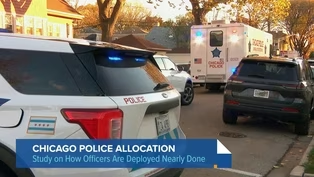
>> A long-awaited study on whether Chicago police officers are efficiently and effectively deployed across the city to stop crime and respond to calls for help is nearly complete.
It is part of Chicago's ongoing efforts to comply with the federal court order known as the consent decree that requires the Chicago Police Department to change the way it trains supervises and disciplines officers.
Our Heather Sharon joins us now with the latest.
So, Heather, when will we see the results of this study, which you reported is very crucial to efforts to comply with the consent degree?
Well, it is set to be completed on time by the end of the year and the public should be able to see the results by January.
At the latest now, city officials and police leaders are hopeful that this study is going to give them a roadmap to one of the central requirements of the consent decree which requires officers to not only work with members of neighborhoods to fight and prevent crime, but also ensure that officers routinely patrolled the same part of the city and reported to the same supervisors on a consistent basis that will go a long way towards fulfilling the hundreds of requirements of the consent decree.
And there are many so during a recent meeting, Chicago Police Superintendent Larry Snelling.
He said the study will help determine whether Chicagoans are quote, getting enough bang for their buck.
What do you Well, the Chicago Police Department's budget is set to swell to 2.1 billion dollars in 2026.
And to put that in context, that is a full 3rd of every discretionary dollar that the city council has at its disposal.
Now, Mayor Brandon Johnson has said that CPD must transform into a new kind of police department.
One that focuses on the root causes of crime like poverty and mental illness and less so on law enforcement to do that.
He says there should be more non sworn positions in the department.
Civilians should work for Cpt and to do that.
This crew, we'll say exactly what makes sense and what does when was the last time CPD completed a workforce allocation study?
It has been 15 because this is one of the 3rd rails of Chicago politics because police deployment is a 0 sum game.
You can put one officer for a certain amount of time in one part of the city and no city council member wants to vote for something that will reduce police resources in their neck of the which makes it very hard for anybody recommend moving police officers from one part of the city to another part of the city.
Even though we know most of the violent crime in the city happens on the south and the west.
That's the independent monitoring team, which is, of course, the eyes and the ears of the federal judge overseeing this reform effort.
They are out with their latest report on efforts to comply with the consent decree.
>> Where things stand now?
Cpd has fully complied with 22% of the consent decree.
>> Now this workforce allocation study.
We should have the results shortly before the consent decree celebrates its 7th birthday.
Commissioner Room, thanks so much.
Thanks.
Brandis.
And you can his full story on our website is all at W T Tw Dot com Slash news.
>> Chicago tonight is made possible in part why the Alexander and John Nichols family.
The gym and K maybe family.
The Pope Brothers Foundation.
And the support of these.
Don't >> The Trump administration's aggressive immigration enforcement in the city is sparking a number of legal battles.
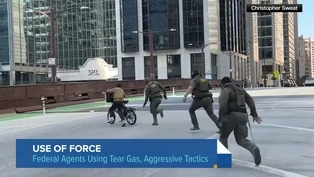
Border Patrol Chief Greg Bovino is heading to court tomorrow amid accusations of using tear gas without justification during a raid in Little village last week, local law enforcement is also caught in the mix as they respond to clashes between protesters and federal agents.
Sometimes themselves getting hurt in the process.
And as the Supreme Court is set to weigh in on a potential National Guard deployment here, some worry about blurring the line between federal law enforcement and local police authority.
Joining us now to discuss it all are David Franklin, associate professor of law at DePaul University.
Franklin currently teaches constitutional law and was a clerk to Supreme Court Justice Ruth Bader Ginsburg and Mitchell Davis, chief of police in south suburban Hazel Crest.
He has served in leadership roles with many policing organizations, including the Illinois Association Association of Chiefs of Police and is a member of the Illinois Law Enforcement Training and standards Board.
We also invited representatives of the Illinois State Police Cook County Sheriff and the Chicago Police Department join us.
But they've all declined.
Gentleman.
I think the 2 of you for joining us.
Chief Michel starting with use, we've seen federal agents deploying tear gas on people protesting raids.
Some Chicago police officers have also been exposed like and that I spree that happened down the East side neighborhood earlier this month.
What do you make of some of the tactics in the operations and how they've escalated?
>> Thanks, Fred, is for having What's going on local law enforcement is getting caught in the middle.
What's happening with federal agencies?
We work collaboratively every day with our federal partners throughout the nation and what the ice enforcement is going on now, those are federal issues and we don't have any jurisdiction over those issues.
But we are also responsible not allowing for federal agents to be harmed by no matter how we we might feel about it.
the Chicago police officers that you saw being tear gas along with the demonstrators an example almost a worst-case scenario, putting us in the middle of something that we have no jurisdiction over.
We're not initiating anything.
We're not participating.
But at the same time we get dragged into a fight that we didn't start.
>> to that point, you know, I think some supporters of ice and in the administration would say that those protesters are are acting aggressively themselves.
They're throwing something at at the agents or getting too close as the agents are trying to do their jobs.
>> Due to local police today have any authority or jurisdiction to challenge any of these federal operations.
>> No, ma'am, we do These are once immigration is not a state issue is a federal issue and that they are carrying out what they've been instructed to do it wants to get presents challenges in that it's not collaborative effort.
That's challenge that we have.
I can't imagine any off or summit leader that would turn down help that is properly done.
But it's not being properly It We have immigrants or anyone this in our community, this wreaking havoc for this breaking the law.
This causing problems in our community.
If we if they came to us and say, hey, chief Davis was going on in your towns, how can we help in?
Are there people in your town that we can possibly use these federal laws to get them out of the community and out of the country?
Well, I wouldn't choose to deal with, but that's not what's going on.
You know, that are coming at collaborating with And it once again is putting us into the middle of something that truly not start.
>> David Franklin, same question about whether local police have any authority or jurisdiction.
For example, there is the court order that requires them to announce that they're about to deploy tear gas, some of the videos which suggests they are not doing that before.
doing it on and then therefore police officers themselves get exposed.
There's also the city's executive order that they're not supposed to use any city property.
>> But local police can't really enforce any of those.
>> Yeah, so I mean, it's a general matter constitutionally speaking, federal officers are not limited by state law.
There's a clause in the Constitution called the Supremacy Clause that says federal law is supreme over state law and that's been interpreted for a very long time to mean that basically with a few exceptions, the states are not allowed to limit or regulate what federal officers do.
However.
Federal officers are still bound by federal law, including the Constitution.
So there's a First Amendment that protects freedom of speech.
There's a 4th Amendment that bars the use of excessive force and those can be the basis for court orders like the one you mentioned concerning the use of tear gas or pepper spray on peaceful protesters.
>> Chief Michel, local law enforcement agencies.
As you said, you know, you will typically when you're working with federal law enforcement partners like FBI or alcohol, Tobacco and there's some coordination.
How does that coordination work?
>> Primarily most of the times, especially in our area, but throughout the country as well.
We have task forces.
So we partners have people assigned to task forces and oftentimes they're assigned task force 20 full-time.
And then there are some task forces is activation standpoint and even if we're working on individual investigations, kind of lead and to lead over into some of the areas that federal officers are X percent will reach out to them for their assistance.
And we have always not just he's a freshman, all local law enforcement is always has a tremendous partnerships with those federal organizations.
>> David Franklin, Trump administration, they are agreeing to this 30 day extension of the temporary restraining order that blocks the deployment of National Guard troops from both Illinois and Texas into the city were still waiting, as we mentioned for the Supreme Court to weigh on that as the Justice Department has requested, what is the constitutional rationale that the administration is using for the industry?
>> Well, you know, let me just say, first of all, the situation that we have here with the president ordering are trying to order troops into American cities is not normal.
It's not acceptable.
We have a long constitutional tradition in this country of keeping troops out of the business of domestic enforcement.
And as I mentioned, we have a First Amendment that protects peaceful protest.
So the legal rationale such as it is, is that there are federal statutes that authorize the president to call up and federalize state national guards.
But he has to meet certain factual threshold before he can do that.
So the president has to show, for example, that he is incapable of enforcing federal law without the presence of the National Guard and what the district judge here in Chicago held and what the 7th Circuit Court of Appeals affirmed, including Trump appointed judge and a George W George HW Bush appointed judge.
Was that the president simply had not met that factual predicate.
There is not a situation right now in Chicago that renders the federal officials, you know, unable or incapable of enforcing federal law.
But as this, you know, what we're seeing in the streets continues to sort of escalate.
>> Could the administration not make the case to the Supreme Court?
I mean, I doubt there will be a hearing, but in their in their documentation of their arguments the Supreme Court, not look at the situation say actually, this is difficult federal agents to enforce.
Well, that's what I'm afraid.
The Supreme Court is going to do.
You know, it is a problem of the Trump administration's own making.
>> But that's their strategy, right?
They want to provoke they they they want to inflame and then they want to look at that and say, see, we've got a situation here where were incapable of enforcing federal law or even call it a rebellion insurrection or an invasion if used all of those words.
But they're all false.
But but I'm afraid that the Supreme Court, very same Supreme Court gave President Trump effectively total immunity from criminal prosecution might well give him a blank check.
You know, total deference to his factual findings as the predicate bringing in the National Guard in a situation like Chief Michel, what are some of the concerns with have go ahead within?
But having National Guard troops on the ground?
>> Absolutely.
And I go back to it again.
It's initially when we do that, we really don't.
We're not sure.
I know that the attorney just mention one means.
But initially it was said that we're bringing National Guard into figure it a crime to help with crime.
Well, once again, if someone wants to give us help.
So so, you know, the first national vice president of an organization called National Organization of Black Law Enforcement executives and Nation.
Why we're not turning away help as once again.
Let's do it.
Constructively.
If you come into Somebodys First of National Guard.
They're not police officers know that they're not law enforcement training, but they could help us in some Let's collaborate where you have problem areas, where can we use some extra bodies?
And we tell them strategically this is what we need.
The assistance in this.
How most effectively be Don't just send folks see without having a plan.
And that puts us now behind the 8 ball when we are not lab or not most effectively using the help that's being provided to us by the federal government.
>> Chief, you know, you know, as we're looking at some of this video, right?
But we're we're talking about the Illinois State Police, for example, are assisting in Broadview, but just region-wide, you know, we've got multiple law enforcement agencies that work here at state police, Cook County Sheriff Municipal Police.
You've got CPD in the suburbs.
You've got municipal police there.
And then you've got the deployment of all these federal agencies with or without coordination with folks on the ground.
Could there be a case of too many cooks in the kitchen?
>> They're absolutely could You know, let's let's not also forget the disruption that happens with the community.
Trust local law enforcement Weaver caught.
We challenge is what we've worked so hard to build trust within our communities.
And now you have people who are coming in their mask.
They're coming in.
oftentimes they had not identified was a person or agency and they come in and they disrupt things and then they leave to deal with the aftermath.
And then, you know, are national president for normal has mentioned in the past that, you know, communities of color had to deal with this some time ago.
But is that a company with mask on it why do that?
And they came in taking people and now it's happening in a new era and we've got to be cautious about what we're doing.
>> David Franklin, you know, we've gotten multiple jurisdictions happening here.
What same question to you sort of, you know, what sort of complications are we talking about when trying to go about, you know, a federal deployments, the way the president says is attempting.
>> Well, I think it's clear that the the president doesn't really care about law enforcement.
He is switching his rationale from immigration to crime control back to immigration as the needs of the new cycle sued him.
But this is a president who is the 34 time convicted felon.
Who doesn't seem to care about the criminal laws that are being violated by, for example, the protesters on January 6th who he gave blanket pardons to.
Right.
So he's perfectly content to pardon protesters who attacked police.
And I'm sure if it came to it, he would give pardons to police who attacked protesters.
If the protesters opposed So, yes, I think the situation where you have multiple jurisdictions on the ground.
Is the situation of chaos that's been brought to us because of the Trump administration's policy, not in spite of Im in the Trump administration.
The in a press release today from Department of Homeland Security there making the case that they have removed more than half a million immigrants.
They're referring to them as illegal aliens.
And we heard how upset Mayor Johnson got over the use of that term over the weekend.
>> But some 527,000 deportations, including another 1.5 million people who have voluntarily self deported so that Trump administration is making the case that what they're doing is working and meeting the president's a mandate.
Governor Pritzker and we've got 30 seconds.
He's created a commission to document what he says or all of these abuses by federal immigration agents.
Could this actually be useful in the future?
Oh, absolutely.
I think if people making videos of people are pulling out their phones and >> documenting what's going on, all of that can be used as evidence in court and in the court of public opinion took really try to rally people around the notion that this is an American.
It's not normal and it's not acceptable, OK, that's where we'll have to leave history still in the making.
Of course, David Franklin and Chief.
>> Mitchell Davis, thanks to both for joining us.
Thank you.
>> Up next, a reminder about what it means to be a sanctuary city and how that affects law enforcement.
As the federal operation Midway Blitz continues.
The conflict between local laws and federal priorities have been front and center.
One particular issue that has been at the forefront Chicago status as a so-called sanctuary city.
But how exactly did Chicago become a sanctuary city?
And what exactly does it mean?
Hardaway Hernandez explores the topic in tonight's edition of WT TW News explains.
>> for decades, Chicago has held the designation of a state city.
But what does it mean and how has Chicago status indoors, the term sanctuary city reverse any jurisdiction that discourages limits or denies cooperation with federal immigration authorities.
There are currently hundreds of same communities in America and 13 same jury states.
Where did they come from while Berkeley, California claimed the title of first same jury city in 1971.
The sanctuary city movement really began popping up across the country in the Mid 1980's as President Reagan focused on identifying and deporting undocumented immigrants, churches opened their doors to provide shelter in resources for Central Americans fleeing civil war and violence in Chicago becoming and remaining a stranger.
Every city has been a bit of mayoral tug of Mayor Harold Washington first declared Chicago a stranger every city in 1985.
Via executive order.
>> The order prohibited police and city employees from questioning residents about their immigration status and terminated cooperation with federal immigration authorities.
Some argued the policy shielded convicted criminals from deportation.
And in the 1990's, Mayor Richard Daley interpreted the policy to allow city officials to provide immigration information to the Fed's the subjects were involved in serious crimes, Chicago, same tree policies when from executive order to a strong law with the 2006 welcoming city ordinance in 2012 Mayor Rahm Emanuel in the city council weaken the law, allowing police to work with federal officials in limited cases reflection you 2016 President Donald Trump threatened century cities with the last of federal dollars.
Nevertheless, Chicago City Council voted to reaffirm ordinance.
Mayor Lori Lightfoot an expanded welcoming ordinance close the loopholes open by Daley and Emanuel banning all police cooperation with federal immigration authorities.
Chicago enters its 40th year as the same tree City Mayor Brandon Johnson has reaffirmed Chicago's commitment.
And today thousands of refugees and undocumented immigrants have found a safe haven in Chicago.
A point of pride for those who believe offering sanctuary is a matter of human rights.
The point of consternation for those see it as a hurdle for law enforcement.
And clearly things have gotten even more complicated here on the ground since we produce that video.
>> You can find the rest of our Emmy Award-winning W T Tw News explains series on our website.
And that is our show for this Monday night.
Be sure to sign up for our free e-mail newsletters, the Daily Chicago in and urban Nature at W T Tw Dot Com Slash newsletter and join us tomorrow night at 5, 30 10 religious leaders from different faiths come together to talk about the issue of immigration enforcement.
Now for all of us here at Chicago Brandis Friedman, thank you for watching.
Stay healthy and safe and have a good night.
>> Closed caption News made possible by Robert Eclipse and Clifford offices, a personal
How Local Law Enforcement Is Reacting to Feds in the City
Video has Closed Captions
Clip: 10/27/2025 | 13m 16s | Federal agents from ICE and Border Patrol have been using increasingly aggressive tactics. (13m 16s)
A Required CPD Study on Officer Deployment is Nearly Complete: Officials
Video has Closed Captions
Clip: 10/27/2025 | 3m 18s | The long-awaited study examines whether Chicago officers are efficiently and effectively deployed. (3m 18s)
Providing Support for PBS.org
Learn Moreabout PBS online sponsorship
- News and Public Affairs

Top journalists deliver compelling original analysis of the hour's headlines.

- News and Public Affairs

FRONTLINE is investigative journalism that questions, explains and changes our world.












Support for PBS provided by:
Chicago Tonight is a local public television program presented by WTTW
WTTW video streaming support provided by members and sponsors.