
Nov. 10, 2025 - Full Show
11/10/2025 | 26m 47sVideo has Closed Captions
Watch the Nov. 10, 2025, episode of "Chicago Tonight."
What a potential end to the government shutdown could mean for air travel. And a controversial bill allowing terminally ill people to end their lives heads to the governor.
Problems playing video? | Closed Captioning Feedback
Problems playing video? | Closed Captioning Feedback
Chicago Tonight is a local public television program presented by WTTW
WTTW video streaming support provided by members and sponsors.
Nov. 10, 2025 - Full Show
11/10/2025 | 26m 47sVideo has Closed Captions
What a potential end to the government shutdown could mean for air travel. And a controversial bill allowing terminally ill people to end their lives heads to the governor.
Problems playing video? | Closed Captioning Feedback
How to Watch Chicago Tonight
Chicago Tonight is available to stream on pbs.org and the free PBS App, available on iPhone, Apple TV, Android TV, Android smartphones, Amazon Fire TV, Amazon Fire Tablet, Roku, Samsung Smart TV, and Vizio.

WTTW News Explains
In this Emmy Award-winning series, WTTW News tackles your questions — big and small — about life in the Chicago area. Our video animations guide you through local government, city history, public utilities and everything in between.Providing Support for PBS.org
Learn Moreabout PBS online sponsorship>> Hello and thanks for joining us on Chicago tonight.
I'm Brandis Friedman.
Here's what we're looking at.
And into the government shutdown may finally be in sight, but flight cancellations could drag We explore why.
A controversial bill allowing people who are terminally ill to end their lives.
Heads to Governor Pritzker's desk.
We hear from groups on both sides of the issue.
>> Airmass hits starts to cool again.
William O Lake effect Snow.
>> And we got our first taste of winter this morning.
But what exactly is lake effect?
Snow?
We explain.
>> First off tonight, the federal government shutdown may be coming to an end.
Senators are expected to begin a series of votes tonight to reopen the government.
But Illinois senators are divided on the proposed compromise last night, Senator Durbin was one of 8 Democrats that voted to advance the measure that would extend government funding until January.
30th.
It also restores full funding for the Supplemental Nutrition Assistance Program or SNAP through September 2026. the bill also reverses the mass firings of federal workers by the Trump administration since the shutdown began and gave workers back pay.
However, the agreement notably does not address the expiring health care tax credits besides promising a future Senate vote on the issue, sparking pushback from many, many Democrats, including Senator Tammy Duckworth from Illinois.
For more on the government shutdown deal and statements from both of Illinois centers.
Check out our Web site.
The federal immigration agents say they came under fire over the weekend while conducting a raid in Little Village.
Mayor Brandon Johnson says he has questions.
>> We don't have much information of this particular incident.
Unfortunately.
The veto and his team have.
Absolutely no credibility.
Because of the repeated lies both to the courts and to the public.
So we have no way to verify the reports.
>> Johnson says federal authorities are investigating the incident, but he still faults the federal government for inciting chaos and put in Chicago police officers between them and frustrated protesters.
In the city of Chicago is already making big plans for New Year's >> For the first time in its 50 year history, Clark's New Year's Rockin Eve celebration is including a live countdown to midnight from a central time zone from downtown Chicago.
The show will also go live from New York City's Times Square as it has every year for the last 55 years.
In addition to having a Spanish language live broadcast from Puerto Rico City says more details are on the way.
Up next, travel has taken a hit during the government shutdown.
Could things be returning to normal soon?
Find out right after this.
>> Chicago tonight is made possible in part why the Alexandra and John Nichols family.
The gym and K maybe family.
The Pope Brothers Foundation.
And the support of these.
Don't >> The historically long government shutdown may finally be coming to an end.
Senators are expected to vote tonight on the bipartisan compromise before going to house part of what apply pressure on lawmakers to strike a deal was the cancellation of thousands of flights at major airports as air traffic controllers were going unpaid along with other federal workers.
But even within into the shutdown, insight aired travel may still be turbulent amid an ongoing shortage of air traffic controllers.
Joining us now are in Joseph Show for a civil engineering professor at Northwestern University.
Robert Mark, a retired pilot, former air traffic controller and publisher of the aviation blog Jet Wind and Darrell English.
Tsa officer at Midway Airport and president of the American Federation of Government Employees, local 7.77, union representing TSA agents in Illinois and Wisconsin.
Gentleman.
Welcome and thanks to all of you for joining us.
Robert Robert Market want to start with you.
President Trump, he took to social media to criticize the number of air traffic controllers who have been missing work some protesting the shutdown.
Others picking up second jobs because they need to make ends meet.
They've been going for a while without a paycheck.
The president wrote, quote, for those that did nothing but complain and took time off, even though everyone knew they would be paid in full shortly into the future.
I am not happy with you.
You didn't step up to help the USA.
Robert is this is reasonable to extend expect air traffic controllers to work without indefinitely.
Thank you, >> So I mean, I I meant that sarcastically I think president said parental at that point and he has never worked in a job like this.
And the these people have been struggling to pay their bills and he has no idea what it's like for someone to work.
6 day week, 6 day weeks, 10 hour days and still have to try to find time for another job.
Driving an Uber delivering things in order to pay the bills.
>> Darrell 7 Senate Democrats, one independent senator.
They all joined Republicans in passing a continuing resolution to fund the government or agreeing on a continuing resolution to fund the government.
That's, of course, a major step towards ending the shutdown, women and possibly insight.
What has the shutdown been like for you as a TSA officer and for your co-workers at O'Hare and Midway airports?
>> Well, for officers our local most, this has been very fatiguing, very troubling.
These officers have through all over a month without a pay sacrificed their livelihoods, but their cells in jeopardy.
As far as Bill collections.
So to see this possibly come to order.
And it's something that, you know, we are looking forward to, but they have also a ticket themselves to to make sure that flying public is secure as possible.
>> Have you heard from any members who have said, you know, I'm going to have to have to cut a cut out of work for a little bit that I can go find other work because I need to earn a paycheck.
>> Yes, we've got officers that taking on second jobs to fund second jobs, additional type work.
We have also is also have officers that resigned because they could not continue the process of not being paid.
There's a lot of things that the officers are going through it's that they have continued to be faithful to making sure that the traveling public, it's a cure.
But needless to say, these officers sacrifice a lot and willing to continue to sacrifice, but they have gone through a lot to make sure that public is secure.
>> Joseph last week, Transportation Secretary Sean Duffy announced a temporary 10% reduction in flights.
What does that mean in practice?
>> But it means is that a lot of people are not going to be able to make the trips that they plan to take.
I think there's a there are a couple of parts to this.
One is the massive uncertainty.
presents to people traveling difficulty in finding another option, which means either not traveling traveling at a different time.
traveling on a different mode, which in the United States for trips over 500 miles is is unlikely.
It's really impossible on that.
The uncertainty is important.
I think one thing that we don't talk about much is in addition to the several 1000 flights that are canceled, flight delays are very considerably.
So he report, for example, this this afternoon had a 2 and a hour, a ground stop, which means all inbound aircraft or held at their at their origin for safety.
And really what's happening is we're trying to reduce were cared for the real meaning.
Air traffic controller said is moderate the number of flights that they have to per per hour.
And that means delays.
And that means cancellations.
>> I would imagine airport here with a two-hour groundstop that's going to create ripple effects across across the sector in this country.
Does show for if the government does reopen in the next few days, will airports be able to resume business as usual or will it take some time to to literally get back some to it's going to take some time because because >> do you what you're really saying is what we will pay you, but we're not going to pay you instantly.
So people are in this in the same situation.
live in a week that they were last week.
So that will take some time for people to respond and to rebuild the capacity I think one of the things that we need to keep in mind is the overall ATC system is not particularly resilient because they've been understaffed for years and then under technology for for years.
And we've let that go.
So this is a listen.
It really was case of the crisis that gives us an opportunity to rethink the system and building some resilience in the long term.
No relief crazy situation like this.
But also for weather disasters.
Yeah.
And to that point, you know, as you said, the FAA is short about 3,000 air traffic controllers, many working with outdated technology.
>> Robert, the shutdown has put a spotlight on this problem and the need for reforming the air traffic control system is Joseph just said potentially moving it outside the federal, a shunt Federal Aviation administration altogether or privatizing it.
What do you make of those possibilities?
>> I think the FAA, if it were listening to I would say please don't don't try to do too many things at one time.
Let's let's get this shutdown figured out.
Get the controllers back to work in a way that they get paid and keep training new people and worry about the system under which ship FAA operate air traffic control system figured out a little bit later.
>> Darrell, even if the House does sign off on the Senate's deal deal to reopen the government, that funding only carries through January.
Howard TSA agents feeling about their job security with the threat of another shutdown possibly looming in January.
>> Well, it's going to weigh heavily on their minds because even though let say it, they made it a government that open up.
They still be concerned about closing back down later or so.
That's going to limit them from being able to move forward or maybe taking trips paid for certain things.
They're going to basically try to compare himself were to happen again and again, lot of questions that themselves into full limit do or what that whether they will continue work threat with TSA possibly move to somewhere else where there's more state.
>> Robert, the National Air Traffic Controllers Association, largest union representing air traffic controllers been calling for legislators in Washington, both Democrat and Republican, of course, too resolve the shutdown.
They've been calling for this for weeks.
How would you describe the relationship between the controllers and government officials?
>> I think the relationship is always was stressed it it has been for many, many decades.
Going back to the controllers strike back in 1981 system never really recovered from that.
And it's been it's been getting a lot of good inches along here.
And there until there's some weather There's a technology failure and then it it becomes front page headline.
But there it's him again the I think the controllers union doing the best that it can work with the administration because they want to see these people get paid.
>> I'm sure they do.
Okay.
Well, fingers crossed whatever, whatever may come out of out of Washington that the skies are still safe.
That is where we'll have to leave it.
Gentlemen, thank you for joining us.
Joseph Show for Robert marking Darrell English.
>> Thank you.
Thank you.
>> Up next, a controversial bill allowing people who are terminally ill to end their lives.
Both sides of the debate share their thoughts.
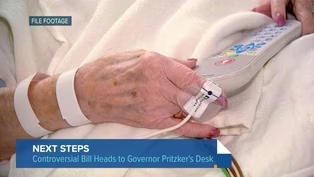
Terminally ill people in Illinois may soon be able to end their lives with medical assistance.
State lawmakers recently passed the controversial medical aid in dying bill, but now heads to the governor's desk.
Supporters of the measure say it gives those who are already dying a compassionate way to go.
But opponents say the measure would worsen longstanding health care disparities, particularly for individuals with disabilities and people who live below the poverty line.
Joining us now with more on the bill are Bennett, the director of advocacy and intergovernmental affairs at the American Civil Liberties Union of Illinois and Amber Smock, vice president of advocacy at Access Living.
Thanks to both for joining us.
So starting with you, this bill has passed both houses in the General Assembly.
Governor Pritzker says that he is considering it.
He's reviewing before signing it into law.
We're not signing it into law.
>> Why do you think this law is needed?
>> It's needed because of people like dead with this bill is named after people who are terminal 6 months or less to live who want to live.
But they know that they're going to die.
There are people who've tried every kind of clinical treatment trial and they know that at some point they're going to die.
pretty painful death.
So this will bring Illinois in line with 10 other 11 other states and the District of Columbia to add another end of life option for people who are terminal and briefly, you named dead for whom this law's who is dead.
So Deb Robertson, she an advocate who's been working on the spill, sit in the last year and a half 2 years.
She's somebody who was diagnosed with a pretty rare form of cancer and it's been her mission to make sure that this bill becomes a law Illinois.
And, you know, as of right now, we don't know if that will make it to when this bill is signed it to 9 months before it goes into effect.
But it's so important for her because one of the things she worries about in and the networks that she's a part of with other people this kind of cancer is the knowledge that at the end, it is very, very painful.
There's no kind of medical breakthrough.
Pain is something that is real and this would give her a peace of mind knowing that this could be an option.
>> Amber, your group, though, you all have said that this bill would hurt those with disabilities.
People who are lacking health care access.
How so so.
>> Right now something like 82% positions actually have reported that they'd go people with significant disabilities as having to a quality of life a good deal of this bill's discussion is about whether or not people having quality of life.
Now the bill was technically designed to.
So people who have 6 months or to that.
The problem with that is that you put a casing a bill on something that is actually not viable.
Medical diagnosis of having 6 months or that's of actually not good.
A predictor to what will actually happen to people are plenty of people to pass a diagnosis, put new people that the you know, but best time to that.
What we're trying to get a class for people with disabilities is that?
To say it got it?
Yeah.
Yeah.
trying to get across for people with disabilities just out.
We really don't know.
The day-to-day existence of tape, a client what we are, what we deal with when we go to the doctor.
So when I say that, go to doctor can't know for sure if your doctor is going to give the best possible recommendation because maybe a doctor actually has a disability problem.
How can you count on that being really health care right now?
This bill is offering suicide as a health care measure, the metal thinking about because that's help cope.
Can just say I think for people like dead who've talked about what option would mean for them, they're very clear that this is not suicide.
These are people who want to live and you know that they're going to die.
>> They're part of her doing every single clinical trials because she really wants to live.
But, you know, set the end is going to happen and she wants that control.
And we see this is a type of bodily autonomy.
People who are facing a terminal illness should have the right to make the best decision for them.
And for some people that may mean using medical aid in dying and for some people, just the idea that they have access to this medication can be all that the need for them to feel comfortable at the end and for people with disabilities, that kind of choice just doesn't actually exist.
>> So a lot of people do want to be certain about that at the end of their life, they want to know what's going to happen with them.
But for a lot of people with disabilities, choice on how to live their lives is actually a day by day process.
Right now, though, a lot of people who don't actually experience real choice because there's so much out of the 5 that is outside the control.
They may not have access to housing.
They might not have access home and community-based services.
They may not have access to pain medication.
Those are the things that we should looking at.
Not often get another way to that.
>> Could some lawmakers have raised concern about there not being enough.
Safeguards are enough guardrails in place to ensure that the people are being basically coerced into into life ending treatment.
What are those guardrails?
So a lot of the law is patient directed.
So if you're a terminal person, your have the capacity to give informed consent or an adult.
So over 18 and you have a prognosis of 6 months or less to live, then you can start the process.
So that means that you would have to speak to an attending doctor confirm your terminal diagnosis.
There has to be consulting doctor to confirm your terminal diagnosis to make sure that you are not simply depressed, that you give an oral request, a written request, another oral requests.
There's a five-day waiting period before the first or look west and the second request.
>> Their car drills and the language that makes it clear somebody that you can't be course, if anyone were to course you it if they could be civilly or criminally prosecuted for that.
There's language that says that an insurance company can't condition care somebody using medical aid in dying.
So if this became law, then your insurance company can see what happened to those other end of life options where they have to continue to provide the care that they already provide.
There.
There's language that says that for the written request, there has to a statement and witnesses to one of those witnesses can be somebody who any way benefits from the law.
So we have a lot of protections in place so Amber, what what's what are your thoughts on some of those guardrails not enough?
Yeah, thing that could was listing a lot of guardrails.
But every single one of those God will govern how work around.
>> Thank And I point out specifically the insurance industry.
We know that the insured insurance industry's bottom line is money is not human interest.
And that is really big problem.
When you have instances night such of what happened in California, there was a case where woman needed covers for chemo, but the insurance company wouldn't cover it.
They said and Sen, you know, will cover only medication if you want to come stuff.
So if you cannot control insurance companies, to the extent that you might like to, in addition, I would also say that this if the governor signs and I certainly hope he doesn't because it can create a problem if the cover sciences, what is going to happen?
Is this now a law?
And you know the thing about laws that you can come back with amendment and there certainly people who are significant components and going even further than what the small towns they want to shorten the time takes to get to.
They want to make sure that people from out of state can access it.
And ultimately we're going to see what happened in Canada when people come back and say that's opening up to groups of people that when it comes up.
So what what potential to that point, though?
I think the first in Oregon was passed in 1994.
It went into effect in 1997.
>> And there it, as I said before, 11 states and DC that have the law on the books, thus the priest argument hasn't played out in the U.S.
and that's what we're talking about.
A law that will be hopefully will become a lot of the U.S.
what's happening in Canada has nothing to do with this conversation about terminally ill people want to be able to choose for themselves and end of life option that has been proven to be medically, OK, we've not seen some of these concerns that's been raised other seconds.
What happened in Canada has everything to do with that.
Happening to People are human.
The move more for assisted death is a global movement.
And so we are very concerned about what happened in Canada.
What people should understand.
>> They Canada opened up that this is suicide to people with disabilities.
It is as simple as going online, filling out a form like at the DMV and 5% of all deaths in Canada nationwide the medication.
That's where we'll have to leave Still awaiting the governor's decision on this to aside or not.
>> Bennett, Amber Spot, thanks to both for joining us.
Thank We're back with more right after this.
Illinois and Indiana residents are digging themselves out after the season's first winter storm.
>> And depending on where you live, you may have been shoveling for while northwest Indiana and Chicago's far north suburbs where the hardest hit due lake effect.
But what exactly causes lake effect snow.
Patty, what Lee breaks down the weather phenomenon in this edition of Wt Tw News explains.
>> Between the wind and the cold in this and disappearing for what seems like months at a time winter in Chicago is not for the faint of heart, but it could We could live in one of these cities.
The snowiest in the U.S.
notice a pattern here.
They're all on the wrong side of a great lake.
>> by wrong side, we mean the side most likely to get socked lake effect.
Snow.
>> Oh, yeah.
lake effect snow machine is real.
It's unpredictable and capable of dumping tons of snow in a short amount of time.
And just because we're on the right side of the lake doesn't mean we're safe when the wind turns on watch So what causes lake effect?
Snow?
2 things, cold air.
>> And comparatively warmer water.
>> Here's how it works during a typical Midwestern winter cold winds sweep in from the north, which not to point fingers usually means Canada.
The Great Lakes hold on to their heat longer than the surrounding land.
So when this cold air passes over the warmer water, it up moisture like a spot depending which way the wind is blowing.
It might cross a lot of water in the more water.
travels over more when this wet, warm air mass hits land starts to cool again.
lake effect snow.
The weirdest thing about lake effect snow is how it can fall fast and furious in one place while the sun is shining just a mile or 2 away.
>> Storm.
What storm?
That's because unlike large weather systems, lake effect events tend to be hyper local.
So what keeps Chicago from being buffalo?
Well, here, wind patterns typically flow west to east pushing that wet, warm air toward Indiana and Michigan.
Sorry, not sorry.
>> But when the winds switch and that's when the city gets a taste of snow pockets.
>> Chicago winter, it could be worse and sometimes it is.
Thanks.
Lake effect, snow.
>> And now, you know, for more on our series W T Tw News explains, Check out our Web site.
And that's our show for this Monday night.
Stay connected with our reporters and what they're working on by following us on Instagram at W T Tw Chicago and join us tomorrow night at 5, 30 10 now for all of us here at Chicago tonight and bring us Friedman.
Thank you for watching.
Stay healthy and safe and have a good night.
>> Closed captioning is made possible by Robert a cliff and law offices, Chicago, personal injury and wrongful death.
Bill Allowing 'Medical Aid in Dying' Headed to Pritzker's Desk
Video has Closed Captions
Clip: 11/10/2025 | 8m 57s | Terminally ill people in Illinois may soon be able to end their lives with medical assistance. (8m 57s)

How the Government Shutdown is Impacting Air Traffic
Video has Closed Captions
Clip: 11/10/2025 | 9m 5s | Air travel won't return to normal overnight after the historic shutdown ends. (9m 5s)
Providing Support for PBS.org
Learn Moreabout PBS online sponsorship
- News and Public Affairs

Top journalists deliver compelling original analysis of the hour's headlines.

- News and Public Affairs

FRONTLINE is investigative journalism that questions, explains and changes our world.











Support for PBS provided by:
Chicago Tonight is a local public television program presented by WTTW
WTTW video streaming support provided by members and sponsors.