Prairie Sportsman
Muzzleloaders, Mussels, and Mushrooms
Season 17 Episode 11 | 27m 46sVideo has Closed Captions
A Veteran deer hunt, MN DNR’s Center for Aquatic Mollusk and foraging for Oyster Mushrooms.
Host Bret Amundson joins a group of veterans who were invited to a muzzleloader deer hunt with Warriors and Walleyes; the Minnesota DNR’s Center for Aquatic Mollusk Programs relocates native mussels to make way for the restoration of Olson’s Island in the Mississippi River; and forager Nicole Zempel teaches us how to identify and prepare the Fall/Winter Oyster Mushroom.
Problems playing video? | Closed Captioning Feedback
Problems playing video? | Closed Captioning Feedback
Prairie Sportsman is a local public television program presented by Pioneer PBS
Production sponsorship is provided by funding from the Environment and Natural Resources Trust Fund and Shalom Hill Farm. Additional funding provided by Big Stone County, Yellow Medicine County, Lac qui...
Support provided by:


Prairie Sportsman
Muzzleloaders, Mussels, and Mushrooms
Season 17 Episode 11 | 27m 46sVideo has Closed Captions
Host Bret Amundson joins a group of veterans who were invited to a muzzleloader deer hunt with Warriors and Walleyes; the Minnesota DNR’s Center for Aquatic Mollusk Programs relocates native mussels to make way for the restoration of Olson’s Island in the Mississippi River; and forager Nicole Zempel teaches us how to identify and prepare the Fall/Winter Oyster Mushroom.
Problems playing video? | Closed Captioning Feedback
Where to Watch Prairie Sportsman
Prairie Sportsman is available to stream on pbs.org and the PBS app.
Providing Support for PBS.org
Learn Moreabout PBS online sponsorshipMore from This Collection
Prairie Sportsman is dedicated to telling the stories of veterans.
An Inspirational Hunt and Prairie Pothole Day
Video has Closed Captions
Host Bret Amundson hunts ducks with John Kriesel and goes to the 42nd Prairie Pothole Day. (27m 46s)
Warrior Walleyes and Invasive Rusties
Video has Closed Captions
Explore the Warrior Walleye Shootout in Lake of the Woods and researchers trap rusty crayfish. (27m 46s)
Video has Closed Captions
A retired conservation officer on a pheasant hunt and conservation can start at home. (27m 46s)
Video has Closed Captions
A Veterans cast-n-blast in western Minnesota and the early history of the Minnesota river. (27m 46s)
Lake of the Woods Remembrances
Video has Closed Captions
Lake of the Woods where veteran is memorialized and Amundsons hold annual fishing trip. (27m 46s)
Video has Closed Captions
Soldier who lost an arm receives a custom-made rod and reel, and inside The Raptor Center. (27m 46s)
Vets Hunt and Ag-based Solar Cells
Video has Closed Captions
Nobles County Pheasants Forever's habitat work and vets hunt and printable solar cells. (27m 46s)
The Annual Minnesota National Guard Pheasant Hunt near Holloway, Minnesota (28m 46s)
Providing Support for PBS.org
Learn Moreabout PBS online sponsorship(bright electronic music) (upbeat contemporary music) - There's a deer right in front of us, a doe.
- [Bret] On today's Prairie Sportsman, we accompany a group of veterans who are invited to a muzzleloader deer hunt with Warriors and Walleyes.
- [Organizer] How many total vets we got?
Stand up.
Well, thank you.
(drowned out by applause) - [Bret] Then we check in on an effort to relocate native mussels in the Mississippi River.
- Our objective today is to get the mussels out of harm's way.
- [Bret] And forager Nicole Zempel teaches us how to identify and prepare the fall-winter oyster mushroom.
- You can forage all four seasons.
There is always something that nature is gifting us.
- Welcome to Prairie Sportsman.
I'm Brett Amundson.
This show is all about Minnesota's outdoor opportunities and the science and management behind those opportunities.
Got another great show for you starting right now.
- [Bret] Funding for Prairie Sportsman is provided by the Minnesota Environment and Natural Resources Trust Fund as recommended by the Legislative Citizen Commission on Minnesota Resources, by Mark and Margaret Yackel-Juleen on behalf of Shalom Hill Farm, a retreat and conference center in a prairie setting near Windom, Minnesota, on the web at shalomhillfarm.org, by the friends of Prairie Sportsman.
To become a friend of Prairie Sportsman, visit pioneer.org/prairiesportsman.
Stories about aquatic invasive species are brought to you by the Aquatic Invasive Species Task Forces of Meeker, Yellow Medicine, Lac Qui Parle, Swift, and Big Stone Counties.
- There's a common bond shared by members of the military that those of us that haven't served will never know.
I can't thank them enough for what they've done for the United States.
One thing I've been able to do to say thank you is to help out with outdoor veterans events.
Whether fishing, hunting, or some other way to enjoy the outdoors, getting those veterans together is all that matters.
Young or old, their shared experiences bring them together and help them navigate life back at home.
(dramatic orchestra music) This morning, we're watching the world wake up 12 feet off the ground in a hunting blind with Roger Strand and military vet, Larry Peterson - I'm watching pretty close there, Roger, all the way through that window here.
I can see him a long way where the trail goes around that way Yeah, I can see 'em coming this way if when it comes.
- Good.
- [Bret] This late season, muzzleloader deer hunt was made possible because of volunteers from the Warriors and Walleyes group.
(heartfelt piano music) - First Minnesota kid that was killed in the Gulf War was one of our classmates in a little town of Wood Lake, 400 people.
- [Bret] Lance Peterson from Warriors and Walleyes created this organization to give back and bring vets together.
- So one day, I had this crazy idea that I was gonna take some veterans fishing, and I came up to my wife at two in the morning when I had this idea and I says, "Honey, I got this great idea.
"I'm gonna take veterans fishing."
She says, "Can it wait till morning?"
(group laughs) - [Bret] We joined them at the VFW in Appleton, Minnesota as they gathered for their first annual muzzle loader deer hunt.
- [Lance] How many total vets have we got?
Stand up.
Well, thank you.
(drowned out by applause) - [Bret] Well, Lance Peterson might be behind the organization.
This event involved numerous volunteers and landowners, including Roger Strand.
- I happen to see, or word Bret go, there you are, right, - Right here.
(group laughs) - I happened to see the Prairie Sportsman on cast and blast.
I was so impressed with what I saw, the appreciation that they were giving us, when we gotta give the appreciation to you guys that are vets, and I said, "Well, we're thinking about, "you know, probably doing a muzzleloader hunt."
"you know, probably doing a muzzle loader hunt."
I said, "I'll give you four heated blinds."
Four blinds, we tried to blow one up tonight.
(group laughs) Sergeant Major and I tried to blow up the bloody heater.
It kinda exploded on us and threw the door open.
(guys talk over each other) (dramatic orchestra music) - There it is.
That's a doe.
- There's two more right here.
- [Bret] They smell us.
(calm jazz music) - I am so excited.
As a group, we try and designate the right people for the right places.
Tyler Giswald is with me on this one 100%.
- I think it was sitting, for me, when I went up north to the lake in the woods with Lance when Chris invited me up there and I got to meet all those guys, I think it was just sitting there listening to everybody's story, and you just sit there and you're in awe, and I think the one that really hit home to me was Gary Guggenberger's story.
(bright flute music) - January 14th, 1969, I had a bad day, and that day, I was on a convoy, and our convoy was ambushed, and I was taken a prisoner of war, and I spent four years in chained to trees and living in holes in the ground.
- You know, the way that he tells that story and how he tells it with, you know, he's super strong human being, you know, and it just humbled me and-- - It's amazing.
- It is.
To hear everybody tell their stories and to think that, well, you know, maybe my story's, maybe it's not as bad as I think it is, you know?
And it'll change you.
It completely changed me.
- I mean, you're here deer hunting, but it's just the sitting around and telling stories and kinda rejuvenates your spirit and gets you going, well, I'm not the only guy or gal that's got a problem or like me, I suffer from PTSD, and when I can get here and talk, your spirit, your heart, is in it, and you want be here so.
- And then that man right there that's giving his property up, Roger, I watched his video in your life.
That is an inspiration to me.
- [Bret] In season 13 of Prairie Sportsman, we learned about Roger's battle with polio.
- About the end of August, first parts of September were the end of the epidemic, and I got it the third week of August, and I was in the hospital for about four and a half months.
- My wife bawled like a baby when she watched that movie, and she goes, "You gotta go on that trip.
"You gotta go."
- Without what our veterans have done for us, I wouldn't have what I have.
I've been very blessed.
- [Bret] Unfortunately one of those vets who was supposed to come had to cancel.
- Sergeant Al Kostel had a stroke, and he was not able to make it here.
- [Bret] He sent a letter describing what it meant for him to be a part of a past event.
- Flashbacks and nightmares from combat in Vietnam can now be replaced with the memories of spending time with fellow veterans in Appleton.
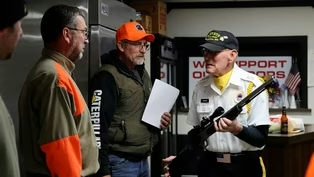
- While everyone was happy to honor these veterans by taking them hunting, they were also presented with a custom engraved muzzleloader.
- Kevin, I'm gonna cry.
(guys laugh) - He can■t keep the case.
- Oh my.
Thank you so much, sir.
Thank you.
(group applauds) - [Bret] United States Marine Corps Justin Johnson, I got to meet this guy earlier.
He's a great guy from Perham.
- Something like this is unreal.
You know, I met Larry for the first time tonight, and I've known him my whole life.
You know, we've put on the same uniform.
- You were a Marine, though, remember.
I was an army boy.
(group laughs) - No, I'm well aware of that, but everybody here made sure I was well aware.
I got a whole box of crayons, man.
- You got you're color crayons.
- Absolutely.
- I didn't none.
- I'll share 'em.
- [Bret] And Sergeant Lindsay Skavlem, US army Reynolds, North Dakota.
Your name on it.
- Here you go, ma'am.
Thank you.
- You're welcome.
(group applauds) - Haven't had an opportunity to shoot a deer so.
- [Man Off Camera] You're gonna get one.
There you go.
- Just seeing one will be thank you enough.
- [Man Off Camera] Just don't get buck fever.
- I'm gonna shoot the first thing that comes in front of the blind.
(drowned out by laughter) (group talks over each other) - Well I met some degenerative human beings that I love so dearly now who introduced me to some more people, and it started off as something simple like, hey, do you wanna go fishing?
And I was like, hell yeah, I do.
I heard about the opportunity to go fishing, ice fishing, which terrifies me a little bit.
I don't like-- - You're from North Dakota.
How is that terrifying?
- Yeah, I understand that.
- Come on.
- No, I understand that.
I've never been a fan of ice.
- I don't mind the ice.
It's when the ice breaks that I don't like it.
(calm jazz music) - You have great people in this community and thank you so much for allowing me to come, and a gun, I'm speechless.
- No you're not.
(group laughs) - I heard somebody say this in the last few days is replace some of the bad memories with good memories, and that's what feels good.
Even though we didn't see a deer this morning, we were still in the deer hut and laughing and telling stories, and yeah, I think that's been a common thing is a lot of conversation.
- Good job now, serg.
You still click your heels nice and tight.
- I do, Sgt.
major.
- On behalf of Warriors and Walleye and responses, I'd like to present you with this flag for your service, and I wish you all the luck again tomorrow as well.
- Thank you Sergeant Major.
(group applauds) - Best of luck tomorrow in your hunt.
Best of luck in all that you do, and I will pray for you tonight.
(group applaud) (dramatic orchestra music) - There's a deer right in front us, a doe.
- Oh yeah, there is.
That's probably the mama.
She's stumping her foot, see?
- That's one of the fawns, I think.
- [Larry] It could be a fawn.
She went across.
- Did she go back in?
- No, she went that.
(bright piano music) - While four vets were taken out hunting, some of those volunteers at this event are vets who participated in the past.
It says a lot when you, you know, someone like yourself who came along as a vet and then decided, hey, I wanna do more.
I wanna be a part of this.
- When I got outta the army, you know, I spent 26 years in the army, and I, you know, what do I want to be when I grow up?
It really took this program to help me figure out what I wanted to be.
I wanted to give back, you know, 'cause I was a senior NCO.
I was taking care of soldiers.
This lets me take care of soldiers again, and that's very rewarding.
- And it's really healing and helping.
You know, we don't want anybody to think that they're alone out there, you know?
It's all about helping, making people happy.
- The first day, nobody really talks, and then the second day, it's just, you know, unbelievable.
So it's really great that way.
- Absolutely amazing.
Very few times you get to sit down and just speak your mind what you did, what you thought, and how you felt, you know?
And it's a good thing, a very good thing.
Fortunate, you know, very fortunate, - [Bret] We all have our reasons to spend time in the outdoors, and success should be measured by the adventures had and the memories made.
Filling tags are just a welcome bonus along the way.
- [Kate] We're gonna be moving them upstream of this site so that they can continue to serve their purpose in the environment.
- If you run into these in the winter, odds are you've got an edible oyster mushroom.
(heartfelt guitar music) - So today, we are out doing a mussel relocation around Olson's Island.
We're partnering with the Minneapolis Parks and Recreation Board to restore Olson's Island by improving the head of the island over here through some restoration efforts.
To make that happen, we're going to be disturbing mussels.
So our objective today is to get the mussels out of harm's way.
- [Bret] Freshwater mussels inhabit lakes and rivers throughout the world, and North America has among the greatest number of mussel species.
These bivalve filter feeders are a vital part of the aquatic ecosystem.
The degradation of our waterways from runoff of silt and chemicals as well as physical changes from damning channeling and dredging have taken their toll on native mussels.
Of the 302 known species recognized in North America, nearly two thirds are considered imperiled.
Here in Minnesota, 28 of our 51 native freshwater mussel species are listed as either endangered, threatened, or of special concern.
So when the city of Minneapolis decided to restore the head of Olson's Island in the Mississippi River, they reached out to Minnesota DNR'S Center for Aquatic Mollusk Programs, or CAMP, to help them relocate any mussels before construction begins.
- We're trying to find all of the mussels that are in the area of impact around Olson's Island, where like the heavy equipment is gonna be driving and doing all the construction work.
So we're trying to get the mussels out of those areas so they're not crushed or disturbed in any way, and then we're gonna be moving them upstream of this site, just like a hundred meters, so that they can continue to serve, you know, their purpose in the environment.
- Well the waters, it ranges from four to eight feet deep.
So we're using scuba.
We'll send two divers down that are tethered to the boat, going down for 20 minute intervals, collecting all the mussels we can find in that area that we're at.
- [Bret] And in the notoriously muddy Mississippi, that's no mean feat.
- The visibility's actually like okay here a couple feet.
Sometimes our divers are in conditions where the visibility's really low and you really have to depend on your touch to find the mussels.
- We're basically covering every square foot of area that is the designated impact area by hand and digging through the sediment by hand, collecting all the mussels that we find, and putting them in a bag that we have attached to our equipment.
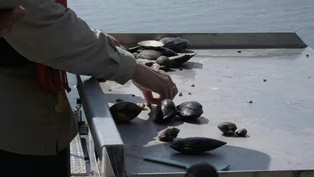
- [Bret] Once collected, the mussels are brought to the boat where they're counted, cataloged, measured, and sorted.
- [Woman Off Camera] Patterned one.
- [Bernard] This is nice mix of species.
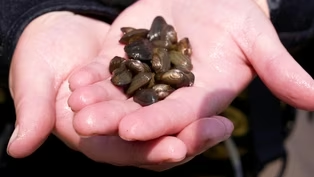
- [Bret] Freshwater mussels have a soft body enclosed by a hard shell made up of two halves called valves.
Inside the shell, a thin tissue called the mantle completely surrounds the soft body and secretes the two valves of the shell.
Young mussels are tiny and nearly translucent.
- [Kate] This is the juvenile, and this is the adult.
So you can see the amount of growth that happens over time.
- [Bret] Once they've been inspected, the mussels are held in the river until being relocated upstream.
- The spot that we picked is a spot that's similar to the habitat here around Olson's Island, and it's a spot where we feel like, you know, they'll just have good access to their host fish, good substrates, and they're not gonna be at risk of being like stranded in low water conditions.
- Mussel beds have been likened to coral reefs because they provide good structure that attracts algae and aquatic insects, which in turn, attracts larger predators.
- In the process of filtering the water, they're pulling out nutrients, that's actually what they're eating, but anything that they don't use is released by the mussel and it's in a form that other aquatic animals can eat, in particular aquatic insects, and then, you know, small fish eat the aquatic insects and larger fish eat the smaller fish.
So you just have a transfer of nutrients from the mussels up through the food chain in our aquatic environments.
So it just kind of is this nice little self-sustaining like environment that the mussels are kind of the base of.
- [Bret] 100 years ago, the Mississippi River was famously declared dead due to severe pollution and ecological degradation.
Industrial waste, untreated sewage, and agricultural runoff, particularly near urban centers, devastated aquatic life.
A century later, thanks to decades of conservation efforts, clean water legislation, and community engagement, much of the river's ecosystem has been revived.
- Mussels were not common.
I mean actually aquatic life in general was depauperate in the Minneapolis St.
Paul area and downstream.
Water quality has improved, and over the last several decades, we'll say 30 years, there's been a recovery in mussel species and fish and water quality's a lot better.
You know, just in the last couple days, we are moving 16 species of mussels that occur in this area, and those species weren't there three decades ago.
- [Bret] It's thanks to the consistent efforts of conservation groups like CAMP that our native species are making a comeback across the state.
- Our group has been around for like over 25 years now, and we started off doing survey work to inform our conservation needs for the mussels, and you know, now we've moved into propagation and monitoring of our mussel populations is really fulfilling to see the mussel conservation full circle, and also it's great that our program has been in existence for so long, because mussels are long-lived animals, and you can't make a difference with them in just a couple years.
This is gonna be a long haul effort to restore them throughout the state.
- [Promoter] We can stop aquatic hitchhikers from infesting more lakes and streams by cleaning up everything we pull out of the water.
It's a simple drill, clean in, clean out.
Before leaving a water access, clean your boat and water equipment, remove and dispose of all plants and aquatic species in the trash, drain water from your boat, ballast tanks, motor, live well, and bait container, remove drain plugs and keep drain plugs out while transporting equipment, dispose of unwanted bait in the trash, to keep live bait, drain the water and refill the bait container with bottled or tap water, and if you have been in infested waters, also spray your boat with high pressure water, Rinse with very hot water, dry for at least five days.
Stop the spread of AIS.
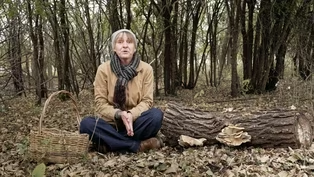
(upbeat ukulele music) (bright guitar music) - I am sitting next to what is called a fall-winter oyster mushroom, and there are a few species of oyster mushrooms that can be found in Minnesota and the upper Midwest.
The scientific name for this fella is pleurotus ostreatus, and we'll also post for you the other species and the names as well.
Fun fact about this mushroom, it's actually carnivorous, and I think that's really cool.
When I first read that, I thought what?
But actually, these oysters, they're the fruiting bodies of the true fungus, which is the mycelium throughout this wood and underneath the ground, and what's interesting is the little hyphae of the mycelium will actually work to attract nematodes, which are teeny tiny little worms, and then they will actually trap them and eat them.
So I just find that to be fascinating, like the deeper you dive into mushrooms, and I'm a huge mushroom nerd, I just found that to be neat, but this time of year, it's starting to get chilly, you see the fall leaves have fallen.
If you're finding an oyster mushroom this time of year, odds are that it is the fall or winter, which is one and the same, oyster mushroom.
They actually love cool and cold weather.
Oftentimes they're gonna pop up kind of after we get the first frost in late fall or freeze.
If you run into these in the winter, odds are you've got an edible oyster mushroom, but you always wanna research.
Anything you plan to consume, research if there are lookalikes, because we do have a lot of lookalikes in mushroom world, but for this, we can see the common name oyster really suits it because you get kind of the wavy edges the larger the cap grows.
It's kind of fan-shaped or shaped like an oyster.
So the gills are decurrent, which means they run all the way down.
Now sometimes, you might find a little bit of a stem that's visible.
Decurrent means it's gonna run down that stem like a little bit.
So what I'm gonna do is try to remove one gently here.
You can see some of the older guys there, and this is my first sighting of a fall or winter oyster of the season, and that also is interesting to point out, foraging in places that have four seasons like Minnesota does, foraging doesn't end.
It just changes a little bit, but you can forage all four seasons.
There is always something that nature is gifting us.
All right, so you can see here, even from cutting, the inner flesh, it's bright white, and when you cut it, it's gonna remain bright white, and then you can see we have some of the tinier, younger ones growing from that, and you can see those gills run decurrent down that stem ever so slightly, and this is a beautiful showing of gills, and you can see they're a whitish gray shade.
As they age, they're gonna turn more of a kind of a yellow.
You can decide how fresh or not fresh you want your mushroom to be when you eat it, but I mean, I've taken some things when they're past their prime, and once you cook 'em up, they're fine.
Oyster mushrooms especially are pretty clean mushrooms, and they don't require a lot of pre-prep, I guess they're like sponges.
So don't get them wet.
You might think, oh, this is from the wild, I have to go rinse it off.
You really don't.
I have a brush on my knife.
You can brush away any debris that might be there.
You wanna use water as little as possible, and definitely don't soak your mushrooms.
That'll just wreck it texturally.
So then if you're gonna cook this up, like we're gonna go home and cook this up this evening, I am just going to take each little shelf and then slice it up into thin strips.
I'm gonna throw it into my skillet, and I'm going to use a little unsalted butter, little pepper, and you know, a pinch of garlic if you want to, and then just slowly saute it up on low heat till it's fully cooked, and then if you're gonna add it into anything, just make sure your mushrooms from the wild are always fully cooked.
So if you're gonna have it with pasta, do up the pasta first, make sure the mushrooms are fully cooked, and then combine.
The fall-winter oyster mushroom is one of my favorites just because it's a good all-arounder mushroom, and you know, cold weather, a lot of people tend to stay indoors, but it's a good way to get you outdoors, exploring the woods, knowing that, hey, I might run across a mushroom, even though it's winter.
(calm contemporary music) - [Bret] Funding for Prairie Sportsman is provided by the Minnesota Environment and Natural Resources Trust Fund as recommended by the Legislative Citizen Commission on Minnesota resources, by Mark and Margaret Yackel-Juleen on behalf of Shalom Hill Farm, a retreat and conference center in a prairie setting near Windom, Minnesota, on the web at shalomhillfarm.org, by the friends of Prairie Sportsman.
To become a friend of Prairie Sportsman, visit pioneer.org/prairiesportsman.
Stories about aquatic invasive species are brought to you by the Aquatic Invasive Species Task Forces of Meeker, Yellow Medicine, Lac Qui Parle, Swift, and Big Stone Counties.
(bright electronic music)
Fast Forage: Fall/Winter Oyster Mushroom
Video has Closed Captions
Clip: S17 Ep11 | 5m 40s | The fall/winter oyster mushroom is common to find on dead or dying trees right before winter comes. (5m 40s)
Video has Closed Captions
Clip: S17 Ep11 | 7m 57s | Learn about the importance of native mussels in our waterways. (7m 57s)
Muzzleloaders, Mussels, and Mushrooms
Video has Closed Captions
Preview: S17 Ep11 | 30s | A Veteran deer hunt, MN DNR’s Center for Aquatic Mollusk and foraging for Oyster Mushrooms. (30s)
Muzzleloading with the Military
Video has Closed Captions
Clip: S17 Ep11 | 11m 17s | Warriors and Walleyes says thank you to those who served our country with a muzzleloader deer hunt. (11m 17s)
Providing Support for PBS.org
Learn Moreabout PBS online sponsorship

- Science and Nature

Explore scientific discoveries on television's most acclaimed science documentary series.









 New Episode

Support for PBS provided by:
Prairie Sportsman is a local public television program presented by Pioneer PBS
Production sponsorship is provided by funding from the Environment and Natural Resources Trust Fund and Shalom Hill Farm. Additional funding provided by Big Stone County, Yellow Medicine County, Lac qui...