Prairie Sportsman
Fast Forage: Fall/Winter Oyster Mushroom
Clip: Season 17 Episode 11 | 5m 40sVideo has Closed Captions
The fall/winter oyster mushroom is common to find on dead or dying trees right before winter comes.
Harvesting Nature’s Bounty” forager Nicole Zempel shares that foraging doesn’t necessarily end when the weather gets colder. The fall/winter oyster mushroom is common to find on dead or dying trees right before winter sets in and are a great compliment to pasta dishes.
Problems playing video? | Closed Captioning Feedback
Problems playing video? | Closed Captioning Feedback
Prairie Sportsman is a local public television program presented by Pioneer PBS
Production sponsorship is provided by funding from the Environment and Natural Resources Trust Fund and Shalom Hill Farm. Additional funding provided by Big Stone County, Yellow Medicine County, Lac qui...
Support provided by:


Prairie Sportsman
Fast Forage: Fall/Winter Oyster Mushroom
Clip: Season 17 Episode 11 | 5m 40sVideo has Closed Captions
Harvesting Nature’s Bounty” forager Nicole Zempel shares that foraging doesn’t necessarily end when the weather gets colder. The fall/winter oyster mushroom is common to find on dead or dying trees right before winter sets in and are a great compliment to pasta dishes.
Problems playing video? | Closed Captioning Feedback
Where to Watch Prairie Sportsman
Prairie Sportsman is available to stream on pbs.org and the PBS app.
Providing Support for PBS.org
Learn Moreabout PBS online sponsorship(upbeat ukulele music) (bright guitar music) - I am sitting next to what is called a fall-winter oyster mushroom, and there are a few species of oyster mushrooms that can be found in Minnesota and the upper Midwest.
The scientific name for this fella is pleurotus ostreatus, and we'll also post for you the other species and the names as well.
Fun fact about this mushroom, it's actually carnivorous, and I think that's really cool.
When I first read that, I thought what?
But actually, these oysters, they're the fruiting bodies of the true fungus, which is the mycelium throughout this wood and underneath the ground, and what's interesting is the little hyphae of the mycelium will actually work to attract nematodes, which are teeny tiny little worms, and then they will actually trap them and eat them.
So I just find that to be fascinating, like the deeper you dive into mushrooms, and I'm a huge mushroom nerd, I just found that to be neat, but this time of year, it's starting to get chilly, you see the fall leaves have fallen.
If you're finding an oyster mushroom this time of year, odds are that it is the fall or winter, which is one and the same, oyster mushroom.
They actually love cool and cold weather.
Oftentimes they're gonna pop up kind of after we get the first frost in late fall or freeze.
If you run into these in the winter, odds are you've got an edible oyster mushroom, but you always wanna research.
Anything you plan to consume, research if there are lookalikes, because we do have a lot of lookalikes in mushroom world, but for this, we can see the common name oyster really suits it because you get kind of the wavy edges the larger the cap grows.
It's kind of fan-shaped or shaped like an oyster.
So the gills are decurrent, which means they run all the way down.
Now sometimes, you might find a little bit of a stem that's visible.
Decurrent means it's gonna run down that stem like a little bit.
So what I'm gonna do is try to remove one gently here.
You can see some of the older guys there, and this is my first sighting of a fall or winter oyster of the season, and that also is interesting to point out, foraging in places that have four seasons like Minnesota does, foraging doesn't end.
It just changes a little bit, but you can forage all four seasons.
There is always something that nature is gifting us.
All right, so you can see here, even from cutting, the inner flesh, it's bright white, and when you cut it, it's gonna remain bright white, and then you can see we have some of the tinier, younger ones growing from that, and you can see those gills run decurrent down that stem ever so slightly, and this is a beautiful showing of gills, and you can see they're a whitish gray shade.
As they age, they're gonna turn more of a kind of a yellow.
You can decide how fresh or not fresh you want your mushroom to be when you eat it, but I mean, I've taken some things when they're past their prime, and once you cook 'em up, they're fine.
Oyster mushrooms especially are pretty clean mushrooms, and they don't require a lot of pre-prep, I guess they're like sponges.
So don't get them wet.
You might think, oh, this is from the wild, I have to go rinse it off.
You really don't.
I have a brush on my knife.
You can brush away any debris that might be there.
You wanna use water as little as possible, and definitely don't soak your mushrooms.
That'll just wreck it texturally.
So then if you're gonna cook this up, like we're gonna go home and cook this up this evening, I am just going to take each little shelf and then slice it up into thin strips.
I'm gonna throw it into my skillet, and I'm going to use a little unsalted butter, little pepper, and you know, a pinch of garlic if you want to, and then just slowly saute it up on low heat till it's fully cooked, and then if you're gonna add it into anything, just make sure your mushrooms from the wild are always fully cooked.
So if you're gonna have it with pasta, do up the pasta first, make sure the mushrooms are fully cooked, and then combine.
The fall-winter oyster mushroom is one of my favorites just because it's a good all-arounder mushroom, and you know, cold weather, a lot of people tend to stay indoors, but it's a good way to get you outdoors, exploring the woods, knowing that, hey, I might run across a mushroom, even though it's winter.
Video has Closed Captions
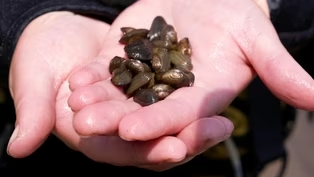
Clip: S17 Ep11 | 7m 57s | Learn about the importance of native mussels in our waterways. (7m 57s)
Muzzleloaders, Mussels, and Mushrooms
Video has Closed Captions
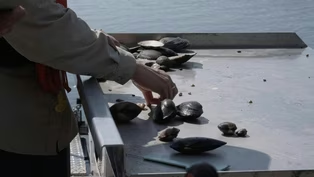
Preview: S17 Ep11 | 30s | A Veteran deer hunt, MN DNR’s Center for Aquatic Mollusk and foraging for Oyster Mushrooms. (30s)

Muzzleloading with the Military
Video has Closed Captions
Clip: S17 Ep11 | 11m 17s | Warriors and Walleyes says thank you to those who served our country with a muzzleloader deer hunt. (11m 17s)
Providing Support for PBS.org
Learn Moreabout PBS online sponsorship

- Science and Nature

Explore scientific discoveries on television's most acclaimed science documentary series.








 New Episode

Support for PBS provided by:
Prairie Sportsman is a local public television program presented by Pioneer PBS
Production sponsorship is provided by funding from the Environment and Natural Resources Trust Fund and Shalom Hill Farm. Additional funding provided by Big Stone County, Yellow Medicine County, Lac qui...