
Antarctica: Life Under the Ice
Episode 2 | 25m 50sVideo has Closed Captions
Antarctica’s icy ecosystems reveal how frozen landscapes can sustain odd forms of life.
Set in Antarctica’s Dry Valleys, Antarctica’s glacial and icy ecosystems reveal how frozen landscapes can sustain surprising forms of life. Explorer Ariel Waldman investigates cryoconite holes and hidden biospheres like Blood Falls, uncovering how extremophiles survive in punishing conditions and what they may teach us about potential life on icy moons beyond Earth.
Problems playing video? | Closed Captioning Feedback
Problems playing video? | Closed Captioning Feedback
Antarctica: Life Under the Ice
Episode 2 | 25m 50sVideo has Closed Captions
Set in Antarctica’s Dry Valleys, Antarctica’s glacial and icy ecosystems reveal how frozen landscapes can sustain surprising forms of life. Explorer Ariel Waldman investigates cryoconite holes and hidden biospheres like Blood Falls, uncovering how extremophiles survive in punishing conditions and what they may teach us about potential life on icy moons beyond Earth.
Problems playing video? | Closed Captioning Feedback
How to Watch Life Unearthed with Ariel Waldman
Life Unearthed with Ariel Waldman is available to stream on pbs.org and the free PBS App, available on iPhone, Apple TV, Android TV, Android smartphones, Amazon Fire TV, Amazon Fire Tablet, Roku, Samsung Smart TV, and Vizio.
Providing Support for PBS.org
Learn Moreabout PBS online sponsorship[mellow string music] Antarctica.
It's a vast land that's unlike anywhere else we know.
From the depths of its frozen lakes to the towering peaks of its spectacular mountains, it's a place of unparalleled wonder and hidden mysteries.
I want to tell the story of a continent that's waiting to be seen.
To truly see this world, though, you need to view it from a different perspective.
From the dizzying heights of an orbiting spacecraft all the way down through the lens of a microscope.
I'm on an expedition in Antarctica to uncover the extreme environments that host the smallest animals on the planet.
As a researcher, for two months, I'll be hiking glaciers, traversing frozen landscapes, flying above mountains, and camping in one of the most otherworldly places on planet Earth.
And if that wasn't enough to keep my hands full, I wanted to see if I could film it all by myself using a suite of cameras, drones, and microscopes to reveal the unusual nature of a unique area of Antarctica.
The food chains and the creatures and the little critters that are all around me, in the soils, in the ice, everywhere, are really unlike anywhere else on the planet.
Here the microscopic world is king.
Welcome to an extraordinary journey to an unlikely oasis at the edge of our world.
[calm orchestral music] When people think of Antarctica, they typically think of ice.
Lots of it.
But here in the Dry Valleys, ice is in limited supply.
[contemplative string music] Even though the Dry Valleys are famous for their lack of ice, glaciers and frozen lakes are a critical piece of the infrastructure for how life is able to survive here.
I'm at the edge of one of the glaciers here in the Dry Valleys that pierce the landscape.
Everywhere you look, there's soil.
But there are also frozen lakes and glaciers.
And glaciers like this one start high up in the mountains behind me and pour slowly down through the cracks, through the valleys, over thousands of years before they end, right here in cliffs that are about 60 to 90 feet high.
They're absolutely beautiful and I love being here right next to one of these giants.
I like to call these glaciers the giants of the Dry Valleys, because really, they are.
And they just move at, well, a glacial pace.
The glaciers in this part of the continent are unique.
Here, these gentle giants don't flow out into the sea and have experienced relatively minimal melting so far.
But even relatively small amounts of melting can drastically change this ecosystem.
During the peak of summer, like right now, glaciers like this one actually start to melt when it ticks just above freezing.
I think it's around 33°F today.
And behind me, there's a rushing creek of water off of this glacier that's just coming down, melting into streams and feeding the frozen lakes of the Dry Valleys.
The frozen lakes of the Dry Valleys are forever frozen year round, but they grow and they build over time, fed by the glaciers around them.
[rushing creek] To me, looking at these glaciers, it looks as if someone spilled a massive bowl of icing that just slowly crept down until it got frozen in time.
And in a sense, that's sort of what glaciers are.
They're rivers of ice that just move very slowly and with their own weight, push everything aside and kind of flow down over time.
We just can't see them in a human lifespan very easily.
[inspiring orchestral music] The glaciers here took thousands of years to form.
Their story is one of creation and destruction as they accumulate ice and carve the land beneath them.
Antarctica is full of secrets, things that you can only see at the right scale.
I first wanted to come to the Dry Valleys because of the life here.
The life that is in the soils and the lakes and the ice.
There's life everywhere.
But often people don't know about it or don't get to see it.
There's penguins, which are amazing, but equally amazing is the life underneath the ice.
[minimal synth music] Inside the frozen depths of colossal glaciers exist tiny neighborhoods, little pockets in the glacier known as cryoconite holes.
Each housing a form of life known as extremophiles.
Extremophiles are creatures that live here on Earth, and they're able to survive extreme environments: incredibly salty ones, dry ones, hot ones, acidic ones, and even inside of ice.
It's thought that life here in Antarctica can inform us not only about Mars, but about icy moons like Enceladus and Europa.
[guitar synth music] Nearly a billion miles away from here Enceladus lies within the rings of Saturn.
It's a tiny moon with a massive footprint.
It's responsible for creating one of the rings of Saturn by venting huge plumes of water and gas from the depths of its subsurface ocean, through the cracks of its icy exterior, out into space.
In those plumes, scientists have discovered some of the building blocks for life that could make the moon an oasis for microscopic organisms.
How life might exist there is still a mystery, but studying how life survives in and under the ice in Antarctica can give us clues.
Inside glaciers like this one exist entire ecosystems of invisible animals and creatures.
They're too tiny for our eyes to see.
And it's thought that these little tiny ecosystems of little tiny animals and creatures can inform us about how ecosystems can get a foothold elsewhere on Earth.
Because they're so small, we can easily study them and figure out what are the necessary ingredients for them to thrive.
And I'm about to go hike up this glacier and check them out.
[determined guitar music] Alright, so after about a two hour hike, we are ready now to get on top of this glacier and check out some cryoconite holes, which is pretty exciting.
It took us about a couple of hours to hike up onto this glacier over rocky terrain.
And for someone like me, it's definitely a challenging hike.
But hikes like these are what scientists are doing all the time in order to study glaciers and soils and all of the ecosystems of the Dry Valleys.
I love being up here because being surrounded by all of these different creatures that you just need a microscope to see, I don't know, it really just reminds you of all the multitudes of life here on Earth and how life can survive even in places like a glacier inside of ice.
[drill motor starting] To get to the extremophiles living inside of this glacier, scientists drill into it to pull out a small ice core.
At the bottom of that icy popsicle is an unassuming, small frozen layer of dirt that easily fits in a sandwich bag.
That's what we hiked up hours of treacherous terrain for.
Back at our campsite, I let the dirt from the cryoconite hole defrost.
I then put a small piece of it under my microscope, eager to see what our effort netted.
Within moments, an entire cornucopia of life immediately becomes visible at this scale.
Squiggly noodles of photosynthetic cyanobacteria with their stiff dance moves.
Single celled critters zoom around, only occasionally stopping to poop, algae moving to the beat of their own drum.
[plucking string music] Amongst the slowest creatures that live inside the glacier are tardigrades.
With a belly full of algae and bacteria, they waddle around, exploring their corner of the microcosmos.
So how does life live inside of a glacier?
How does that work?
When tiny pieces of dust and sand and dirt, like all the dirt and soil of the Dry Valleys, blows on to the tops of the glaciers, those little pieces of dirt are a little bit darker than the rest of the ice, and because of that, they absorb sunlight and begin to sink down as they melt the ice around them.
And slowly, slowly, they begin melting down into the ice and create little holes at the top of the glacier.
And as more dirt and sand and dust gets blown on to the glacier, those tiny little holes accumulate even more dirt and sink down even more until they kind of go down into a soupy hole of dirt within the ice.
And in that dirt, riding along those little dust grains, are tiny tardigrades and rotifers and other creatures that live on those dust grains inside the ice.
And when it gets cold again, which it often does, then the top freezes over, sealing these tiny little animals inside of the glacier.
You would think they would die, that nothing could be able to survive encased in a block of ice.
But these creatures actually not only survive, but they thrive.
And it's just amazing that there's life here on Earth that's able to survive the extremes of Antarctica.
And not only that, but inside of a glacier.
[investigative synth music] Inch-worming around are a number of rotifers.
When they aren't displaying their Roomba-like heads to rummage for food, they get around by using a single sticky foot at the end of their body to anchor and push off with.
Some species have pointed sides that look as if they're pulling out their pockets as they squish around.
Along with tardigrades and nematodes, they are among the smallest creatures in the animal kingdom, often only a quarter of a millimeter in size.
They survive inside of a glacier by retracting themselves into a ball that can endure dehydration and freezing temperatures for multiple years, if necessary, until liquid water returns.
They essentially pack themselves into a built-in storage unit to ride out the long winter.
[creek water rushing] In a warmer, windier climate, the makeup of these tiny neighborhoods of micro animals could soon change, bringing in new creatures from other continents that may be better adapted at competing for what little resources exist in the Dry Valleys.
[calm string music] Unique environments like this one are so incredibly fragile, and so incredibly important that we take a close look at them and understand what it is that lives here, and how these landscapes are amazing and dynamic.
Because if we don't, places like this might change and we wouldn't even know what we're losing.
[helicopter flying] At the edge of a glacier in a separate corner of the Dry Valleys, a different scene of life unfolds.
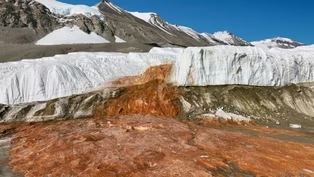
[suspenseful string music] In an expanse of bright white snow and crystal blue glaciers, what looks like a gruesome scene out of a cheap horror movie interrupts this otherwise serene landscape.
Known as Blood Falls, its grisly name is a bit of a misnomer.
The crimson red color isn't the site of a murder mystery, but it still managed to mystify scientists for nearly a century.
I'm standing here at the edge of a hidden biosphere.
Blood Falls is one of the most fascinating places on Earth, not only for how striking it looks here in Antarctica, but also because what it means for our understanding of life on planet Earth.
When Blood Falls was discovered over 100 years ago, they thought this red color was algae.
But later on, they were able to figure out it's actually iron oxide.
Iron from a subglacial lake that spurting out and as it's hitting oxygen, turns red.
But people thought that it was devoid of life, that there was nothing living in this iron oxide subglacial pond that's pouring out over the edge and creating this beautiful stream behind me.
But in the past couple of decades, a groundbreaking discovery was made.
It was discovered that there's actually life here.
[mellow playful synth music] Under my microscope, a sample I took from Blood Falls begins to dance around.
Little cells of bacteria, each with their own dance moves.
Look at them for long enough, and you might begin to even ascribe them different personalities.
While it's possible for me to see there's life here, we weren't so sure a couple of decades ago.
Several years ago, a grad student was doing research around Blood Falls and sampled a part of the glacial stream here.
Her name was Jill Mikucki.
And when she sampled that stream, she noticed something really unusual.
Unlike most glacial streams, it was extremely clear.
But not only that, it was twice as salty as the ocean, had no oxygen, but there were living cells inside of it.
What Jill and others were able to discover was that there was an entire subsurface, hidden ecosystem full of bacteria that were living in complete darkness underneath the glacier, without oxygen and in freezing temperatures.
The discovery redefined the boundaries of what extremes life can withstand on our planet and beyond.
The bacteria here are able to thrive in frigid darkness, thanks in part to the iron and sulfur of the bedrock beneath the glacier, providing them the necessary energy to live without access to sunlight.
If there's life on Enceladus or Europa, it too would likely need a similar way of feeding off a rocky core to survive below miles of ice.
Blood Falls shows us that there are places here on planet Earth where life can thrive, where we thought nothing could survive.
And that's just really cool.
[plucking synth music] [helicopter flying] I'm here at one of the frozen lakes here in the Dry Valleys.
Today is actually the summer solstice.
And as you can see, parts of this frozen lake are already liquid.
All around me is a really clear pond, but the middle stays forever frozen and that's what makes studying life here so fascinating.
The frozen lakes of the Dry Valleys are one of the most dynamic ecosystems to witness.
Their interactions with the glaciers and soil in the area makes them one of the more biodiverse places in this polar desert.
[submerging below water] Beneath this still and silent icy facade, the lake brims with a rich tapestry of life.
[inspirational orchestral music] What appears as a motionless surface hides an undercurrent of ecological activity.
Specialized divers are able to venture deep under the ice.
What they experience is otherworldly.
A fabric of microorganisms coats the lake bed like a carpet.
Pinnacles reach up toward the ice-filtered sunlight, reminiscent of nebulas seen by the Hubble Space Telescope.
These are known as liftoff mats.
Each layer is made up of different types of bacteria, archaea, algae, and other lake dwelling micro creatures.
Tardigrades and rotifers scour for food amongst the tendrils of cyanobacteria, like big cats hidden by a thick jungle forest.
As these organisms photosynthesize, they produce oxygen, which becomes trapped within the mat.
Over time, the increasing buoyancy of the trapped gases peels part of the mat off of the lake floor until it breaks away and lifts off.
Those wayward pieces of mat float upward until they're entangled with the lake ice, frozen in place.
Over several years, as the ice on top of the lake melts and new layers of ice form deep below, the mat is pushed upward until it reaches the surface, looking something like a freeze-dried piece of lettuce.
Yet despite its multiyear journey from the watery depths, through being encased in layers of ice until it reaches open air, these liftoff mats continue to host a world of life.
Even in their dehydrated state.
[somber string music] As temperatures warm across this region over time, the frozen lakes are bound to see the most change early on.
Over the years, glacial melt has resulted in significant lake level rise.
But what's more concerning is that the McMurdo Dry Valleys Long Term Ecological Research team predict that the frozen lakes that have been permanently covered in ice for millennia will lose their ice within 10 to 40 years.
Such a change is expected to significantly disrupt the food webs and life that have otherwise enjoyed a stable home here.
As I explore more through the frozen lakes and glaciers of the Dry Valleys, I'm in awe of their quiet contradiction.
Natural features that feel simply serene to witness at my small scale in time.
But over the course of hundreds and thousands of years, these features are capable of immense power, carving and filling the land beneath them.
[slow inspirational string music] I first came to Antarctica to study the life under the ice, and I ended up hiking up this glacier behind me, and it was an incredibly challenging hike.
I had never hiked up a glacier before, but I wanted to see the environments and places that these microscopic creatures call home.
And despite the challenging nature of the hike, it was absolutely worth it.
And getting to actually see and peer into how life exists in such an extreme environment like Antarctica is priceless.
When we look to Antarctica, we can see an environment that's at the precipice of change.
Everything here is so incredibly fragile, and it's so incredibly important that we take a close look at how important this place is on Earth.
While Antarctica can inform us about many places in our solar system and beyond, it's important to remember that we've found nowhere else like Antarctica anywhere in the universe so far, and it's an incredibly unique place here on Earth that we need to protect.
[reflective piano music]
Video has Closed Captions
Clip: Ep2 | 2m 56s | A gruesome-looking sight in Antarctica known as Blood Falls sparks a science mystery. (2m 56s)
Video has Closed Captions
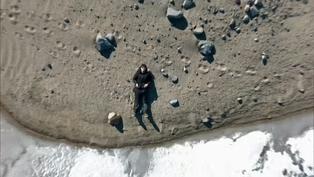
Preview: Ep2 | 30s | Antarctica’s icy ecosystems reveal how frozen landscapes can sustain odd forms of life. (30s)
Providing Support for PBS.org
Learn Moreabout PBS online sponsorship
- Science and Nature

Explore scientific discoveries on television's most acclaimed science documentary series.

- Science and Nature

Capturing the splendor of the natural world, from the African plains to the Antarctic ice.












Support for PBS provided by: